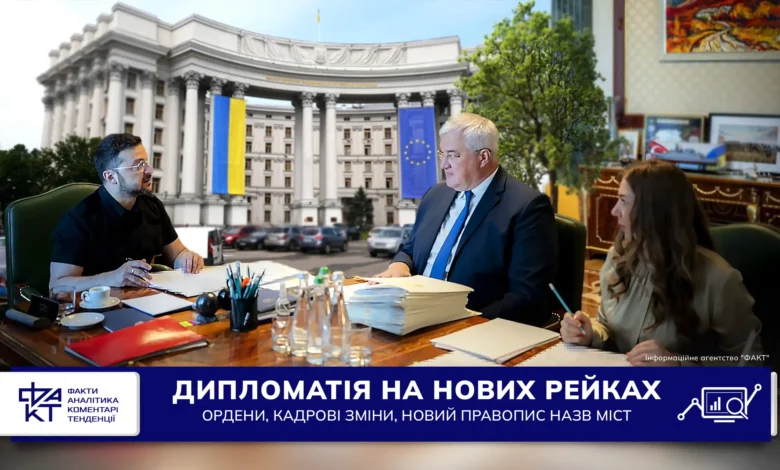
By decree of the President of Ukraine, a number of employees of the diplomatic service received state awards — mostly for “significant personal contribution to the development of interstate cooperation” and “consolidation of international support for Ukraine.” The formulations are standard, but behind them are specific surnames, diplomatic files and assessments, which are not always unambiguous. The awarding coincided with a large-scale rotation in the diplomatic corps: the head of state appointed 16 ambassadors. Against this background, the public statement of the Minister of Foreign Affairs Andrii Sybiga about the introduction of Ukrainian variants of foreign toponyms in international communication became a separate signal. It is a transliteration of Kyiv, Kharkiv, Odesa, Lviv, Chernihiv and Chernobyl. Who received orders, who was appointed to new diplomatic positions and what does the new language policy of the Ministry of Foreign Affairs envisage?
Awards and new appointments in the diplomatic corps
On July 20, the President of Ukraine signed a decree awarding employees of the diplomatic service with state awards. The official basis was the recognition of their significant contribution to the development of interstate cooperation, the consolidation of international support for the sovereignty and territorial integrity of Ukraine, as well as fruitful diplomatic activity and high professionalism. The decree applies to both current ambassadors in key countries and officials of the Ministry of Foreign Affairs who occupy or are preparing to occupy strategic positions. It should be noted that the President did not award them on the occasion of the Day of Diplomatic Service Employees or an official state holiday — the decree appeared outside the usual protocol calendar.
Vsevolod Chentsov, the representative of Ukraine to the European Union, received the highest award — the Order of Merit, 1st degree. He is a key figure in communication between Kyiv and Brussels, especially in the context of negotiations on Ukraine’s approach to EU membership, financial support and military aid. Considering the strategic weight of the European direction, this award seems logical and proves Bankova’s intention to establish trust in the permanent representation at the EU.
The 2nd degree Order of Merit was awarded to Serhii Kyslytsa, the First Deputy Minister of Foreign Affairs of Ukraine, who is also the Permanent Representative of Ukraine to the UN. He regularly speaks at meetings of the General Assembly and the Security Council, promoting Ukraine’s position in the United Nations. Diplomatic efforts of Kyslytsia have a permanent public nature and form part of the state’s external communication at the global level.
Olga Stefanishyna, who previously held the position of Deputy Prime Minister for European and Euro-Atlantic integration, received the same award. She currently serves as the President’s Special Representative for the Development of Cooperation with the United States. According to the available information, Stefanyshyn is preparing to be appointed as Ukraine’s ambassador to Washington — a critically important position given the volume of American military aid and the political role of the United States in the formation of international support. In this context, the order can be an element of public confirmation of trust on the part of the head of state.
Vasyl Zvarych, current ambassador of Ukraine to the Czech Republic, and Vadym Omelchenko, ambassador to France, were awarded the III degree Order of Merit. Both diplomats represent Ukraine in states that play an important role in the formation of a European consensus on aid to Kyiv. In Prague, in particular, the issues of defense cooperation, munitions and military-industrial cooperation have considerable weight. France, on the other hand, is a permanent member of the UN Security Council and a player that occupies a special place in the balance between the transatlantic and European vector of support for Ukraine.
At the same time, the Ambassador of Ukraine to the USA, Oksana Markarova, was awarded the Order of Princess Olga, 1st degree. The gesture follows the expected end of her term in Washington. According to unofficial reports, she will leave her post in the near future. The order is in recognition of her time at one of the country’s key embassies, although the effectiveness of her work, particularly in the context of recent delays in military aid, has been the subject of public debate.
A separate item of the decree honored the employees of the Ministry of Foreign Affairs: Hanna Pankova and Tetiana Poliants, who received medals “For work and achievement”. Both hold the positions of chief specialists in the structural units of the ministry. These awards traditionally have internal significance and are rarely accompanied by public attention, but they record formal recognition of seniority, loyalty and professionalism in the bureaucratic vertical of the foreign policy department.
In addition, on July 21, Volodymyr Zelenskyi announced a large-scale rotation in the diplomatic corps. According to him, after consultations with the leadership of the Ministry of Foreign Affairs, law enforcement agencies and the Office of the President, a decision was made to appoint 16 new ambassadors at once. Judging by the decrees published on the president’s website, the rotation covered not only bilateral appointments, but also the renewal of Ukrainian representations in a number of international organizations.
Among the newly appointed ambassadors is Oleksandr Voronin, who will now represent Ukraine in Algeria. Oleksandr Balanutsa is appointed to the United Arab Emirates, and Volodymyr Bachynskyi will go to work in Bosnia and Herzegovina. Volodymyr Boyechko will head the embassy in Estonia, Andriy Kasyanov – in Angola, and Yurii Lutovinov – in Japan. Yaroslav Melnyk was appointed ambassador to Belgium, Gennadiy Nadolenko to Malaysia, and Serhiy Nizhynskyi to Cyprus.
The diplomatic mission in Mexico will be headed by Serhii Pohoreltsev. In Canada, Ukraine will be represented by Andrii Plahotniuk, in Oman by Olga Selykh, and in Spain by Yulia Sokolovska. Maksym Subha was appointed ambassador to Kuwait, Yuriy Tokar to Kenya, and Oleksandr Shcherba to the Republic of South Africa.
In addition, several Ukrainian diplomats received separate appointments to international organizations. Oleksandr Balanutsa will become the permanent representative of Ukraine at the International Renewable Energy Agency (IRENA), which works in the context of the global transition to green energy. Andriy Plahotniuk will head the representation at ICAO – the International Civil Aviation Organization, which defines the rules for world aviation. Yuliya Sokolovska will represent Ukraine at the World Tourism Organization, while Yuriy Tokar will work at two UN structures – UNEP and UN-Habitat, which deal with environmental and urban issues.
Such a large-scale rotation in the diplomatic corps can have several reasons, and not all of them indicate a strategic renewal. Some of the changes should be considered as an attempt to correct the imbalance or inefficiency in the work of individual embassies, especially where in recent years it was not possible to achieve tangible results either in the political or the economic sphere. In some cases, it is about the rotation of ambassadors, defined in the Law of Ukraine “On Diplomatic Service”, in others – about the removal from their posts of those who lost trust or could not adapt to new requirements. At the same time, such a number of decisions may also indicate an internal revision of approaches to personnel policy or a desire to centralize control over key foreign policy areas.
The order contradicts the context: Stefanyshyn and Markarov are among the awardees
The decree on state awards, signed by the president, contains the names of officials that raise questions — especially in the case of Olga Stefanishyna. The former vice-prime minister for European and Euro-Atlantic integration, who currently holds the special position of the president’s commissioner for the development of cooperation with the USA, is included in the list of recipients of the Order of Merit II degree. This award is explained in the presidential decree with the standard formula: “for a significant personal contribution”, but it does not contain any specific achievements of the official.
At the time of the publication of the decree, the Specialized Anti-Corruption Prosecutor’s Office had already registered a criminal proceeding regarding the facts presented in the investigation of “Ukrainian Pravda”, which includes Stefanishyna. As reported by the spokeswoman of SAP Olha Postoliuk, it is about checking a possible conflict of interests in the transfer of seized assets of ARMA to companies connected with the close circle of the former deputy prime minister. In particular, the focus is on the situation surrounding the House of Trade Unions in Kyiv, the management of which was delegated to the structure and which journalists associate with Stefanyshyn’s ex-husband. She herself denies her involvement. So far, no person has been informed of the suspicion in the specified criminal proceedings, but the pre-trial investigation is ongoing.
This is not the first episode when the official’s name appears in the context of criminal proceedings. Back in 2019, after her work at the Ministry of Justice during the time of Elena Lukash, Stefanyshyn was charged under Art. 191 of the Code of Criminal Procedure — a waste of state funds in particularly large amounts. It was about a tender for the study of Ukrainian legislation, for which the Ministry of Justice paid 2.5 million hryvnias, and the cost of one page of the text reached more than 4 thousand hryvnias. The preliminary court hearing in this case took place only in September 2023 at the High Anti-Corruption Court.
In addition, a month before the award — on June 27, 2025 — Hromadske published material about the real estate of Stefanishyna’s mother: a 100-meter apartment in the center of Kyiv was purchased almost four times cheaper than the market value — for 3 million UAH instead of the minimum 12. No official explanation for such a price was given.
Against this background, the inclusion of Stefanishina in the list of awardees “for significant personal contribution” looks at least contradictory.
Among those awarded by the presidential decree is also the current ambassador of Ukraine to the United States, Oksana Markarova, who received the Order of Princess Olga, 1st degree. The honor coincides with her expected resignation from her post, which the Foreign Office says is part of a “planned rotation”. However, behind the formal explanation of personnel renewal are more complex political circumstances, which started the process of her replacement as early as 2024.
The turning point was Volodymyr Zelenskyi’s visit to a company in Pennsylvania, an event organized by the Ukrainian embassy at a time when the US was entering the peak phase of the election campaign. The very fact of the participation of the Ukrainian delegation in the event, which had a connection with infrastructure production in the “fragile” state, caused dissatisfaction among parts of the American political community, in particular among the Republican Party. Pennsylvania is one of the states that critically influence the outcome of the US presidential election. Therefore, any participation of foreign representatives, even in a neutral or symbolic format, is viewed through the lens of possible political advantage for individual players.
The consequences of this incident were not limited to discussions on the sidelines. According to diplomatic sources, after the visit, Speaker of the House of Representatives Mike Johnson directly addressed the Ukrainian side with a demand for Markarova’s release. After that, her public presence in the highest political circles of the United States significantly decreased, and the circle of contacts in Congress significantly narrowed. The loss of access to key figures and the dissatisfaction of part of the American elites turned the Ukrainian representation into a formally present, but politically limited tool.
In Washington, this episode became a reason for increased criticism from those who already questioned the expediency of further large-scale financing of Ukraine. The story itself became an internal argument for the Office of the President of Ukraine in favor of replacing the ambassador — not only as a diplomatic solution, but as a tool to reduce tension in the political dialogue with the US administration.
In this context, the awarding of the order to Markarova does not look like evidence of her future role in the system of diplomacy, but rather a final formality — an element of accompaniment to leaving office, designed as a gesture of political correctness. Against the background of complicated contacts, the loss of the de facto agreement and the expected replacement, the award takes on the character of an internal procedure that does not change the real political status of the diplomat. However, the state award for the sake of formality, rather than recognition of real merit, is a sign of devaluation of the very idea of honor. When the order is not awarded for a specific breakthrough, but “on exit” from the position or for the routine performance of functions without visible results, this calls into question not only the sincerity of the motivation, but also the selection criteria. In such a situation, the distinction ceases to be a signal of success or an example for others and turns into a gesture of polite farewell or part of administrative etiquette. This reduces trust in the reward system itself and blurs the line between real achievement and mechanical performance.
Toponyms in the focus of the Ministry of Foreign Affairs: what does the Sybiga initiative mean
The public statement of the Minister of Foreign Affairs Andrii Sybiga regarding the need to systematically use Ukrainian forms of foreign toponyms was a continuation of the already familiar language policy of the Ministry of Foreign Affairs, but on a new level. The initiative concerns not only the transliteration of the names of Ukrainian cities in Latin – Kyiv, Odesa, Lviv, Kharkiv, Chernihiv, Chornobyl, etc., but also a broader approach: in domestic usage in Ukraine, the Ministry of Foreign Affairs suggests using Ukrainian forms for geographical names of other states. In particular, instead of “Brest” – “Berestya”, instead of “Belhorod” – “Bilhorod”, and instead of “Debrecen” – “Dobrochyn”.
Formally, the initiative is based on current legislation. Part 3 of Article 41 of the Law “On Ensuring the Functioning of the Ukrainian Language as a State Language” provides for the preference of names of Ukrainian origin in official documents. Sybiga directly refers to this norm as a basis for implementing changes. He substantiates his position with an example: the note from a foreign country that he received contained the writing “Kiev”. As a result, the document was returned without consideration. Sybiga explained that if the official appeal does not comply with the accepted norms of writing Ukrainian toponyms, it will not be considered. This should become a new rule in communication with international partners. According to his logic, if Ukraine requires other states to correctly spell the names of their cities, then it must consistently abandon forms of Soviet or Russian origin.
The current activity of the Ministry of Foreign Affairs, according to the official, includes correcting incorrect spellings in the public space: from online resources and maps to names on transport, in the media and in international organizations. Some of the changes have already been implemented: several major world media, as well as airlines, governments and airports have switched to using Ukrainian forms of toponyms.
The next stage is the intention to organize and standardize the use of Ukrainian names for foreign geographical objects. This involves the creation of an official list of names that correspond to the Ukrainian tradition. Many countries have this practice, and, according to Sybiga, it is time to introduce it in Ukraine as well. The Ministry of Foreign Affairs plans to initiate interdepartmental work, professional discussion and the involvement of scientific institutions in the formation of an agreed list.
A separate part of the initiative is a public appeal to citizens and organizations with a request to report cases of incorrect use of the names of Ukrainian cities in the international environment. According to Sybiga, this work should be collective and systematic, and its goal is not a declaration, but the regulation of the language standard in internal and external use.
This initiative raises questions not only from the point of view of technical implementation, but also from the point of view of expediency. First of all, it is the lack of professional support. So far, the Ministry of Foreign Affairs has not presented any list that would be agreed with scientific institutions, the spelling commission or the linguistic community. This creates a risk of selectivity: on what grounds are Berestya, Dobrochyn or Bilhorod chosen? Are historical sources, etymology, local usage taken into account?
Secondly, some of the proposed names may be incomprehensible even for Ukrainian users. For example, Dobrochyn does not have a stable usage, and Bilhorod can be confused with Bilhorod-Dnistrovsky. This situation creates a risk of confusion in diplomatic documents, mass media, and official translations.
Thirdly, the initiative still looks one-sided — that is, it is formulated not as a result of discussion, but as an after-the-fact decision. Public signals such as “I didn’t read because it was written Kiev” can be perceived as a demonstration of a tough position, but do not create a feeling of openness to professional dialogue.
In the context of a full-scale war with Russia, when issues of security, defense, international support, evacuation, military aid and repatriation of prisoners come to the fore, the question of transliteration of the names of foreign cities can hardly be considered a priority. It is not key in the daily work of Ukrainian diplomats, it has no direct impact on the outcome of negotiations or the strengthening of defense capabilities. In this sense, there is a risk that such an initiative will be perceived as a diversion of attention from more important tasks or as a symbolic gesture without a real applied effect. This is especially noticeable against the background of protracted negotiations regarding the end of the war, obtaining international support and working with the countries of the Global South, where diplomatic resources are not always enough.
The introduction of Ukrainian names for foreign toponyms is a step that makes sense in the long term, but requires a systematic, professional, well-founded implementation. Without clear criteria agreed with the scientific community, and without taking into account the practical complexity of implementation, this initiative may lose credibility and remain declarative. In wartime, it is important to maintain a balance between symbolic solutions and effective foreign policy, without replacing one with the other.