From solidarity to pragmatism and indignation: why EU countries changed their attitude towards Ukrainian refugees during the war

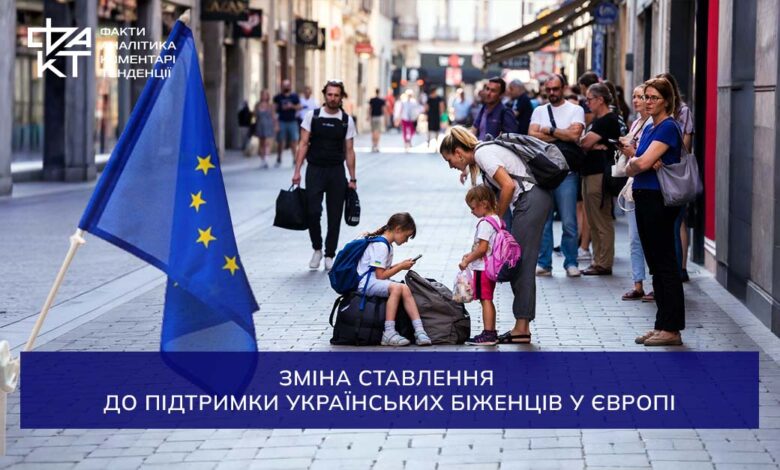
The total number of Ukrainians who fled their homes as a result of the full-scale war has become the largest migration crisis in Europe since World War II. However, in four years, the attitude of the inhabitants of the European Union towards our refugees has gone from a wave of emotional solidarity to strict pragmatism. Now humanitarian support is increasingly limited to the conditions of employment, linguistic integration and economic independence. The initial images of train stations overflowing with hugs and help have gradually replaced rational approaches to resources and social obligations. European states do not close the doors, but form a rigid framework where Ukrainian refugees become participants in the system of economic and administrative integration. This shapes the current dynamics of support for Ukrainians and determines the political, social and economic dimension of the coming years.
Integration architecture and changing political priorities
The modern map of the European Union clearly reflects where the bulk of Ukrainians who received temporary protection have moved. This distribution demonstrates a stable structure in which a few countries accumulate a significant part of the total flow.
Geography of temporary protection in the EU (as of December 2025)
| Country / Position | Number of persons | Share in the EU (%) | Monthly dynamics (persons) |
| 1. Germany | 1 250 620 | 28.7% | + 9 620 |
| 2. Poland | 969 240 | 22.3% | (stabilization) |
| 3. Czech Republic | 393 055 | 9.0% | (growth) |
| 4. Spain | 255,180 | 5.9% | + 2,235 |
| 5. Romania | 201,865 | 4.6% | + 2,160 |
On the one hand, this picture looks like a clear hierarchy of states, where Germany, Poland, and the Czech Republic concentrate the bulk of Ukrainians under temporary protection. On the other hand, even with a slower growth rate, the total number continues to increase, and the movement covers most of the European Union countries. The December statistics only emphasize this duality, because the system is already operating in a mode of relative stability, but its scale continues to expand.
However, European hospitality no longer carries the emotional impulse with hugs at train stations that we saw at the beginning of the great war. Today it is more of a balanced and sometimes cool calculation, where empathy exists next to fatigue. The overall level of support among Ukrainians, although it has decreased significantly, is surprisingly stable, since 80% of Europeans are still ready to accept refugees. However, if we look closely at the map of Europe, we will see not monolithic support, but a real shower of contrasts.
At one pole is the iron solidarity of the North. Finland and Sweden demonstrate an almost anomalous 97% of support, because here Ukrainians are perceived not as a burden, but as part of a common defensive wall against the aggressor. The Scandinavian calm of Denmark (94%) and the sunny optimism of the Pyrenees — Spain (93%) and Portugal (91%) — have also not wavered. For these countries, helping Ukrainians has become a matter of basic value, because although they are far from the front line, they firmly hold the humanitarian rear.
At the other extreme, the situation is significantly different, because there the lowest indicators are recorded in places where a significant number of Ukrainians are concentrated, or where there is a strong influence of domestic populist politics. The Czech Republic has become the “coldest” point on the map with an indicator of 53%. Here, every second person already questions the stay of Ukrainians in this country. A similar atmosphere prevails in Bulgaria (69%) and Romania (71%), where the economic difficulties of the local population force people to compete with migrants for social resources.
Even in Poland, which was and remains the main hub, the degree of approval has dropped to 74%. Hungary, with its 73%, also demonstrates that the prolonged presence of millions of people nearby inevitably leads to domestic friction. This is no longer a “refugee crisis” in its pure form, but a complex process of coexistence, where every cent of support now has to be won not with pitiful stories, but with real integration and respect for local rules.
The application of the Temporary Protection Directive, which has been in “suspension” for more than two decades, has given Ukrainians an unprecedented carte blanche to legalize, access the labor market and healthcare systems on an equal footing with EU citizens. This “green corridor” allowed us to avoid chaos in the first months, but in the fifth year of the confrontation we see a clear trend towards the curtailment of preferential regimes in countries such as Germany, Norway and Ireland. European capitals are increasingly loudly declaring a change in the vector of social assistance, which becomes directly dependent on activity in job search and the depth of linguistic assimilation, which actually ends the era of unconditional financial support.
Despite the narratives spread in right-wing radical circles about the “burden on the budget”, real statistics demonstrate a stunning economic paradox, especially noticeable in the example of Poland. Ukrainian citizens have not only integrated into the Polish economy, but have become its powerful accelerator, generating income that is 8 times higher than all Warsaw’s spending on humanitarian needs. The high concentration of women with higher education among refugees has created a unique situation when host countries have received ready-made qualified human capital without investing in its upbringing and training, which only exacerbates the demographic deficit within Ukraine itself.
Table 2. Comparative panorama of conditions and statuses (2025-2026)
| Region / Country | Policy vector | Key indicators and changes | Legal perspectives |
| Germany | Strengthening requirements | Over 1.25 million people. Abolition of Bürgergeld for new arrivals, transition to a system for asylum seekers. | Temporary status until 2027, focus on Blue Card. |
| Poland | Pragmatic benefit | Linking “800+” payments to children’s school attendance and parents’ legal employment. | High demand on the labor market (employment rate 75-85%). |
| Czech Republic | Harsh austerity | Reduction of free housing to 90 days. Payments at the subsistence level after 150 days. | Requirement of notarized confirmation of lease to extend status. |
| USA | Legal uncertainty | Suspension of the U4U program. Freezing work permits for hundreds of thousands of people. | Real threat of deportation and “libmo” status (uncertainty). |
| Great Britain | Limited protection | Visa extension for 18-24 months (until the end of 2026). | No direct path to permanent residence (ILR). |
As we can see, after the initial wave of unconditional support for Ukrainians, European states are moving to a more cautious and pragmatic model. Social benefits are being reduced, free housing is being limited in time, and assistance is increasingly directly linked to employment. Formally, the EU has extended the Temporary Protection Directive until March 2026, but maintaining legal status no longer means maintaining the previous volume of benefits.
Eastern flank countries, in particular Poland, the Czech Republic, Latvia and Estonia, are openly talking about the limits of possibilities and reviewing support programs. Poland, which has accepted more than 900,000 Ukrainians, is limiting the validity of special laws and streamlining the status through the CUKR card. Latvia is cutting payments and reducing the assistance budget by almost half, arguing this with the growth of employment among Ukrainians.
In Germany, the emphasis is on stimulating entry into the labor market, when able-bodied refugees risk losing part of their benefits if they refuse to work. Ireland is limiting the duration of state placement, Norway is tightening the conditions for granting asylum, and the Netherlands is preparing a new temporary status after 2027 and gradually shifting part of the costs to those with income.
The general trend is obvious and points to the fact that Europe is not closing its doors to Ukrainians, but is changing the conditions of stay. Economic activity and independence have been concentrated at the center of the new policy, as states seek to transform humanitarian reception into long-term integration without excessive pressure on budgets.
Discussions around 2027, when the term of temporary protection in the EU will expire, point to the inevitable fragmentation of statuses, where each state will independently determine the fate of Ukrainians on its territory. While some countries see our citizens as a demographic resource for the rejuvenation of the nation, Ukraine is faced with the reality of a “demographic gap” of 10 million people, taking into account the unborn and the deceased. The Ukrainian authorities should understand that the return of this active part of society cannot be stimulated only by cash payments for the trip. Since it will only happen if a basic sense of security is restored and a social environment is created where a qualified specialist can realize his potential at home no worse than in Munich or Prague.
The Reputational Crisis of Ukrainians in Europe: Who Creates the Toxic Trail
It is worth recognizing that the modern migration situation in Europe has finally lost its initial halo of sacrifice, turning into a complex social canvas, where cynical calculation coexists alongside tragedy. While one part of Ukrainians is exhaustingly gnawing away at a foreign environment, learning the language and confirming diplomas, the other has created a stable ecosystem of parasitism on European humanism. This stratification can no longer be ignored, as it becomes toxic fuel for European right-wing radicals and destroys the reputation of those who were truly escaping death.
A separate, most acute episode of this process was the phenomenon of “double enrichment” of immigrants from relatively safe Western regions. The model of behavior here is striking in its cynicism, when a family leaves for Germany or Austria, receives free housing, health insurance and social benefits in euros, while simultaneously turning their real estate in Lviv or Uzhhorod into a gold mine. While European taxpayers finance their lives, these so-called refugees squeeze the last juice out of their own compatriots – refugees from the East and South of Ukraine, renting them apartments at prices that exceed the average European. The constant increase in rent for people who have lost everything, against the background of receiving assistance from the EU, looks like looting, legalized by the lack of state control.
In addition, conflicts are increasingly recorded in social services in Germany and Poland, where Ukrainians persistently make demands on the quality of food or the area of residence, perceiving solidarity as a due tribute. At the same time, the refusal to integrate and the reluctance to enter the labor market become a conscious strategy, according to which the logic of “parasitism” arises, because why work in a low-skilled job, if the amount of assistance and income from renting an apartment in Ukraine allow you to lead a comfortable life of an “eternal tourist”.
The situation is also complicated by reputational blows of a criminal nature, which become the last straw for the patience of local communities. The tragedy in Gdansk, where Ukrainians are suspected of the brutal murder of their own compatriot with the subsequent burning of the body, breaks the template of “peaceful asylum seekers”. When such savage plots appear in the criminal chronicles of Poland or the Czech Republic, they are inevitably and instantly transferred to all Ukrainian migrants. The local population ceases to see Ukrainians as intellectual capital and begins to perceive them as a threat that requires tough police measures.
Today, European governments are forced to react to the behavior of our refugees, so the era of “open checks” is coming to an end. The introduction of checks on the availability of real estate in Ukraine, the denial of shelter to residents of western and central regions of Ukraine, the cancellation of payments for those who are unemployed, and the strict linking of status to language courses have become, albeit belated, but necessary reactions to the abuse of Ukrainians. This critical moment demonstrates that solidarity is an exhaustible resource. However, unfortunately, those Ukrainians who truly have nowhere to return to, but whose opportunities are now narrowing due to the toxic trail left by their more cynical compatriots, are also forced to pay for such “smartness” of certain groups.