
Million-dollar business on blood: how the country makes money on the sale of weapons stolen from the front

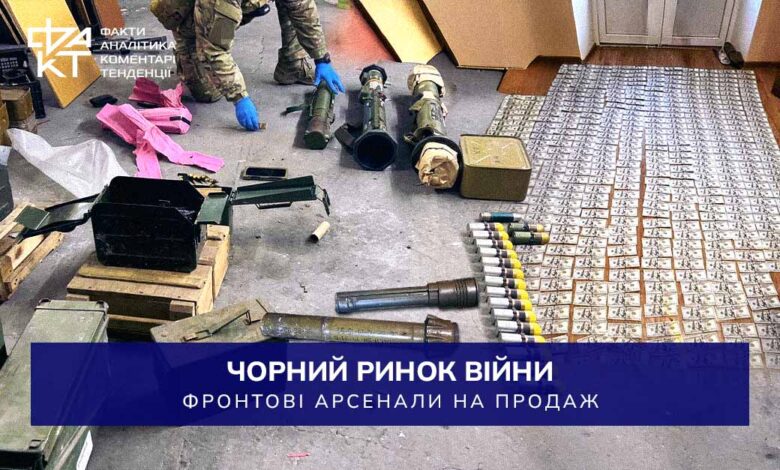
War brings to the surface not only heroism, but also what society would rather not see. While some military personnel defend the country, others actively turn the war into a black market for weapons. They are taken out of the front in batches, used in “online stores”, caches at service stations and even tow trucks, and then sold in the rear. This means that the problem has long gone beyond individual crimes and has become a systemic threat to the security of society. Criminal schemes flourish due to the lack of control, as well as the connivance or tacit consent of those who should be responsible for accounting for arsenals.
Weapons from the front and sales for millions
On March 17, it became known that the State Bureau of Investigation and the Specialized Prosecutor’s Office exposed a scheme in which the war became a cover for the illegal arms trade. According to the investigation, five servicemen serving in the Kharkiv and Donetsk directions took machine guns, shots and grenades of various modifications, assault rifles, cartridges of various calibers, explosives and ammunition from the arsenals of their units and sold them, effectively turning stolen weapons into goods for regular sales.
In this case, not only the fact of the theft of weapons from the combat zone itself, but also the way in which the entire sales system was built is particularly telling. The figures in the scheme created an “online store” through which they offered their “goods” to buyers. That is, they did not act as random sellers, but as a whole group that gave their activities the form of an organized supply channel. When weapons begin to be sold through a well-established mechanism, the case takes on the features of an organized scheme in which front-line arsenals, logistics, storage location, and method of transfer to the buyer are combined into one chain.
He worked in several directions at the same time, which even more clearly shows his well-organized nature. Some weapons, in particular grenade launchers, were sent by mail to Odessa, while large batches were delivered in person. In the Odessa region, the weapons storage cache was set up on the territory of a technical service station, that is, it was disguised in an everyday environment, where equipment, the movement of people, and economic activity can dissolve dangerous contents in the usual rear landscape.
An equally cynical detail is the use by the dealers of an evacuation vehicle intended for transporting wounded soldiers. And here we are not just talking about illegal logistics, but about the appropriation of a resource that is supposed to save the lives of fighters, not serve a criminal channel.
According to episodes documented by law enforcement officers, the illegal sale of weapons brought in profits of more than 1.5 million UAH per month, which is a financial marker of the scale of the crime. After the detention, all the defendants were informed of suspicion of illegal handling of weapons, ammunition or explosives, committed by a group of people in a prior conspiracy. The court has already chosen preventive measures for the suspects in the form of detention with the possibility of posting bail: for two defendants – 1.9 million UAH, for the others – 1.6 million, 260 thousand and 200 thousand UAH, respectively.
In addition, on March 16, law enforcement officers in the Ternopil region exposed a criminal group of seven men suspected of selling weapons, ammunition, explosives, and rocket fuel. At the same time, the investigation considers one of the key figures in this case to be an employee of the fire and rescue unit of the State Emergency Service, who was engaged in the sale of weapons in one of the regions of the region. SBU officers, together with police officers, conducted 30 simultaneous searches in different regions of the Ternopil region. As a result, law enforcement officers found 2 Kalashnikov assault rifles, 11 other firearms, including pistols, rifles and converted weapons, 1 grenade launcher, 52 grenades, 2 fuses, 2 mines, 170 30-millimeter shells, over 3,000 rounds of ammunition, 20 kilograms of gunpowder, 83 kilograms of bullets, 12.2 kilograms of rocket fuel, as well as components for weapons and other means of destruction.
According to preliminary estimates, the value of the seized weapons is about 4.5 million hryvnias. At the same time, during the searches, in addition to weapons and ammunition, significant amounts of cash were seized, which, according to the investigation, could have been obtained from the sale of an illegal arsenal – almost 127 thousand dollars and 36 thousand euros.
Another example of the arms business during the war is the events of March 9, when the SBU and the National Police prevented new attempts to establish illegal sales of captured weapons and ammunition in Ukraine. As the SBU reported, eight dealers were detained who were trading in weapons illegally exported from frontline areas and combat zones. Among the seized items were Russian Kalashnikov assault rifles, “Jmil” infantry flamethrowers, “Val” silent assault rifles, anti-tank grenade launchers, and almost 20,000 rounds of ammunition of various calibers.
Also in the Kyiv region, law enforcement officers detained the owner of a service station and two of his accomplices who were trying to sell weapons transported from the frontline areas of eastern Ukraine, and the arsenal itself, according to the investigation, they hid in caches arranged in a garage and a guest house on the territory of private households. The suspects were caught selling a combat kit, which included anti-tank rocket-propelled grenades, an underbarrel grenade launcher, AK-series assault rifles and ammunition, and during further searches, an anti-tank guided missile, 192-mm grenade launcher rounds in boxes, a rocket-propelled flamethrower, 9 small arms and over 11,500 rounds of ammunition were additionally seized.
In the Donetsk region, two mobilized soldiers were exposed who were taking captured weapons from the frontline for sale. They were detained in the Kramatorsk district while attempting to sell an RPG-22 grenade launcher and five Russian AK-47s.
In the Dnipropetrovsk region, suspicions were raised against an employee of a local metal warehouse and his friend, who had previously served sentences for illegal weapons sales. They set up an underground workshop in the garage of a private house to restore the combat properties of small arms.
In the Khmelnytskyi region, a resident of the capital was detained after being caught selling weapons, and he also prepared more than 1.6 kilograms of plastid, 11 combat grenades, more than 2 thousand cartridges, a grenade launcher shot and smoke bombs for sale. All detainees were informed of suspicion of illegal handling of weapons, ammunition or explosives, and the issue of additional qualification of their actions is also being resolved.
Why does the shadow arms market exist during war and what are its consequences
A series of revelations of criminal schemes in various regions, as well as those that are currently being kept quiet, show not random crimes, but a whole well-established system in which weapons from the front or near-front areas enter civilian circulation through well-established sales channels. Moreover, these cases involve not single pistols or machine guns hidden “in reserve”, but entire arsenals: grenade launchers, rocket-propelled flamethrowers, mines, grenades, shells, thousands of rounds of ammunition, explosives and even rocket fuel. So, we are no longer talking about random weapons supplies, but about a whole shadow business that thrives under the cover of war.
However, questions arise: how do weapons leave military units and why is their movement possible? An ordinary soldier does not exist outside the strict vertical of subordination, does not dispose of arsenals at his own discretion and cannot export combat weapons without a trace if there is strict control at each level. Therefore, the repetition of such cases inevitably leads to the conclusion that the problem lies above the level of individual soldiers. It is either about the tacit consent of commanders in the field, or about such a deep breakdown of internal control that the disappearance of weapons, their movement and subsequent sale cease to be an exception and become part of shadow practice. Obviously, the first reason is the main one.
In addition, there are many questions for the Ministry of Defense, because a series of criminal schemes looks like an indicator of a systemic failure of control, accounting and supervision of weapons. If it leaves the units not individually, but in batches, if it manages to be transported, accumulated in caches and sold in different regions, then state control over the circulation of military property does not work. It is hard to believe that the arms business is going on behind the backs of ministry officials.
It should be noted that during the war this process is unlikely to stop, because it creates a favorable environment for it. Large volumes of weapons, constant movements of military units, exhaustion of the system, complex logistics, losses, transfer of resources between directions – all this opens up space for people who see weapons not as a means of defense, but as a quick, crazy money. At the same time, such a business is fueled by weak control from the command, official connivance and a sense of impunity. As long as the war continues, the temptation to export goods from it that can be sold profitably on the black market will persist.
However, for society, the consequences of this are and will be much more severe than individual criminal sentences. Weapons that leave military units today settle in garages, private houses, workshops, cars, rented premises and caches. Later, it begins a new life in the criminal environment. It passes to people who have no connection to the front, but have a motive to use it in domestic conflicts, as well as during robberies and robberies. The more weapons are distributed across the country, the less predictable the everyday life of Ukrainians becomes.
This process becomes especially dangerous where weapons come close to children. For an adult, a grenade, a fuse or an explosive device have an understandable meaning, while for a child it may simply be a found object that you want to pick up, look at or bring to show someone. Where weapons of mass destruction are distributed across the civilian environment, the risk of accidental explosions, injuries and deaths in yards or outbuildings increases. Already now there are not infrequent cases of children dying while playing with weapons that their parents keep, contrary to established rules. However, it is difficult to imagine what will happen after the war. Over time, society will begin to receive not only more armed criminals, but also a generation of children who grow up next to the presence of deadly weapons in everyday life.
Another threat is that the large number of illegal weapons in the hands of the population blurs the very line between war and the rear. When machine guns, grenade launchers, explosives and ammunition cease to be an exclusively military category and become an element of the domestic black market, the crisis within the country takes on a different scale. In addition, any domestic quarrel, conflict over property, debt or revenge can lead to the use of weapons. Therefore, the sale of weapons from the front should be perceived not as another criminal chronicle, but as a signal that the state is losing control over what, by definition, cannot be outside its accounting, supervision and responsibility.
Without strict state control, in particular from the Ministry of Defense, the shadow arms market will inevitably grow, further overgrown with corruption, intermediaries and criminal schemes. What today looks like a “gray zone” will very quickly turn into a direct threat to society in the future. Weapons will end up not where they are supposed to protect, but where they kill, blackmail, and undermine domestic security. If the circulation of weapons is not controlled by the state, it will begin to be controlled by crime.


