He talked about the return of refugees, but he himself disappeared in Europe: what is known about Minister Chernyshov’s business trip against the backdrop of the high-profile NABU case

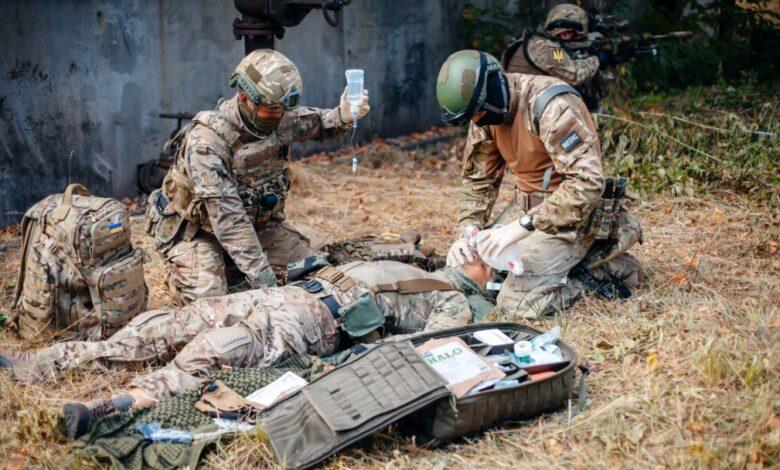
The full-scale war made tactical medicine in Ukraine not just a part of military training, but an element of survival. In a combat zone, the first minutes after being wounded determine whether a fighter will live. That is why tactical prehospital care has become one of the key disciplines in basic combined military training, regardless of whether the recruit is an infantryman, signalman or machine gunner. It doesn’t matter how long he’s been in the shooting range if he knows how to stop arterial bleeding. On the front line, there is rarely a medic nearby, and there is almost never time, so from the first day, newbies are taught not only how to apply a tourniquet, but also how to do it themselves, in the dark, with trembling hands, when all around are explosions, panic, other people’s screams and their own fear. In this reality, teaching under calm instructions does not work. Only simulation of combat stress works – controlled, but as close as possible to the real one.
Instructor Yevhen, who works on the basis of one of the centers of the Ground Forces, told, that some recruits initially do not realize how important tactical medicine is. It seems that it is more important to shoot well or to disguise, but after the first classes, their attitude changes. Before practice, recruits must be shown training videos created using augmented reality. They have open arterial bleeding, traumatic amputation, neck and chest injuries. Fighters see what it looks like on the battlefield: no effects, no editing, no heroics – just screams, blood and seconds.
Evgeny said that after that, the cadets are taken to classes, where every scenario of events is simulated. They work in pairs, on mannequins, on each other. Instructors do not just explain, but create conditions as close as possible to frontline conditions. Screams, empty shots, smoke grenades, grenades, chaotic commands, limited time. At the same time, each cadet should not just apply a tourniquet, but do it when others are screaming, when he can’t see anything, and when he himself is in a panic.
“This is not just an exercise, but a simulation of a situation where either you save a life – or it will no longer exist.” – thinks Evgeny.
It is in such an environment that those who only yesterday dealt with a computer or a construction crane begin to understand the value of speed and accuracy.
Yevhen says that the first impression many people have is an ordinary medical unit with bandages and diagrams. But already after the first days it is perceived differently. One of the main tasks of the instructor is to break the idea that tactical medicine is something secondary.
“It’s one thing to apply a tourniquet in a calm state, with an instructor nearby. The other is when there are shots, screams, smoke and no one gives a clue. When everything depends only on you, and time passes by seconds.” the instructor explains.
He says that in the classes they use dummies that simulate real wounds. Dummies can be warm, with simulated pulsation or even with blood under pressure. Sometimes help should be provided not on a mannequin, but on a partner — with real turnstiles, scissors, under the bombardment of sounds. This is not a game or a simulator, but an emotional and physical preparation for a situation where a mistake costs life.
According to Yevgeny, the tactical medicine course is not limited to applying tourniquets. Recruits are taught:
– stop bleeding of various types (venous, arterial, capillary);
– correctly evacuate the wounded from under fire;
– assess the level of consciousness, breathing, pulse;
– provide assistance in case of pneumothorax;
– fix fractures, immobilize the spine;
– use the first-aid kit of the IFAK standard;
– not to lose self-control during pain, screams, fear.
In addition, attention is paid to psychological preparation: how to cope with one’s own shock, not to fall into a stupor, not to faint. Instructors emphasize: a cool head is more important than hands.
The instructor says that the biggest mistake is to think that “it’s not about me.” The war expanded the idea of the front: shelling takes place in the rear, shells fly into columns of equipment, drones work in groups that have not yet taken up positions. And in these conditions, anyone can become the one who provides first aid. There is no guarantee that a medic will be nearby, and a tourniquet in the hands of a comrade is sometimes the only thing that stands between life and death. That is why the course of tactical medicine has long ceased to be a formality. It is passed not “for a tick”, but to avoid becoming another black-and-white portrait in the grid. He who knows how to save, lives alone and saves others. And this can be taught only when the shouting and pressure is not a metaphor, but part of the preparation.