
Illegal vaping in Ukraine: how electronic cigarettes without excise duty and state control became a mass phenomenon

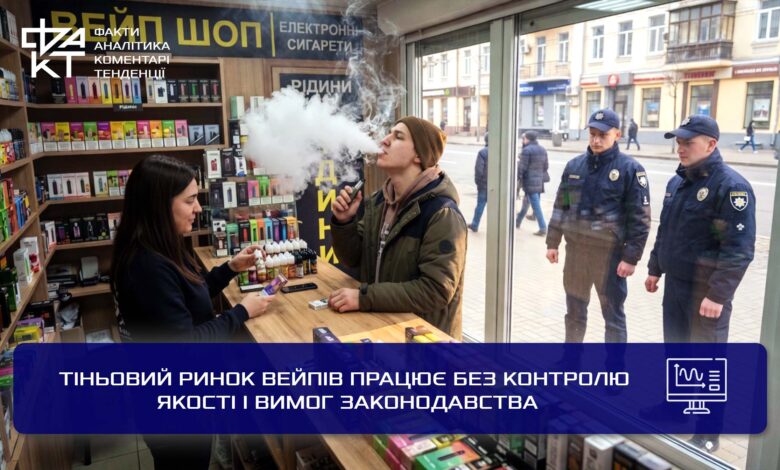
Today, a large-scale illegal scheme is not hiding underground, but boldly occupying the shelves of the capital’s shopping malls and shops in every city of Ukraine. According to Kantar, from 93% to 95% of the electronic cigarette market in Ukraine is in the “shadow”. Almost every vape or bottle of liquid displayed in bright shop windows is a counterfeit without excise duty and any quality control. The total presence of illegal products in open sale serves as a de facto painting of the state in its own inability or unwillingness to implement the laws it has adopted.
In addition to the billions of budget hryvnias lost, the country is gaining a generation with undermined health. Behind the illusion of “safe” and fragrant smoke, untested chemical compounds are hidden that provoke serious pathologies in millions of Ukrainians, including teenagers. Institutional weakness is converted into human losses from diseases that could be prevented by state control, which currently exists only on paper.
Illegal Vaping in Ukraine: How the “Gray Zone” Became the Market Norm
The situation with the circulation of electronic cigarettes in Ukraine resembles a legal vacuum, where legislative prohibitions have almost no control over the situation, while reality dictates the rules of aggressive and often criminalized marketing. The large-scale shadowing of this sector testifies to both the ingenuity of businessmen and the systemic inability of regulatory authorities to stop blatantly ignoring safety and taxation standards.
Instead of the expected regulation of the market after the introduction of excise taxes, the vaping industry has actually plunged into a “gray zone”, where illegal status has become the norm. The budgetary losses from this state of affairs are striking in their scale, because every year the state loses about UAH 7.6 billion in tax revenues, of which the lion’s share falls on excise duties.
Vaping marketers have built their promotion strategy on myths about a “safe alternative” and help in overcoming tobacco addiction, although medical research paints a much bleaker picture. Despite advertising slogans about “concern for the health of the consumer,” the composition of e-liquids contains a whole cocktail of dangerous compounds:
- nicotine: causes persistent addiction and inhibits cognitive development, especially in adolescents;
- carcinogens (formaldehyde, acetaldehyde): decomposition products of liquid components when heated, which are directly related to the risk of cancer;
- heavy metals (cadmium, benzene): affect the cardiovascular system and lungs;
- acrolein: a specific substance capable of causing irreversible destructive changes in lung tissue.
The industry’s focus on the youth audience is of particular concern. The use of thousands of bright flavors, images from pop culture and the involvement of influencers in social networks create the illusion of a harmless accessory for socialization. However, the statistics of the Central Tobacco Control Agency refute the myth of vapes as a tool for quitting smoking. On the contrary, they often become an “entry ticket” to nicotine addiction, which later only strengthens the craving for traditional cigarettes.
Exposé without effect: how law enforcement officers find schemes, but the vaping market remains in the shadows
The complete ban on flavored liquids introduced in July 2024 should have been a point in the history of mass involvement of children in vaping, but the business instantly adapted through the “self-mixing” mechanism. By selling the ingredients separately, stores do not formally violate the law, since each component in itself is not an excisable good. This allows retailers to avoid licensing and responsibility for the sale of prohibited products, shifting the mixing process to the shoulders of the buyer.
Compared to the European market, where the share of shadow business is about 48%, the Ukrainian situation looks much more critical due to the high level of domestic underground production. While Chinese smuggling in parcels prevails in the EU, in Ukraine more than half of illegal liquids are manufactured domestically without any supervision over the chemical composition.
A large-scale campaign by state bodies to de-offshorize and systematically combat the shadow economy sector took on concrete outlines during the latest special operation aimed at eliminating illegal markets for excisable products. Trying to return the circulation of excisable goods to the legal field and protect consumers, the law enforcement system struck at the infrastructure operating under the signs of the famous U420 “cafe shops”. The investigation found that these establishments had been disguising the sale of prohibited cannabinoids for a long time under the guise of harmless souvenir products, in particular drinks and cigarettes. Over 200 searches conducted within the framework of this investigation confirmed the systemic nature of the violations, where dangerous chemical compounds were hidden behind bright marketing that could cause irreversible damage to the health of citizens.
The economic basis of this network was based on an extensive system of minimizing tax liabilities, which directly contradicts state interests and the principles of transparent competition. The organizers involved more than 56 controlled business entities — the so-called “drops”, which were de facto only legal decorations for the implementation of the business fragmentation scheme. This approach allowed a large retail chain to artificially maintain the status of small enterprises, avoiding paying taxes in particularly large amounts. The funds received were later legalized through fictitious financial transactions and transfers between accounts, which allowed the defendants to integrate dirty capital into the legal economy and purchase valuable movable property with it.
Along with the exposure of the “cafe shops”, the Bureau of Economic Security liquidated a powerful industrial hub in Kyiv and the region, where the clandestine production of vaping liquids had been operating since 2023. During the investigative actions, property worth UAH 30 million was seized, which included tens of thousands of units of raw materials: from flavorings and glycerin to strength enhancers and ready-made cartridges. This illegal workshop operated outside of any state supervision, producing “home-made mixtures” that were massively distributed through online platforms and physical vape shops throughout Ukraine, creating uncontrolled risks for young people and regular customers.
The Western region also found itself at the epicenter of the investigation, where detectives from the territorial department of the BEB in the Lviv region stopped the activities of a network specializing in the sale of smuggled electronic cigarettes. Law enforcement officers seized excisable products with a total value of about 16 million UAH, including more than 48 thousand units of nicotine-containing goods that were imported into the country in circumvention of customs regulations. The seized cash, computer equipment and communication equipment became material evidence in the proceedings under the article on smuggling, which testifies to the determination of the state in the issue of dismantling corrupt logistics chains that feed the shadow market.
However, despite periodic reports from the Bureau of Economic Security on the exposure of large networks, there is no systematic solution to the problem. State authorities are actually signing off on their own powerlessness, calling the fight against schemes an endless road to nowhere. The lack of new legislative initiatives and the inability to effectively administer excise taxes lead to the market continuing to function according to the principles of wild capitalism, where the excess profits of dealers outweigh the health of the nation and filling the budget.
Responsibility for the free sale of psychotropic drugs under the guise of souvenirs and the widespread availability of prohibited flavored mixtures lies with the system that has allowed the absence of strict and unavoidable control over retail outlets. This state of affairs has become possible due to the long-term impunity of dealers who skillfully use legal loopholes to circumvent current legislation. It is quite clear that without real reforms in the supervision system, the Ukrainian vaping market will remain a toxic combination of smuggling, tax fraud, and a threat to public health.
Many Controllers, Zero Synchronization: How the State Loses the Vaping Market
The system of supervision over the circulation of electronic cigarettes in Ukraine resembles a ramified mechanism, where each cog has a clearly defined trajectory, but the overall movement is often slowed down due to the lack of synchronization. The division of powers between four key departments creates a multi-level barrier, which in theory should make the market transparent, but in practice turns into a labyrinth of bureaucratic areas of responsibility.
The National Police acts as the front office of the state, performing the role of the first line of response due to its presence in the most remote corners of the country. Although its tools are limited mainly to fixing administrative offenses directly at points of sale, it is the patrol officers who discover questionable liquids without excise stamps or devices with prohibited flavors on the shelves.
The detection of products of unknown origin is completed by drawing up a report and confiscating the goods, which entails a financial penalty of UAH 3,400 to UAH 10,200. However, such measures have a spot effect, since the police work with the consequences, and not with the root causes of the emergence of shadow flows, leaving large-scale investigations to specialists of a different profile.
The Bureau of Economic Security takes responsibility for dismantling the very foundations of illegal business – from underground workshops to extensive smuggling routes. BEB detectives operate in the categories of the Criminal Code, where the minimum fine starts from UAH 85,000 and can reach UAH 170,000, and systemic relapses or the activities of organized groups are punishable by actual imprisonment. The peculiarity of this body’s work is the long process of collecting evidence and seizing assets, which often stretches over years of litigation, but it is the BEB that has the potential to block the arteries that feed the “black” market, instead of fighting individual small sellers.
The State Tax Service is building a system of economic safeguards, focusing on the legality of each transaction and the availability of appropriate permits from entrepreneurs. Control purchases and verification of the use of cash registers allow tax officials to respond promptly to unlicensed trade, for which severe sanctions of 200% of the value of the consignment of goods are provided.
Even the sale of components for self-mixing liquids, which is often perceived as a “gray area”, is subject to a sanction of three minimum wages, which makes the economic risks for violators very tangible. The State Tax Service has the right not only to charge additional taxes, but also to cancel licenses, effectively pushing unscrupulous players out of the legal field if they ignore the rules of labeling and accounting.
The State Service for Food and Consumer Protection closes this perimeter of control, focusing on the social aspects of the market: compliance with age restrictions and the cleanliness of advertising space. This service acts as a kind of filter, which should guarantee that aggressive marketing of nicotine-containing products does not cross the line of what is permitted and does not harm vulnerable segments of the population.
Despite the fact that each agency is endowed with specific and powerful levers of influence, the overall picture remains fragmented due to the lack of horizontal interaction. The effectiveness of the state machine in this area directly depends on the ability of the police, tax authorities, the State Consumer Protection Service and the State Service for Food and Consumer Protection to act as a single organism, because without a systematic approach, the fight against the illegal market turns into an endless process of responding to symptoms, while the “disease” itself continues to progress in the shadows.
The key challenge for the state remains the transformation of declarative prohibitions into real deterrent mechanisms, where the inevitability of punishment will outweigh the excess profits from “shadow” schemes. While the vertical of regulatory bodies operates in the mode of local special operations, the market manages to adapt to any legislative changes faster than the law enforcement system manages to implement them.
The solution to the problem lies not so much in the area of new fines, but in the political will to create transparent digital monitoring that would make it impossible for illegal goods to be present on the shelves of legal shopping centers. The ultimate success of this struggle will be determined by the ability of state institutions to go beyond bureaucratic competition and recognize that consumer safety and the filling of the State Budget are inseparable components of national security. Without such a holistic approach, any point successes of detectives or tax officers will remain only a temporary pause in the expansion of uncontrolled and toxic business.


