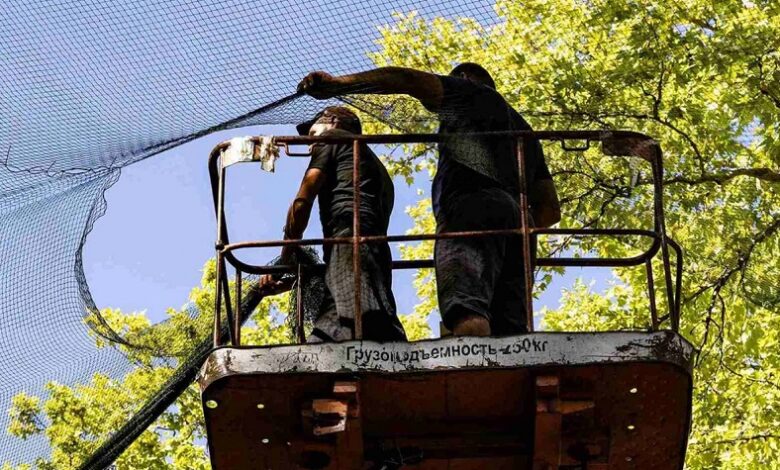
Kherson and part of the liberated Kherson Oblast are subjected to shelling and massive drone attacks on a daily basis. Every day, the enemy is increasingly using drones against the civilian population. In order to increase the safety of the city’s residents, they plan to install special mesh structures to counter drones on highways and critical infrastructure facilities.
Earlier, such a fortification element as an anti-drone net was used by the military mainly for camouflage. Now it covers roads, hospitals and energy facilities like a web.
The head of the Kherson regional military administration Oleksandr Prokudin said that the installation of anti-drone nets in the region has been going on for about a year. First of all, they covered the needs of the military. For this, they collected fishing nets seized by the fish protection patrol during raids, including in other regions. Then they were handed over to the military for testing to determine the most reliable protection option for highways and critical facilities.
At first, power substations in the region were protected with single-layer nets, but this method turned out to be ineffective. Nets were tested and selected until specific types were identified that provided the appropriate level of protection. The plan envisages the construction of 264 kilometers of roads and critical infrastructure facilities, and 7 kilometers of roads have already been equipped. However, due to the high cost of the works — about 1 million hryvnias per kilometer — the completion of the project is possible only with additional funding. That is why the regional authorities turned to the government with a request to allocate approximately 300 million hryvnias.
“The process of arranging grids is technically complex. For example, on city roads, grids are installed in such a way as to avoid sagging and not to damage communications. For this, metal cables are used, they provide the necessary tension. I understand that they are talking about the speed of work, but it is necessary to provide high-quality protection for people and so that all transport can safely move on the roads, – explained the deputy head of OVA Olga Malyarchuk.