Interagency data exchange on children with police involvement: a control tool or a source of new risks

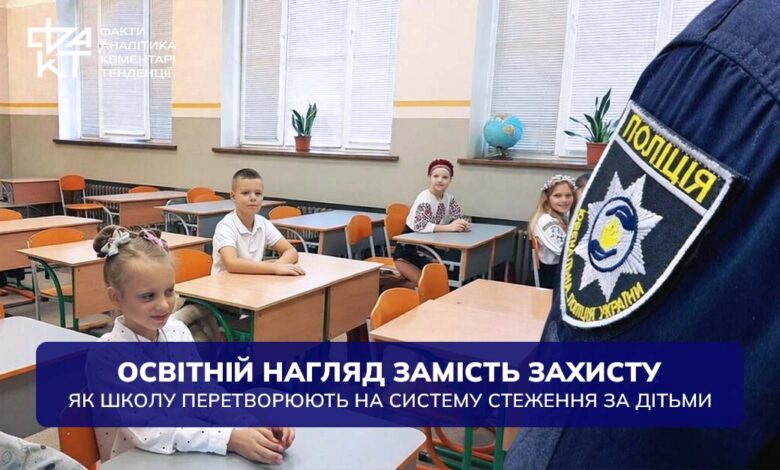
During the years of full-scale war, the educational space of Ukraine has turned into a torn map, where hundreds of thousands of children balance between evacuation flights and laptop screens every day. The old methods of paper reporting have proven useless in conditions where a student’s place of residence changes faster than the class journal is updated. In this regard, the government is trying to take this chaotic movement under tight control, introducing new methods for monitoring school attendance, involving juvenile police. However, this process has certain risks, under which the punitive mechanism will operate instead of real social assistance.
Liquidation of educational anonymity: new rules for recording students as an attempt by the state to curb migration chaos
Government Resolution No. 241 of February 25, 2026 amended the Procedure for Keeping Records of Preschool and School-Age Children, Pupils and Students, approved by the Resolution of the Cabinet of Ministers of Ukraine of September 13, 2017 No. 684. The new document significantly revises the principles of keeping records of preschool and school-age children, effectively dismantling the outdated model in favor of a dynamic digital monitoring system. Such updates are aimed at streamlining the recording of a student’s presence in the classroom, as well as creating a continuous data transmission chain between key state institutions for the full coverage of children with education.
Key tools of the updated Procedure for registering children
| Direction of updating | Content and mechanism for implementing changes |
| Interdepartmental coordination | Creating end-to-end data exchange algorithms that unite educational institutions, government bodies, social services and units of the National Police into a single information chain. |
| Effectiveness of monitoring | Implementing a system of instant notification of cases when a student stops attending classes or drops out of the educational process without proper documentation confirmation. |
| Regulation of deadlines | Establishing clear time frames for processing and transferring information between structures, which aims to eliminate bureaucratic delays in identifying children who have “disappeared” from the register. |
| Digitalization of processes | Switching to the use of automated information systems and specialized services that minimize the human factor and speed up the response of the juvenile police to violations. |
| Protection of the right to education | Strengthening systemic state supervision to ensure that every child remains within the educational field, regardless of martial law or displacement conditions families. |
Head of the Juvenile Police Vasyl Bohdan believes that the reform developed at the initiative of the Juvenile Prevention Department is aimed at overcoming the communication gap between educators, social services and law enforcement officers. Flexible interaction allows law enforcement agencies to intervene in the situation at the very moment when a child disappears from the educational radar without official registration or good reasons. Quick access to the database becomes a timely response tool for police officers, where the priority remains the safety of pupils and support for families in times of crisis.
In addition, the government and police believe that a clear regulation of the terms of informing about the absence of students from classes deprives the educational process of unnecessary bureaucratic inertia, which during mass internal displacement and the departure of citizens abroad often led to the loss of contact with thousands of students. The issue of attendance now goes beyond the competence of the educational institution alone, turning into the object of close attention of interagency groups, which are obliged to promptly find out the reasons for the child’s withdrawal from school. Such a model of interaction is considered critically important in wartime, when distance learning formats and chaotic evacuation complicate physical control over the acquisition of education.
In addition, according to officials, the integration of digital tools and automated systems into the accounting process becomes a vital safeguard that eliminates the risks of losing paper archives due to shelling or urgent evacuation of institutions. Automation allows juvenile police officers to identify the social vulnerability of a family much faster, preventing the child from becoming an invisible subject for the state, who has lost the right to development. The use of technology is designed to ensure the continuity of the educational process even in communities where the usual infrastructure has suffered significant destruction.
Maintaining consistency in the face of a constant transition between offline and online formats requires the state to be able to see each student through the chaos of migration processes, guaranteeing equal access to knowledge regardless of their location. Coordination of efforts is aimed at ensuring that the right to education remains a real protection mechanism, and not a declarative norm that loses its force while the family is in temporary shelter or a new community. Strengthening control over registration in this way turns into an attempt by the state to keep the educational vertical from collapsing under external pressure from wartime circumstances.
Presumption of guilt: how automated accounting turns every student absence into a reason for inspection
However, the introduction of a new automated system for notifying law enforcement agencies about every student absence provokes a persistent feeling of insecurity in society, since this algorithm completely ignores real obstacles in the form of long power outages or the consequences of night shelling.
State institutions choose the path of punitive supervision instead of investing in safe shelters and providing schools with textbooks, effectively shifting responsibility for systemic failures in the educational infrastructure onto the shoulders of exhausted families. The greatest concerns relate not to the recording of data itself, but to the likely consequences in the form of administrative pressure, monetary penalties, or even manipulation of parental rights at the moments of the family’s greatest vulnerability.
The absence in the legislative field of a clear list of valid reasons that would take into account the circumstances of a child’s absence from school, his right to rest after a sleepless night in a bomb shelter or the corridor of an apartment, makes us perceive these updates as a tool of cold coercion, which only deepens the social distance between people and the authorities in the conditions of daily survival.
Comparison of government requirements and real possibilities of survival of families
| Scope of responsibility | State’s declared obligations and system needs | Actual requirements for parents and students according to the order |
| Physical safety and space | Establishment of certified protective structures with ventilation, heat and lighting, capable of accommodating all students at the same time. | Mandatory presence in existing basements with fungus and open pipes, where the temperature reaches critical levels in winter. |
| Technical provision | Providing autonomous power sources, generators for schools and providing each student with free textbooks. | Independent purchase of flashlights, power banks, as well as printing or purchasing textbooks for which there was no money in the State Budget. |
| Physiological needs | Adapting lesson schedules to war conditions, taking into account the child’s right to sleep and recovery after prolonged nighttime alarms or shelling. | The need to be on call or in class at 8 a.m., since fatigue after a sleepless night is officially not considered a valid reason. |
| Social protection | Identifying the reasons for absence through the provision of assistance, psychological support and solutions everyday family problems. | Transferring data on missed classes to the juvenile police, which triggers a mechanism of checks, explanatory notes and administrative pressure. |
| Administration of the process | Simplifying document flow for teachers to focus on the quality of knowledge and the emotional state of children. | Spending the first quarter of the lesson filling out reports on attendance, nutrition and whereabouts of students for the sake of reporting. |
The rigid centralization of data and automation of information exchange between schools and law enforcement agencies inevitably collides with the fragile reality of martial law, where formal rules often contradict physical survival. The introduction of such mechanisms carries the risk of legal traps, in which parents and guardians find themselves facing the threat of administrative or even criminal liability for the child’s absence from classes.
When the system ignores the destruction of infrastructure, communication disruptions or forced evacuation, any failure in the educational process turns into a pretext for bureaucratic pressure, which only exhausts already overburdened state bodies and families.
In addition, the concentration of significant supervisory powers in the hands of local administrations and law enforcement officers creates fertile ground for abuse and corrupt manipulation. In crisis conditions, such a toolkit can be used to force families to make certain decisions or as a lever of influence on those who do not share the position of the authorities, which turns educational accounting into an element of political control. Moreover, there is a well-founded fear that detailed information on movements and family composition will become part of a broader surveillance system, where this data will be used for mobilization or political purposes.
When data on movements and family composition are received by various state agencies, this information can potentially fall into the hands of the enemy through cyberattacks, leaks or malicious use. Knowing the exact location of specific individuals, the number of family members and their contacts allows the enemy to plan attacks, attacks, kidnappings or recruitment. Information on the movement of people can also allow the enemy to analyze demographic flows, population structure and reserves for mobilization. Such information allows for the compilation of movement maps, the identification of concentrations of the civilian population and potential military resources, which directly threatens the country’s defense capabilities.
It should not be forgotten that information on family ties and place of residence can be used for selective repression or pressure on certain groups of the population. For example, the enemy may try to use this data to blackmail individual family members or to demand cooperation from those who remain in occupied territories.
The transmission of movement data can also create a sense of surveillance and control among the civilian population, which undermines trust in the state and local authorities. People may begin to evade official registration or hide their movements, which reduces the effectiveness of aid and humanitarian planning.
Depriving schools of local decision-making autonomy undermines the ability of educational institutions to flexibly adapt to the conditions of frontline zones or remote communities. Instead of responding actively to the needs of a particular student, principals and teachers are forced to submit to the directives of a centralized system, which makes the educational process inert and indifferent to individual human tragedies. If strict accounting forces families to avoid contact with the state for fear of persecution, the country risks having an “invisible” generation that will find itself outside of socialization and economic prospects, which will inevitably turn into a demographic and intellectual catastrophe in the future.
It is also important that the deep psychological distancing of society from state institutions becomes a logical consequence of the perception of school as a punitive body, rather than a center of support.
The technical imperfection of databases, combined with the human factor and unstable power supply, makes official reports often inaccurate and disconnected from the real state of affairs. A child who is physically unable to get in touch due to the lack of Internet in the shelter is marked in the system reports as a violator of the obligation to study, which triggers a false chain of reactions and erroneous decisions.
It is quite obvious that without the introduction of flexible mechanisms that would take into account all the circumstances and real living conditions (rather, survival) of each family, increased interagency control over school attendance may turn into a source of even greater social tension. A state that builds a system of total digital surveillance without simultaneously creating a safe educational environment risks turning school into an instrument of coercion and surveillance, where reports on student attendance will hide a real loss of people’s trust in their own country.