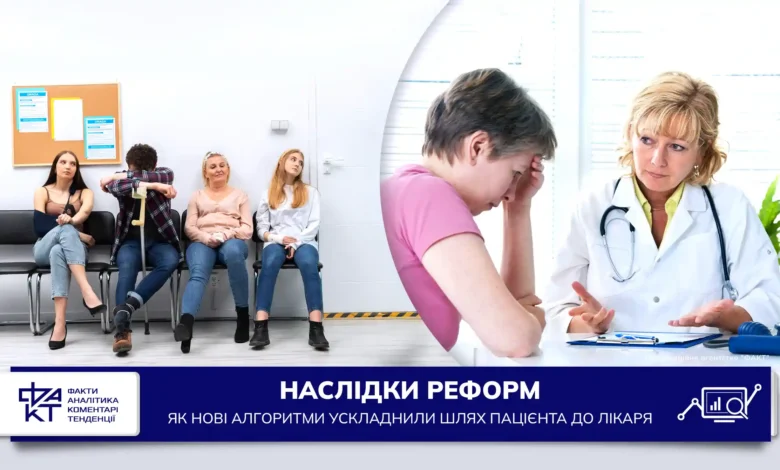
Recent years have been marked by a series of reforms aimed at optimizing and digitizing state and municipal services. After each high-profile reform in Ukraine, a new stage begins — a test of endurance for Ukrainians who have to deal with the way things are now. And if on paper the innovations look like forward movement, in practice it often turns out to be the opposite: a simple visit to the doctor turns into a long, tiring procedure with online queues and electronic referrals. As a result, people face a situation where they are effectively left without timely access to professional help. At the same time, the doctors themselves admit that instead of easing the burden and bringing services closer to people, they got additional administrative distance and endless conflicts.
Limits of competence or limits of absurdity
An appointment with a specialized doctor in Ukraine today has turned into a real marathon, and not with a clear distance, but a path full of obstacles. The process begins with a queue to the family doctor, which can stretch for a week or more. But not everything is so simple, because one such visit is only one direction. If a consultation of several specialists is required, each direction requires a separate appointment and a new wait.
Next, the patient faces a long queue to see a narrow specialist, where the nearest date is often a month later or even later. For many, the only way out is turning to private clinics. But even there the situation is not always better: queues, high prices, delays in reception. The system, which should provide quick access to specialized care, in practice turns into a complex and exhausting process, and even serious symptoms do not guarantee a quick medical response.
Even yesterday, the family doctor could issue a referral for an MRI, CT or advanced tests without any problems. But starting from 2025, the usual route to examinations has become much more complicated. For example, to get a referral for a CT scan, even if the problem is already obvious during the initial appointment with the family doctor, the patient still needs to see a specialist.
Now the prime works in clearer ones within the framework. Referrals for abdominal or thyroid ultrasound, chest or limb X-ray, basic blood tests, Holter or gastroscopy are still the family physician’s responsibility. But if an MRI, CT scan, advanced lab tests, or lung function tests are needed, the route changes. In such cases, a referral can only be made by a specialized doctor who treats the patient according to a specific diagnosis. At the same time, he can write out only one referral, and to get another, you should make an appointment with him again.
Interestingly, the new restrictions came as a surprise not only to patients. Some doctors themselves found out about the changes already after they had faced with the refusal to pay for the service several times. Surprisingly, instead of official explanations, doctors have only discussions in internal chat rooms, personal guesses and attempts to understand how to act correctly in standard situations.
The reason for such changes was the updated rules of the National Health Service. They determined which examinations can be prescribed by a primary care physician, and which only a secondary level specialist can prescribe. This decision was explained by the need to avoid unnecessary research and streamline the referral process. While technically family doctors are still able to make referrals for almost all services, the National Health Service will no longer pay for them if they are outside their scope of competence.
It should be noted that there are no restrictions in the system, but there is a risk that the patient, not knowing about the new rules, will be refused or will be forced to undergo diagnostics at his own expense. NSHU explained its decision with the desire to streamline the process, reduce the number of unnecessary studies and avoid duplication. However, for many Ukrainians, this means another step in the long way to the necessary examination, as well as untimely receipt of medical assistance in the event of serious health problems that require an urgent solution.
These changes affected not only the approach to the organization of care, but also the trust between the patient and the doctor. The established scheme of interaction stopped working as all the participants in the process were used to. That is why such innovations increasingly become the cause of conflicts. Patients are used to everything being resolved through the family doctor and demand an examination, but doctors are confused because they have not yet received any official explanations, and the system itself has become overloaded with misunderstandings. They say that they are forced to issue referrals for examinations that are not included in the approved list, just to avoid a conflict in the office. People do not believe in change, are indignant and demand the usual. And then they face rejection already at the level of a specialist. The referral is not repaid, the examination is not performed, and everyone remains dissatisfied.
In addition, doctors are accused of “footballing” even though they are only following the new routing of patients. As a result, we have another problem, when responsibility is distributed among everyone, and there is no clear system of verification and automatic protection against errors.
Probably, in order to avoid misunderstandings and save time, the system should either block the creation of incorrect referrals, or at least warn about the risk of non-payment. Unfortunately, such a mechanism does not exist now. A doctor can write a referral that looks legitimate, but from the point of view of the National Health Service, it is not subject to financing.
Legal boundaries that patients do not see
Confusion with who exactly should issue referrals did not arise yesterday. But in 2025, it manifested itself especially acutely, when patients began to be massively refused referrals for MRI, CT or other complex examinations, and doctors threw up their hands without a clear explanation.
It has long been prescribed in laws and by-laws that the referral should be issued by the doctor who actually treats the patient. Everything that the NSZU is announcing now is, in fact, only an attempt to remind about the already valid norms. Also, the law clearly states that a doctor who does not just examine, but participates in the full process from diagnosis to treatment, is considered a doctor. It can be both a family doctor and a narrow specialist, but everyone works within their specialty. For example, if a patient presents a problem that requires the involvement of a neurologist or pulmonologist, then these specialists should make decisions about further diagnostic steps. In this case, the family doctor is no longer a doctor, but only provides an initial consultation and directs further.
In many cases, patients continue to turn to primary care physicians with a request to write out a referral for examination to narrow specialists, but from the point of view of the law, this is an excess of authority. A family doctor does not have the right to direct a person to research that is beyond his professional competence. Such actions can create risks for the doctor himself, because he can be accused of exceeding his powers or improper actions.
So, the essence of the new clarifications of the National Health Service lies in the unification of approaches: who is responsible for what and at what stage in the patient’s medical route. The idea is that the patient does not have to find out on his own who to contact and where to get this or that signature – the system should operate transparently, with a clear division of roles between doctors. However, the problem is that these changes were not explained to doctors or patients in a timely manner.
A game of endurance: a patient in a maze of referrals
The situation with the new referral rules is more and more reminiscent not of a reform, but of classic bureaucratic football, in which the ball becomes the patient. The rules of the game are changed “from above”, without worrying too much about how it works in reality in live offices, with queues, human pains and non-obvious symptoms.
Now, instead of a direct path to a narrow specialist and examination, the patient is forced to go around in circles, spend weeks, or even months, to “go the route” as the National Health Service sees it. Instead of receiving a diagnosis and treatment, people find themselves in a never-ending game of referrals. Meanwhile, the disease does not wait. Diagnosis is delayed, the condition worsens. In the worst cases, all this red tape can cost lives. But there is no one in the system who is personally responsible for this loss. The decision was made collectively, and responsibility remained blurred.
In medical practice, there is no “average patient” that can be included in one regulation, because each case is individual. However, bureaucratic logic tries to fit everyone under one model. In such conditions, the doctor is faced with a choice: either to maintain loyalty to the system, or to the patient sitting across from him.
In addition to problems with the new referral rules, the Ukrainian medical system at the level of primary and specialized care faces a number of other difficulties that directly affect the quality and availability of treatment. Even if the patient received the correct referral, a new stage begins, namely the search for a specialist and waiting. In many state polyclinics, an appointment with a narrow specialist is scheduled for several weeks, in some areas certain specialists are simply not available. Therefore, people are forced to go to another city or contact private clinics, where the cost of admission may be prohibitive for many.
Limiting the number of referrals that a family doctor can make during one visit also becomes a real obstacle. Often, the patient needs to undergo several examinations at once or consult with several specialists. But according to the rules, a doctor can prescribe only one referral at a time. For the next one, you need to sign up again, wait again, and waste time again. This makes the situation especially difficult for the elderly, patients with chronic diseases and those living in rural areas.
We should not forget about the doctors themselves, especially at the primary level, who work at the limit of their physical and moral capabilities. By data According to the survey “Research on the psychological well-being of patients and medical workers in health care facilities” conducted in 2024, recently, such negative states and emotions as tension (55%), fatigue (53%) and confusion (22%) prevail among workers in health care facilities.
The highest level of tension is observed among doctors aged 51 to 65 (58%). The lowest rate is noted among younger workers aged 19 to 35, where 46% of respondents noted stress. And it is not surprising, because in many polyclinics, one family doctor treats more than 2,000 patients. In addition to direct consultations, the doctor maintains documentation, makes referrals, works with the electronic system and simultaneously faces emotional pressure and aggression from confused patients. Such a regime does not contribute to the accuracy of diagnosis or the quality of patient management.
The situation is difficult in the cities, but it is even worse in the villages and small OTGs. There is a lack of even basic laboratory services. Often, in order to take a routine blood test or do an ECG, the patient has to travel tens of kilometers. If the examination is scheduled by a specialized specialist, the route may stretch for several days with interruptions in transport and the lack of a convenient record.
Due to difficulties with access to free care, more and more people are turning to private doctors without a referral and official registration in the system. Often this happens “bypass” for cash, without entering data into eHealth. Thus, a person actually falls out of the official system, and the state does not see a real burden on medicine. This deepens the imbalance and distorts the statistics that should affect the distribution of funding.
At the same time, the eHealth system itself still does not work stably. During peak hours, it “drops”, referrals disappear or are not picked up, and doctors cannot complete the visit. Patients wait for several hours or leave without documents. And although this has already become a common part of medical everyday life, it does not solve the systemic problem.
All these complications are superimposed on each other, creating the impression of a dead end. A patient seeking care must navigate a maze of restrictions, delays, and inconsistencies to qualify for an examination. Here, the issue is not the quality of medicine, but its availability, responsibility, and system management imperfections.
Unfortunately, all the above-mentioned problems have already ceased to be exceptional failures, turning into symptoms of a systemic crisis, despite the slogans of officials – “everything for the people.” The reform, which was intended to make medicine clearer, more transparent and more convenient, in practice created confusion, mistrust and fatigue. Both the doctor and the patient found themselves in a situation where correct actions do not guarantee a result, and the logic of medical care gives way to instructions without explanations. In such conditions, the main thing is lost — speed, efficiency and humanity. Health cannot wait for a system-agreed route. And the longer this administrative game of “who has the right” continues, the more losses there will be that cannot be compensated by any statistics.