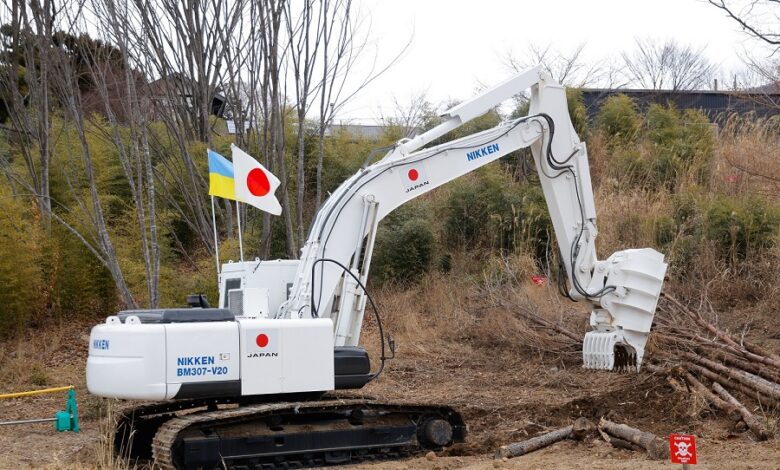
Ukraine received modern equipment for soil research and sampling within the framework of the Emergency Rehabilitation Program of Ukraine (JICA), which is implemented by the Government of Japan.
The Institute of Soil Protection of Ukraine has been replenished with more than 100 units of specialized equipment. Among the received items are gas chromatographs, atomic absorption spectrometers, an electronic total station, acid cleaning systems, automatic soil samplers, generators, pickup trucks and other equipment. This set is primarily intended for the restoration of agricultural work in the deoccupied territories. The equipment transfer took place on October 14 in Kyiv.
The event was attended by Deputy Minister of Economy, Environment and Agriculture of Ukraine Denys Bashlyk, Ambassador Extraordinary and Plenipotentiary of Japan to Ukraine Nakagome Masashi, Acting Director General of the Soil Protection Institute of Ukraine Oleksandr Galushchenko, and Acting Chief Representative of JICA in Ukraine Kotaro Tanaka.
“Japan’s support is not just technical assistance, it is an investment in the restoration of Ukrainian agriculture. Japan is helping us restore the land, literally bringing it back to life. This is a contribution that will be felt by Ukrainian communities, farmers, everyone who works on this land, which has been suffering from war for years. Your support, friends, partners, is invaluable” – emphasized Denys Bashlyk.
The Ambassador of Japan, Nakagome Masashi, emphasized that the agricultural sector is the foundation of society and the economy of the state. He noted that Ukrainian agriculture is of great importance for world food security. Therefore, Japan will continue to provide assistance to Ukraine.
Let us recall that the Japanese government constantly provides technical, financial and resource support to Ukrainian agricultural producers. JICA is implementing a grant program for the emergency restoration of the agricultural sector of Ukraine. In addition, farmers in front-line regions were given seeds for sowing in the amount of $ 1.5 million.