
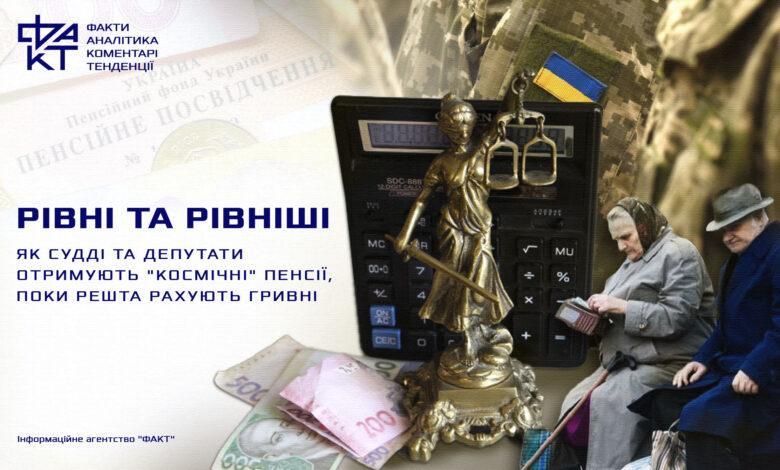
The pension system in Ukraine long ago turned into an explosive mixture of ridiculous coefficients, unfair calculations and chronic ignoring of those who really need support. People work for decades, pay taxes, but in the end receive meager pensions that cannot withstand any criticism. Meanwhile, the privileged categories continue to receive pensions, the size of which cannot be explained by either common sense or economic logic.
This problem is not new, it is discussed, outraged, articles are written about it, but the mechanism remains unchanged. The authorities find excuses, but no changes happen. However, now, during the war, when the budget is torn between defense and social needs, this injustice has become even more pronounced. People who have worked for the country all their lives are forced to survive, while the system continues to work in the interests of those who have long been accustomed to receiving more.
“Golden” pensions of judges
Judicial pensions in Ukraine have long become a symbol of social inequality, and 2024 only strengthened this trend. As of the beginning of 2025, there are 3,908 retired judges on state welfare, and their average pension is currently UAH 107,040.28 per month. Such a respond provided by the Pension Fund of Ukraine at the request of Slidstvo.Info journalists. That is, if you calculate, it turns out that in 2024 the state budget of Ukraine spent about UAH 5,019,760,970 for the maintenance of retired judges, which exceeds the corresponding expenses of 2023, which amounted to UAH 4.4 billion. At the same time, it was previously reported that UAH 4.1 billion was spent on these needs in 2022.
Therefore, funding for the maintenance of retired judges increases every year. The allocation of funds from the state budget in 2024 was 600 million more than in 2023, which only confirms: even in wartime, the system provides the privileged categories with stability and financial comfort that millions of ordinary pensioners cannot count on. In conditions when the country is at war, and state resources should be directed to support the army and socially vulnerable citizens, such expenses look particularly absurd.
Here are some more interesting calculations. During the analysis of the register of court decisions, journalists managed to find out that the highest-paid retired judge receives UAH 390,184. However, the average judge’s pension today is UAH 107,040 per month. These are impressive 30 average pensions of ordinary Ukrainians, who receive a little more than 4 thousand hryvnias (as of 2024, the average pension in Ukraine was 4,723 hryvnias). That is, one retired judge receives monthly as much as 30 ordinary pensioners combined with the average pension. At the same time, more than 80% of pensioners receive payments that do not exceed UAH 5,000. This is many times less than the living wage for the disabled, which the government sets at UAH 2,361, but is actually insufficient for a normal life. In 2023, UAH 594.4 billion was spent on the pension provision of all Ukrainian pensioners. This means that payments for 3,908 retired judges took almost 1% of the country’s entire pension fund.
In addition, the judge’s pension of UAH 107,040 per month is 13 times higher than the average salary in Ukraine. For comparison, the average salary of a Ukrainian in 2024 was about UAH 14,000. This means that even working full-time, a person receives significantly less than a judge who has already left office. At the same time, individual judges receive payments of up to 200,000 hryvnias.
It should be noted that the resignation of a judge in Ukraine is not just a retirement, but actually lifelong financial maintenance at the expense of the state budget, which has a separate legal status. This detail allows you to avoid the general rules of pension provision and receive significantly higher payments. According to Article 138 of the Law of Ukraine “On the Judiciary and the Status of Judges”, men who have reached the age of 62 can receive either a pension under the conditions provided for in Article 37 of the Law of Ukraine “On Civil Service” or a monthly lifetime allowance. The choice between these two options is up to the judge. The amount of these payments is determined as a percentage of the judge’s salary and ranges from 50 to 90%, depending on his seniority. This means that even after retirement, the servants of Themis continue to receive funds that significantly exceed the wages of most working Ukrainians.
However, even if a retired judge has not yet reached the age of 62, he will still be paid a lifetime allowance. In particular, men born in 1955 and older are entitled to such benefits after reaching the age set for retirement: for those born before December 31, 1952, this age is 60. When such a judge reaches the prescribed age, he retains the right to choose between a monthly lifetime allowance and a pension according to state standards for civil servants.
What is particularly interesting is that the source of financing judges’ payments is not the Pension Fund, as for ordinary citizens, but the funds of the State Budget. This means that, in fact, retired judges receive their support at the expense of all taxpayers, while ordinary Ukrainians are forced to rely on an unstable pension system, where there is constant talk of a deficit and the need to raise the retirement age.
It is particularly egregious that the mechanism of lifelong monetary maintenance is often used as a tool to avoid the responsibility of judges for their wrongful actions. Ukrainian mass media have repeatedly recorded and covered cases when judges who appeared in corruption cases or made controversial or politically motivated decisions resigned, “caroled” millions, received bribes in cash, apartments, cars or even exotic vacations, acquitted criminals, “exonerated” each other from punishment. Privatized office apartments, luxurious estates, elite car fleets and bank accounts that do not correspond to official incomes – all this can be found in the declarations of Ukrainian judges. And you can also see how those who took away drivers’ licenses yesterday for drunken driving, today themselves get into loud accidents and don’t even appear in court. These cases are not exceptional, they are a systemic phenomenon. However, instead of being held accountable for their actions, they resign on time and receive a guaranteed lifetime allowance.
So, judges in Ukraine have long been a separate caste, which, instead of serving the law, often become heroes of scandals. Of course, not all judges who leave their positions have tarnished reputations. However, there is an obvious trend: those who find themselves at the center of scandals or who may lose their mantle due to violations, often hurry to “leave gracefully” – to retire with honor. And if for an ordinary citizen, a pension means years of waiting and minimal payments, then for the servants of Themis it is an opportunity to comfortably retire from work and instead of prison time, they receive a luxurious pension. At the same time, it should be noted that the more years they are in the mantle, the higher percentage of their salary they receive in the form of payments. That is, the system actually encourages them to hold on to their position until the end, and when the situation becomes threatening, to quickly go into “honorable retirement”.
Deputy pensions
The situation with people’s deputies is also indicative – while ordinary Ukrainians receive pensions that are only 30-35% of their average lifetime salary, former people’s deputies had much more favorable conditions. Until recently, the law “On the status of people’s deputy” guaranteed former deputies a pension of 60% of their salary. And it’s not just a share of their average income over the years of work – the payments were calculated from the current MP salary, which continues to grow. And the more current parliamentarians received, the higher their predecessors’ pensions became.
Even after the introduction of restrictions, the maximum pension for them is UAH 23,610 – several times more than the majority of Ukrainian pensioners who have worked all their lives in production, medicine or education. In order to retire, a Ukrainian must have at least 35 years of experience. Deputies often work in the Verkhovna Rada for only one or two convocations and can already count on a pension that is many times higher than the payments of ordinary citizens. In other words, the system is designed in such a way that the people who passed the laws provide for themselves as comfortably as possible in their old age, while ordinary Ukrainians receive payments that are barely enough for utilities.
Currently, the rules for pension payments to “servants of the people” have officially changed, but has the essence changed? Formally, deputies no longer receive pensions according to the former scheme, but their salaries remain so high that even after leaving parliament they have all the possibilities for financial stability.
Extremely eloquent example of this phenomenon is that the former People’s Deputy of many convocations, who appears in NABU’s investigation into the corruption of judges, Serhiy Kivalov, set an absolute record: after appealing to the court, his pension was increased 17 times – from 14 thousand to 246 thousand hryvnias per month. For comparison, this is almost 150 times more than the minimum pension on which most Ukrainians are forced to survive.
Kivalov appealed to the Pension Fund, demanding to raise his pension in accordance with the new salaries of deputies. When they refused, he filed a lawsuit in the Odesa District Administrative Court. Certificates about his salaries at the International Humanities University, which he himself heads, showed incredible figures: in October 2019, he received 84,000 hryvnias, and already in November – 442,000 hryvnias. Such a sharp jump in income allowed him to artificially inflate the pension calculation. At the same time, judge Mykhailo Kravchenko, who resigned after this decision, became the one who legitimized this pension absurdity. He obliged the PFU to carry out the recalculation without any restrictions. As a result, Kivalov’s monthly pension reached 246 thousand hryvnias, and for a year – almost 3 million.
It is significant that Serhii Kivalov still remains one of the most influential figures in the judiciary. For 19 years, he was either a member or chairman of the Supreme Council of Justice (later the Supreme Council of Justice), which effectively controlled the appointment and dismissal of judges. His name also appears in NABU investigations: in scandalous tapes with private conversations of judges of the District Administrative Court of Kyiv, Pavlo Vovk, the former head of this court, personally appealed to Kivalov to help block the work of the Higher Qualification Commission of Judges of Ukraine.
But it seems that the main “achievement” of Kivalov in the field of justice was that the judges provided him with a unique pension, which is an absolute anomaly and has no analogues in the pension system of Ukraine. Kivalov, who during Yanukovych’s time was called the “shadow curator of the judicial system”, having even now a long-term influence on the judicial system, used all possible loopholes to provide himself with record maintenance at the expense of the state. In fact, the system he spent years building and overseeing ultimately thanked him. And while ordinary Ukrainians receive meager pensions and hear about the deficit of the Pension Fund, Kivalov receives almost a quarter of a million hryvnias from the state every month – as a symbol that the law always works differently for “his” people.
Selective fight against pension inequality
In Ukraine, they finally began to talk about limiting the “space” pensions that certain privileged categories received for decades. The Ministry of Social Policy announced the reduction of the highest pensions in 2025, and more than 17 thousand pensioners were affected by these changes.
“The law on the state budget for 2025 approved the rule on the application in 2025 of restrictive coefficients to pensions that are 4 or more times the average pension in the country, or 10 subsistence minimums for disabled persons”, – the message says departments.
The reform proposed by the government introduces the so-called reduction coefficients for pensions, which are 4 times higher than the average level or 10 times higher than the subsistence minimum (23,610 UAH). This means that from 2025, a part of pensions worth more than UAH 23,610 will be gradually reduced. The higher the payouts, the higher the reduction factor. However, there is one caveat: first of all, payments to ex-military and security forces will be cut, but for some reason, judges’ pensions will not be significantly affected. It is the military, law enforcement officers, and rescuers, who have been performing their work at risk to health and life for years, who remain in much worse conditions than representatives of the judicial system.
And although the government stated that servicemen who participated in the war since 2014 will not be subject to cuts, the very fact that the system of restrictions is aimed primarily at those who actually defended the country, and not at those who made decisions in cabinets, looks like another attempt to avoid real reforms. Indeed, the pension system should have been reviewed a long time ago, but it had to be done systematically, not selectively. When the state budget allocates more than 5 billion hryvnias for the maintenance of retired judges, and for security forces and ordinary pensioners who have been paying contributions to the Pension Fund for years, there is not enough money – this is not a reform, but a farce.
Is the work of doctors, teachers, workers or rescuers less valuable than the work of judges and deputies? They save lives, raise new generations, support the country’s infrastructure, but receive penny pensions, which are not enough even for basic needs. Instead, those who make decisions in comfortable halls and offices ensure themselves a luxurious stay for decades to come.
The logic of payments to judges and deputies seems to be clear – high pensions should reduce corruption risks. But does this scheme work? Practice shows the opposite: bribes, shady deals and corruption scandals in the judiciary and legislature have not disappeared, and the people’s trust in it remains at an all-time low. It turns out that taxpayers’ money is spent on maintaining the judicial elite, but does not solve the problems of the system.
In a country at war, where the budget is torn between the critical needs of the army, medicine and social support, spending billions on ex-suds and MPs is absurd and contempt for the whole society. These funds should go to those who really need it – veterans, families of the dead, soldiers who risk their lives every day for the sake of Ukraine.
The pension system has been in need of a systemic review for a long time, but the government stubbornly ignores this problem. Every year, the gap between the “elite” and the majority only grows, and even a full-scale war did not change this gap, but, paradoxically, only increased it. So, the pensions of judges and deputies clearly demonstrate how the system of public administration is organized as a whole: for the privileged – exorbitant payments, legal loopholes, unwritten laws and guarantees of a carefree life, and for the rest of the citizens – bureaucracy, a deficit of the state budget and the Pension Fund, as well as a constant struggle for survival


