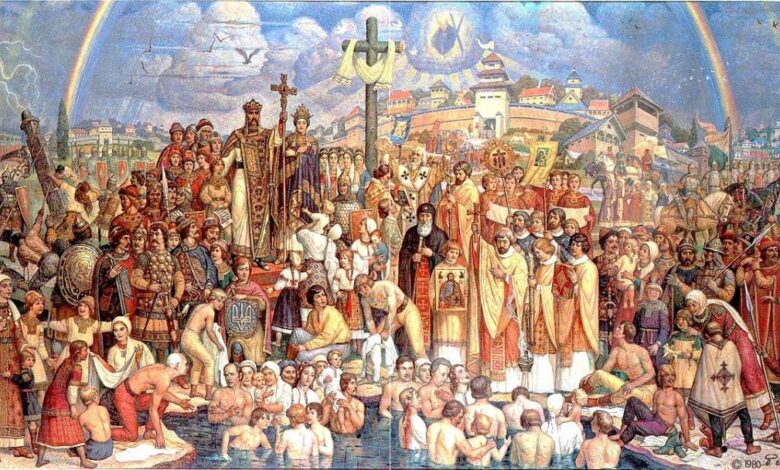
Several important holidays are celebrated on July 15: the Day of the Baptism of Kyivan Rus-Ukraine, the Day of Ukrainian Statehood, and the Day of Ukrainian Peacekeepers. World Youth Skills Day, established by the UN in 2014, is also celebrated on this day.
Baptism Day of Kyivan Rus-Ukraine
This year, Ukraine celebrates this day for the first time on July 15 due to the transition of the Orthodox Church of Ukraine and the Ukrainian Greek Catholic Church to the New Julian calendar. This holiday commemorates one of the most important religious events in Ukrainian history – the baptism of Kyivan Rus, which was initiated by Prince Volodymyr the Great. In 2024, the 1036th anniversary of this event will be celebrated, on this day, services in honor of Volodymyr the Great are held in churches.
This event became a key event in the history of Ukraine, opening a new stage in the formation of national identity and cultural development. Prince Volodymyr the Great converted to Christianity and baptized his people, which started a new era in the country’s history.
Until the age of 30, Prince Volodymyr was a pagan, but he realized that polytheism had exhausted itself. Many neighboring countries, including Byzantium, had already adopted Christianity. In 988, he decided that Christianity as the state religion would strengthen his power and unite the disparate tribes. It also contributed to Russia’s international prestige and cultural exchange.
The baptism of Russia began in Kyiv. Residents of the capital were baptized en masse at the confluence of the Pochayna River with the Dnipro. However, not all residents of Russia accepted the new religion voluntarily, and riots broke out in many territories. Many pagan customs have been preserved and intertwined with Christian ones.
This event significantly influenced the further development of the country, bringing new moral values, legal norms and cultural traditions that became the basis of Ukrainian identity.
Interesting facts about the baptism of Russia:
- Before Volodymyr, attempts to spread Christianity were made by Askold and Dir.
- Princess Olga, grandmother of Volodymyr, was the first among the rulers of Russia to convert to Christianity.
- Countries such as Iceland, Norway and Sweden were baptized later than Russia.
- Before baptism, Volodymyr led a promiscuous life and married many times.
- After baptism, the Cyrillic alphabet spread and the first written monuments appeared.
- Orthodox churches hold special services and ring bells on this holiday.
Ukrainian statehood day
The Day of Ukrainian Statehood was established by the decree of President Volodymyr Zelenskyi in 2021 and was celebrated for the first time in 2022. Initially, the celebration fell on July 28, but with the transition of the Orthodox Church of Ukraine to the New Julian calendar, the date shifted to July 15.
This day has its own symbol – four tridents, symbolizing struggle, independence, history and identity, disproving the myth of the youth of the Ukrainian state. Our coat of arms comes from the family sign of the Rurikovichs, which was used by Prince Volodymyr the Great.
Day of Ukrainian peacekeepers
Ukraine joined international peacekeeping operations in 1992, after the Verkhovna Rada of Ukraine adopted the Resolution “On the Participation of Battalions of the Armed Forces of Ukraine in United Nations Peacekeeping Forces in Conflict Zones in the Territory of the Former Yugoslavia.” The next day, the Minister of Defense of Ukraine signed an order on the formation of a peacekeeping unit. The 240th battalion was created in a record short time – in three weeks, from personnel gathered from various military units of Ukraine.
On July 15, 1992, two planes with the advance group of the battalion took off from the Dnipropetrovsk airfield in the direction of Bosnia. There were 42 servicemen in the group. After landing in Sarajevo, Ukrainian peacekeepers immediately found themselves in the epicenter of hostilities: the city and the airfield were shelled by artillery and snipers. At the beginning of the mission, as a result of the mortar shelling of the airfield and our artillery radar complex, seven servicemen were seriously injured. Unfortunately, Senior Lieutenant Serhii Topikha died of his wounds in the hospital. Despite the difficult conditions, our peacekeepers performed their tasks efficiently, conducting more than 800 convoys with humanitarian cargo in four months.
The Ukrainian military not only defends its own land from the aggression of the Russian Federation, but also performs tasks in the hottest spots of the world. Their participation in international peacekeeping operations strengthens the authority of Ukraine as a reliable partner on the world stage.
Our peacekeepers performed combat missions in the countries of the former Yugoslavia (Bosnia and Herzegovina, Eastern Slavonia, Macedonia, Serbia and Montenegro, Croatia), in Africa (Angola, Sierra Leone, Liberia, Ivory Coast, DR Congo, South Sudan, Darfur ), in the Middle East and the Caucasus (South Lebanon, Tajikistan, Kuwait, Iraq, Georgia) and in many other regions of the world. 58 servicemen of the Armed Forces of Ukraine gave their lives while performing peacekeeping tasks.
Since independence, more than 45,000 Ukrainian servicemen have participated in peacekeeping operations in more than 25 missions in different regions of the world and in 18 countries. Today, our peacekeepers participate in two international peacekeeping operations under the auspices of the UN and NATO as part of two national contingents.
Events of this day
1015 – Grand Duke Volodymyr the Great of Kyiv died.
1228 – Pope Gregory IX canonized Francis of Assisi.
1240 – Alexander Nevsky won a victory over the Swedes in a battle later named after him.
1410 – Battle of Grunwald between the troops of the Teutonic Order and the united army under the leadership of Prince Vytautas and King Jagail.
1663 – King John II decided to organize a campaign in Ukraine.
1683 – the army of the Ottoman Empire surrounded Vienna.
1776 – the “La Scala” theater opened.
1783 – the first steamship was launched in France.
1799 – the Rosetta Stone was found.
1916 – Ilya Mechnikov, winner of the Nobel Prize in the field of physiology and medicine, died.
1920 – Kyiv Pedagogical University was founded.
1959 – the premiere of the film “Only girls in jazz”.
1975 – the first joint flight of Soyuz-19 (USSR) and Apollo (USA) spacecraft.
July 15, 1606 world-famous Dutch artist Rembrandt Harmens van Rijn was born in His name became synonymous with the great master, and his work on biblical themes influenced the development of painting in the following centuries.
Interesting Facts:
Rembrandt is known for his exceptional use of chiaroscuro (a technique of contrasting light and shadow), which gave his paintings depth and drama.
Rembrandt worked in a variety of genres, including portraits, historical and biblical scenes, landscapes, genre scenes, and still lifes. The artist left behind more than 700 paintings and many other sketches, glorifying the Creator with his talent and influencing the development of painting in the following centuries. During his lifetime, Rembrandt created more than 90 self-portraits, giving us an insight into his appearance, emotions and the development of his technique over the years.
One of Rembrandt’s most famous works is “The Night Watch” (1642). This painting is known for its dynamic composition and use of light to emphasize key figures.
In addition to painting, Rembrandt was a talented engraver. His engravings are considered masterpieces of graphic art and had a significant influence on subsequent artists.
Rembrandt experimented with techniques and materials, particularly with complex layered brush strokes that gave his paintings unique texture and depth.
Rembrandt experienced numerous personal losses, including the deaths of three of his four children and his wife Saskia. These tragedies were often reflected in his works.
Despite his great success as an artist, Rembrandt faced financial difficulties. In 1656, he was forced to declare himself bankrupt and sell off his collections and house.
Rembrandt had many pupils, among whom were distinguished artists such as Hovert Flinck and Ferdinand Bol. They adopted his techniques and helped preserve his legacy.
Although Rembrandt experienced financial difficulties in his later years, his works continue to be highly regarded and are considered among the most important in the history of art. His influence can be seen in the work of many artists, both his contemporaries and subsequent generations.