Language Policy Between Violence and Identity: Why Bohdan Beniuk’s Statement Is a Wake-Up Call

Since Ukraine gained independence, the language issue remains one of the most sensitive and at the same time the most controversial. Since the beginning of the full-scale war, this debate has become even more acute. Many politicians, experts and cultural figures express the opinion that the Russian language should not just be pushed out of the public space, but also completely banned, resorting to harsh sanctions against those who use it. However, are such methods capable of forcing those for whom it was natural from birth to abandon their language? Can radical measures change the linguistic identity of society, and will they create new traumas instead of healing?
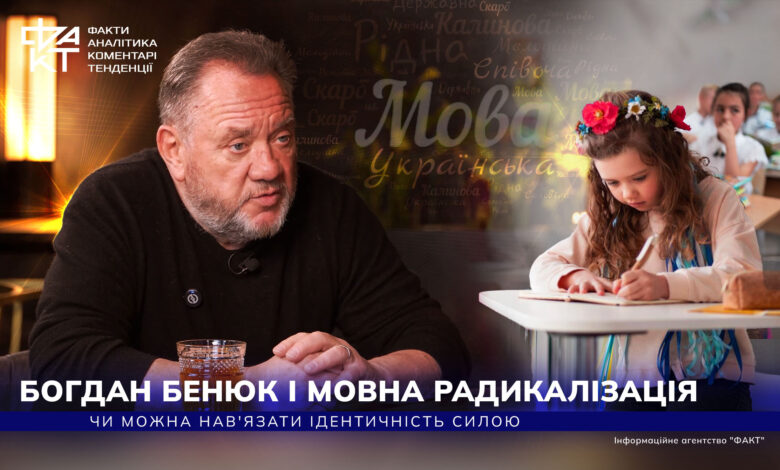
We have to look for answers to these questions in the context of the statements of the Ukrainian actor Bohdan Benyuk, who proposed methods of violent influence on children in order to eradicate the use of the Russian language. It is his words, as well as the broader issue of the permissibility of force in language policy, that require careful analysis today.
When the rod becomes an argument: Bohdan Benyuk and the language issue
When calls for violence come from the mouths of politicians or experts, society knows how to react with caution and caution. But when such ideas are promoted by a Ukrainian theater and film actor, former deputy of parliament, People’s Artist of Ukraine, director and artistic director of one of the country’s leading drama theaters – the Kyiv Academic Drama Theater in Podil, the situation takes on a fundamentally different dimension. Bohdan Beniuk is a public figure, a representative of Ukrainian culture, a person who should form values and ideas for thousands of viewers and listeners. And that is why his words that children should be beaten with a rod, and Russian-speakers should be poured with contempt and spit in their faces, cannot remain outside of a serious analytical assessment.
Benyuk spoke about the language issue from the standpoint of forced eradication.
“You take a rod. And damn it with a rod, so that he forgets forever and ever that there is a Russian language… Fight with them, fight with them, beat with a rod, beat the elders on the head with a bottle from under the water” — this is his recipe for fighting for the Ukrainian language among children, which he expressed in an interview.
It is clear from the context: it is not about hyperbole or an emotional metaphor, but a very real proposal for the use of physical punishment of children as a tool for the education of linguistic loyalty. And this is the first danger. Beniuk, endowed with the status of an authoritative cultural figure, legalizes violence not only as a tool to fight against dissent, but as a norm for raising children. In a country where, for the fourth year in a row, children are experiencing the trauma of war, losses, bombings, evacuations and severing of family ties, violence is not a theoretical threat for many, but a daily reality. In these conditions, the call to beat a child for his language is not just cruelty, but an attempt to deepen trauma, to consolidate through fear and humiliation the idea of linguistic identity.
Even more troubling is that Benyuk’s statement is not random or taken out of context. It fits perfectly into a broader trend that is gaining momentum in part of Ukrainian society: the radical imposition of linguistic uniformity at any cost. The stigmatization of those who speak Russian since childhood turns into socially sanctioned bullying. The actor advises to spit in the face of those who dare to speak in Russian. He suggests boycotting them, showing public contempt, forcing linguistic identity through humiliation and aggression. And this is no longer a problem of a separate interview, but a mirror of social division, which instead of unification works to divide.
Against this background, the duality of the rhetoric of Bohdan Benyuk himself is particularly hypocritical and revealing. He claims that Ukrainians have an infantile attitude towards war and that every citizen should be ready to serve in the army.
“As a Jewish state, we need to be very strong: everyone should be able to own a weapon, everyone should be able to serve in the army, this is a duty for both women and men.” he declares.
At the same time, his son, Bohdan-Gordiy, received a reprieve, studying in graduate school, majoring in “theatrical business organization.” In November 2024, Beniuk said in an interview that his son was finishing graduate school and working in the field of acting and production. Therefore, military service did not become an urgent duty for the Benyuk family, despite the cynical rhetoric of appeals to others. It turns out that this is a task for other Ukrainians. This contrast between words and actions clearly outlines the problem of double standards: others must be prepared for war and sacrifice, but when it comes to one’s own family, there are options.
It should be mentioned that in 2014, Bohdan Benyuk was at the center of several high-profile scandals, which revealed the unattractive aspects of his political and social activities. At his own creative evening in April 2014, Benyuk was greeted not with applause, but with rotten tomatoes. Spectators chanted “Shame!” and demanded that he submit the mandate of the People’s Deputy. This became a public reaction to the episode, which a few weeks before caused a wide public outcry: the forceful pressure of a group of people’s deputies from VO “Svoboda”, among whom was Benyuk, on the head of the First National TV channel Oleksandr Panteleimonov.
Then Beniuk, together with his party colleagues, broke into Panteleimonov’s office and forced him to write a resignation letter. This incident, recorded on video, caused a wave of indignation in society. Protest actions were held under the walls of the General Prosecutor’s Office of Ukraine with the demand to bring to justice the members of the Freedom Party for self-governance and physical pressure on an official. Among the demands, there was not only criticism of specific actions, but also a general question: can a person who himself resorts to forceful methods remain in public service.
Against this background, another revealing episode was Benyuk’s public position regarding the statements of the leader of “Svoboda” Oleg Tyagnibok. On the air of the “112 Ukraine” channel, in a conversation with journalist Alisa Batsman, the actor was reminded of Tyagnibok’s old performance, where he called “Muscovites and Jews” “evil”. When asked directly whether he was ashamed of such words, Bohdan Beniuk said that he fully justified these statements. He added that there was, in his words, “a grain of truth” in the opinion expressed at the time, and that these things should not be “pedaled” all the time.
This position clearly demonstrates Benyuk’s consistency: both in matters of force pressure and in assessments of xenophobic rhetoric, he not only does not distance himself from radicalism, but also tries to legitimize it. The justification of public images based on the national character and the support of forceful methods of political pressure form the image of an actor for whom political identity has priority over individual rights and standards of civilized behavior. Taken together, all these episodes show not individual random mistakes, but the consistent logic of the cultural figure’s actions. And it is precisely this logic that allows Bohdan Benyuk to call without a doubt to beat children because of their language. For him, forceful pressure, physical humiliation, justification of enmity is an accepted practice for a long time.
It is indicative that Bohdan Beniuk is not an ordinary commentator, he represents the state theater, receives recognition and awards, and has an influence on cultural policy. That is why it is important to analyze his words not as an emotional breakdown of the actor, but as a symptom of a dangerous social trend: the search for simple solutions through violence where the complex work of culture, education and civil mutual respect is needed.
When a public figure responsible for educating the taste and values of the Ukrainian audience says this, it is no longer a matter of personal opinion. This is a demonstration of how part of the cultural milieu is beginning to promote violence as a way of language politics. His statement is not a single excess, such ideas are gradually spreading in the public space. And the fact that the Ministry of Culture has not yet evaluated Bohdan Benyuk’s statements is an eloquent testimony to this. Official silence looks like an agreement or refusal to acknowledge the scale of the problem.
National composition of Ukraine and language policy
Ukraine has always been a country where different peoples coexisted in a common space without rigid divisions based on language or ethnicity. More than 30 national communities live on its territory, including Gagauz, Azov Greeks, Austrians, Roma, Jews, Czechs, Cubans, Nigerians, Crimean Tatars, Krymchaks, Karaites, and Caucasians. Moreover, Ukrainians make up the vast majority of the population in all regions of the country, with the exception of Crimea (until 2014), where the share of Russians exceeded 50%.
Regions of compact minority residence have their own established history: Crimean Tatars in Crimea, Romanians and Moldovans in Bukovina, Hungarians in Transcarpathia, Bulgarians and Gagauz in Odesa region, Bulgarians and Greeks in Azov region. At the same time, there is a large share of Russians in the east and south of Ukraine, which is the result of historical migration processes during the times of the Russian Empire and the Soviet Union. The statistics clearly show the dynamics of the ethnic composition of the population of Ukraine:
- in 1897, there were 72% Ukrainians, 8.8% Russians, 9% Jews, and 4.4% Poles;
- in 1989, Ukrainians made up 72.7%, Russians – 22.1%;
- in 2001, 77.8% were Ukrainians, 17.3% were Russians.
Despite the war, Ukrainian society today remains multi-ethnic and multilingual. And this diversity should not be a threat to the state, but its resource, because in Ukraine people of different ethnic origins perceive Ukraine as their home, not a temporary place of residence.
It should be noted that the Russian language is a real and integral element of the language map of Ukraine. According to the latest population census conducted in 2001, 14.27 million citizens of Ukraine named Russian as their native language, that is 29.6% of the population. Moreover, 44% of this number were not ethnic Russians. Now the situation has changed both demographically and in relation to the Russian language. However, it has long ceased to be the language of only the Russian minority, and has become the language of part of the Ukrainian population — those who, by origin, family traditions and environment, grew up in a bilingual or Russian-speaking environment.
Even in 2024, after everything experienced in the war, the data of the “Rating” survey show that 59% of Ukrainians speak Ukrainian at home, 12% – Russian, and another 28% – both languages. At the same time, in the west of Ukraine, Ukrainian absolutely dominates (93% communicate only in Ukrainian), in the center – 67% speak Ukrainian, but 25% use both languages. In the south, 22% speak Russian at home, and in the east – 25%. At the same time, half of the residents of the east identify themselves as bilingual. These are data that are difficult to ignore or reduce to a simple division into “own” and “others”.
Moreover, according to the KMIS survey in April 2024, 38% of Ukrainians believe that the Russian language should be studied in schools in one form or another. And this is not a statistical error, but a clear signal that even today, a large part of the citizens see the Russian language not as the “language of the enemy”, but as part of their life space, a language that came to Ukraine long before the war began.
Against this background, the calls of “patriots” to beat children for using Russian look like direct aggression against part of Ukrainian society. Children do not choose which language to speak at home, they are born into an already formed environment where the language is part of the family culture. To punish for this means to punish for the circumstances of birth.
It is important to know real historical examples that demonstrate that violence in language policy does not work. Thus, in 19th-20th century France, children were forbidden to speak Breton, Occitan, and Alsatian in schools. They were punished with humiliation, fines, sometimes corporal punishment. As a result, instead of love for the French language, there was distrust of the state, parallel cultural movements for autonomy and the preservation of native languages.
In Ireland, after several centuries of being forced to use English, the majority of the population switched to English in everyday life. But the Irish language remained a symbol of national resistance, despite official bans and repression.
In Spain, during the Franco regime, the Catalan language was banned. Only Castilian could be used in schools and public institutions. The policy lasted for decades. However, after the fall of the dictatorship, the Catalan identity recovered with new strength, and the language problem remained a source of deep division in Spanish society.
All these examples prove: imposition does not work. Fear does not create identity, and beatings do not instill respect. Just the opposite – an attempt to ban a language by force inevitably generates resistance even where it did not exist before. As you know, “forbidden fruit is always sweet.”
That is why the approach to language policy proposed by Bohdan Beniuk and his associates is destructive. Attempts to impose linguistic uniformity through violence are not only dangerous, they pose a direct threat to the internal stability of our state. Linguistic terror, persecution for using one or another language in everyday life, discrimination against children — all this will inevitably lead to the marginalization of some citizens, division within the country and loss of trust between different population groups. Does Ukraine need it?
The real situation at the front shows how artificial attempts to foment a linguistic divide in the rear are. On the front line, Ukrainian soldiers — Ukrainian-speaking, Russian-speaking, bilingual — stand side by side. There is no language issue, but only a common enemy and goal. Ukrainian soldiers, regardless of the language of everyday communication, equally protect the state. Linguistic identity is not an indicator of patriotism at the front. Today, people are fighting for Ukraine on the front line, for whom Ukrainian may be their first, second or even third language, but for whom Ukraine itself is an undoubted value.
Therefore, the imposition of a single language model through coercion in peaceful regions, while this issue does not even exist in war, looks like an attempt to weaken society from within. Instead of uniting through shared values, screening based on language is proposed. This is a short-sighted policy that threatens to create new lines of division at a time when the country should be as consolidated as possible.
In the conditions of war, our country has a unique opportunity to carry out natural humanitarian integration, and the Ukrainian language is already gradually turning into a real symbol of statehood without the need for violence. That is why Ukraine needs a reasonable language policy: one that stimulates the transition to Ukrainian not out of fear, but out of pride and opportunity. A policy that protects the rights of Ukrainians of any origin and opinion does not work through coercion, but through respect. Because it is precisely respect for the diversity of the people that is the factor that will make Ukraine stronger, not weaker.