Managed uncertainty: what the Ministry of Education and Science is launching from September 1 under the guise of educational reform

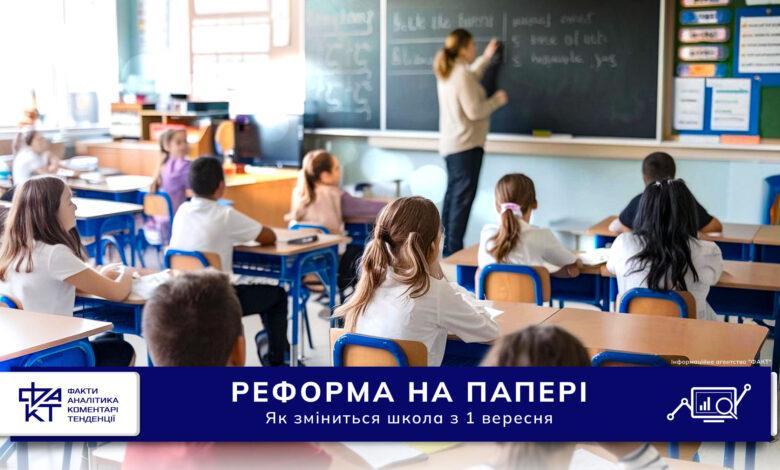
The Ministry of Education and Science of Ukraine once again “pleased” the educational community with a new reform, but do not rush to applaud. Let’s imagine a marathon for a moment. But not the one where runners in the same uniform with numbers overcome the track with a bottle of water and clearly marked kilometers. And a marathon with an uneven surface, a different length of the distance for each participant, without a map of the route and even without a guarantee that the finish line exists at all. This is what the reform of school education, which will start in September 2025, may look like. The Ministry of Education and Science promises to update the content of education, textbooks, principles of teacher training and make school closer to life. It sounds like a new start, but are the participants of this “race” – principals, teachers, students and parents – ready for the fact that the road will not be flat, but winding, and some of them will not have shoes at all? Before we begin to reap the fruits of the beginning of the “educational breakthrough”, it is worth soberly assessing what awaits us at this distance.
Textbooks, programs, teachers: the three pillars of the 2025 reform
So we will start on September 1, 2025 from the system renewal, which relate to several areas at once: content of educational programs, approaches to teaching and mechanisms of professional development of teachers. The Ministry of Education and Culture emphasizes that the purpose of the changes is to transform the educational process into a more relevant, practically oriented and open to the needs of both students and teachers. This time, 5th and 6th grade students were targeted by experts from the Ministry of Education and Science. It is these links that will become the starting point for the introduction of updated programs and modern teaching methods.
The MES does not hide the fact that there is still a noticeable gap between what children learn in class and what they can actually apply outside of school. In order to reduce this distance, they plan to better adapt the material to the students’ age capabilities, to emphasize the development of critical thinking, ability to work with information, communicate, use technology and tools of the digital age. The content of the courses should be more in line with the realities of modern life, and not remain in the past. The idea is for students to see why they need this knowledge and how it can help in real situations, starting with everyday tasks and ending with choosing a future profession.
The update will also affect textbooks and not only in terms of content, but also in terms of the very principle of their creation. The Ministry of Education intends to revise the approach to the preparation of educational materials, making the process more open and closer to those who actually use these books, that is, to students and teachers. Feedback from the educational environment is promised to be taken into account at the development stage, not after the fact. Author teams should work more flexibly, taking into account changes in science, society, and even the information space. This should help to get rid of outdated phrases, clichés and patterns that are still found in educational literature. The new textbooks are planned to be positioned not just as a source of facts, but as a working tool for the development of logic, critical thinking and the ability to interact. It is planned to make the textbooks able to meet not only the formal requirements of the program, but also to be really useful here and now.
The MES did not forget about teachers, promising them an individualized format of professional development, which, according to officials, will give them more autonomy in choosing educational resources. Instead of centralized lists of “mandatory” courses, teachers are promised to be given a personal budget — funds that they can manage independently. From now on, the teacher will be able to choose which training programs he really needs. These can be courses, trainings or professional events that meet his real needs. The money goes not to the institution or the departmental list, but directly to the student. Officials strive to make the process of teacher development more flexible, individual and practical without excessive bureaucracy and imposed topics. The ministry promises that detailed rules for the use of these funds will appear closer to the beginning of the academic year.
As you can see, according to the plan of the Ministry of Education, the school should gradually turn into a space where learning is connected with real life, and the development of the student and the teacher will become equal components of the educational process. At first glance, everything looks modern, flexible and logical. However, in practice we risk running into many pitfalls.
The textbook is a challenge, not a support
One of the most sensitive aspects of the new wave of changes will be the updating of school textbooks. It is planned to revise the content and principles of creating training manuals, and this already raises questions. Formally, everything sounds convincing: author teams will participate in the creation of new textbooks, which will focus on current events, challenges of war, digital reality and the need to develop critical thinking. However, who exactly will be these authors, how the quality of the content will be evaluated, and, most importantly, who will be responsible for the practicality and relevance of this content still remains a big question. Without a clear mechanism of external examination and independent quality control, it is easy to slide into another wave of impractical, theory-laden textbooks with beautiful covers. Teachers have long complained that even after previous updates, textbooks often remain disconnected from reality. In addition, there are no guarantees that the new books will reach schools on time. Therefore, teachers can again be left alone with new requirements, but old materials, as has happened more than once in Ukrainian educational history.
Curricula: between good intentions and the blackboard
The 5th and 6th grades became the focus of updates. It is at this stage, according to the plan of the reformers, that the new content of education will be tested. Instead of theoretical lectures, practical cases will be offered, instead of cramming – interdisciplinary integrations, and instead of “tick” lessons, they will create tasks that supposedly prepare them for life. However, a good idea has a chance to turn into an educational experiment if the reform turns out to be ill-conceived at the level of implementation. Teacher training, methodical support, and performance evaluation should go hand in hand with changing programs.
If each component moves in its own way, we will get even more confusion. I still remember the transition to the standards of the New Ukrainian School, when the poor teachers wandered between different standards and programs, keeping in their heads which classes should be taught according to which standard. In addition, the very fact that the reform is being launched in only two classes shows the caution of the Ministry of Education and Culture. At the same time, the officials themselves recognize the magnitude of the risks, and therefore have found themselves “guinea pigs” among future fifth- and sixth-graders. It is likely that the system will not be ready for such field testing.
Teachers with new money but old problems
One of the most atypical initiatives for the Ukrainian system is the teacher’s financial autonomy in choosing courses for professional development. Now each teacher will receive an individual educational budget, which he can spend on certifications, trainings or thematic courses. And all this will happen without the intervention of education departments or school administrations.
Theoretically, this approach opens a new era of professional freedom. But at the same time, it raises several difficult questions. It was not explained to us how the quality of the courses will be checked and who and how will control the expenditure of budget funds. It is still unknown which structures will be able to provide these services, and whether a market of “educational shakes” will emerge that will only imitate development. One important nuance should not be ignored either. For many teachers, this new space of freedom may turn out not to be a gift, but an additional source of stress, because they will have to independently search, analyze, choose and be responsible for deciding which courses to choose. The problem is that most teachers do not have real experience in choosing educational services in a competitive market. Educators are used to the fact that the district and district will indicate when and where exactly the necessary courses for professional development should be taken in order to gain those valuable hours. And then, immediately without warning and familiarization with all the necessary criteria, they tell you, “fly, stork, fly far.”
It is obvious that the need to “reform the school” sounds logical now, but it is worth recognizing the different starting level of schools in different regions. If access to technology, the Internet, and alternative resources is more or less stable in urban institutions, rural schools often work under conditions of personnel and infrastructure shortages. They will inevitably face serious challenges of the need to retrain teachers in a short period of time, review schedules and organizational logic of the educational process, and adapt to new textbooks, which will probably appear during the school year and will not be available to everyone immediately.
This school reform will affect everyone and, first of all, those institutions where there is a lack of personnel, lack of modern equipment or isolation from educational innovations. We are talking about rural schools, low-staffed institutions, lyceums with a small staff resource. In such conditions, even the best initiatives run the risk of suffocating in routine. It is clear that without additional logistical, methodical and financial support, the reform will remain a declaration from the offices of the Ministry of Education and Culture, and not a classroom reality.
On the other hand, schools that already work according to modernized principles, with flexible schedules, project approach and modern material base, will really get new opportunities for development. They will be able to pick up the reform and use it to their advantage. And yes, this is very good, but we should not forget about the equality of all participants in the educational process. It is impossible not to recognize the fact that education cannot continue to function according to the schemes of the 90s.
However, the reform, which will start in September 2025, will not be just an inspection for schools. It will show whether the educational system itself is capable of learning, developing and being flexible. We may indeed be on the verge of a major upgrade. But instead of pathos, we all really need specifics, and instead of slogans, honest analytics. Otherwise, according to the next wave of reports, we will be showered with real changes in the classroom, where the teacher and the student will again drown in a multitude of incurable problems, not seeing the meaning in what they do every day. Once again, I would like to remind officials from the Ministry of Education and Culture that their next reform is very similar to a marathon. And unfortunately, not every school today has the shoes to overcome it.
The planned changes demonstrate good intentions: to bring education closer to life, to give freedom to teachers, to make school a place of development, not just instruction. However, practical implementation depends not so much on beautiful slogans, but on the ability of the Ministry of Education and Culture to take into account risks, a variety of conditions and feedback from below.