
Mandatory English in kindergartens: between state ambitions and the psychophysiological limits of preschoolers

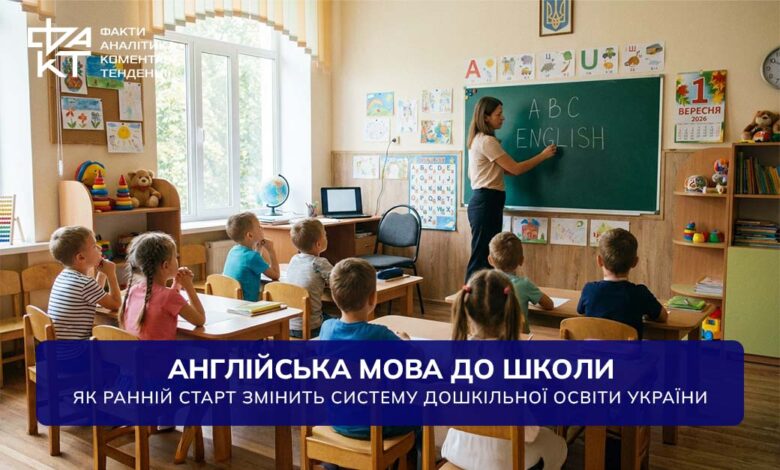
While parents of toddlers are just planning their children’s first steps to school, the systemic transformation of the Ukrainian educational landscape is already taking on clear legislative contours. From September 1, 2026, English will officially transform from an optional subject to a mandatory element of the program for children of senior preschool age. Instead of fragmentary study of individual words, officials are introducing a holistic approach focused on five- and six-year-olds, while from the age of three, a foreign language will gradually be integrated into the educational process of preschoolers. Lawmakers believe that this will allow laying a solid foundation of linguistic competence even before the child first sits down at a school desk. Such a decision looks like an ambitious civilizational leap, but behind the beautiful wording in the laws are hidden problems that are already causing heated discussions among parents, teachers, and psychologists.
What the new initiative entails
From September 1, 2026, all preschool educational institutions in Ukraine will be required to include English in the educational program for children of senior preschool age, as this is stipulated by the laws “On the Use of the English Language in Ukraine” and “On Preschool Education”. According to the document, from the age of three, a foreign language will be gradually integrated into the educational process of preschoolers, and children aged five to six will necessarily master English in kindergarten.
The implementation of this large-scale plan requires not only updating the programs, but also serious staffing, which is regulated in detail by the order of the Ministry of Education and Science of June 12, 2025 No. 844. According to the updated staffing standards, a specialized position of English teacher is being introduced in kindergartens, and the calculation of the workload is based on an indicator of 0.25 staff units for each senior group. Such an architecture of resource distribution allows one specialist to effectively supervise several children’s groups, providing professional support for the educational process without excessive financial pressure on institutions. Thanks to this approach, a qualified teacher becomes part of the daily life of the kindergarten, which guarantees the quality of teaching that differs from amateur circles.
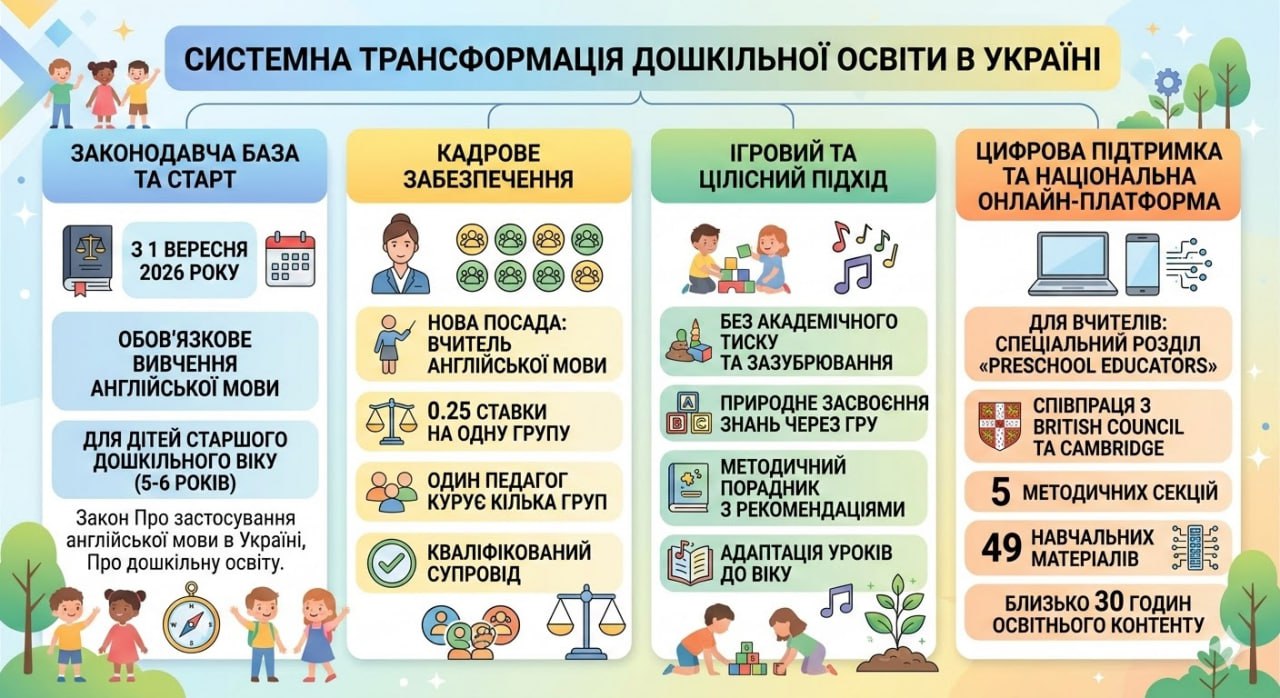
The methodological foundation of the innovation excludes any academic pressure, as experts rely on the natural assimilation of knowledge through play and emotional involvement. For the successful adaptation of teachers to working with young children, a thorough methodological guide was created, which offers: ready-made lesson planning scenarios, as well as tools for the soft formation of language skills.
This document explains in detail how to adapt complex language structures to the age characteristics of preschoolers, using game mechanics instead of traditional memorization. The main goal is for the child to perceive English as a natural communication tool, integrated into entertainment, songs and creative exercises.
It should be noted that digital support for the pedagogical community is carried out through a specialized national online platform developed by the Ministry of Education and Science in close collaboration with the British Council and Cambridge University Press & Assessment. Within this resource, there is a specialized section “Preschool Educators”, which accumulates international experience in early language learning and offers teachers 49 detailed educational materials. The structure of the platform includes 5 methodological sections and approximately 30 hours of rich educational content, which has been carefully adapted to the psychological needs of Ukrainian children. Such a synergy of global expertise and local requests creates conditions under which each teacher receives access to the highest quality tools.
As educational officials note, the psychophysiological feasibility of such an early start is confirmed by numerous studies that identify preschool age as the most favorable “window of opportunity” for learning foreign vocabulary and phonetics. It is during this period that the child’s brain has a unique plasticity, which allows it to easily adopt authentic pronunciation and memorize language structures without visible intellectual effort. According to them, by implementing this norm, Ukraine joins the circle of European countries where a foreign language in the playroom is the norm, modernizing the entire system of preschool education. This step opens up broader horizons for a new generation of Ukrainians, making them an organic part of the modern open world.
Neuroplasticity vs. Speech Therapy: The Main Dilemma of Early English
The discussion around mandatory English for five-year-olds today resembles a clash of two fundamental paradigms: ambitious neurobiology and harsh speech therapy reality. On the one hand, we have an undeniable scientific fact: preschool age is a period of peak neuroplasticity, when the brain works as a super-powerful “neural architect”, creating billions of connections every second. The involvement of a foreign language at this time acts as a cognitive stimulant, forcing both hemispheres to work in synergy, training memory, auditory selectivity and the ability to quickly switch between tasks. For a modern child, early bilingualism is nothing more than an investment in the flexibility of thinking, which in the future is converted into higher concentration and speed of mastering any complex systems.
In addition, by integrating English into the playroom, the state is effectively eliminating long-standing social injustice, when only students of private centers had access to a high-quality linguistic base, while the public sector remained captive to outdated standards.
However, the greatest concern is the risk that this large-scale project may turn into a form without content, where instead of real knowledge we will only get tired children who have not yet had time to master the articulation and logic of their native language, and are already forced to learn foreign constructions. There is a real danger that in the absence of a sufficient number of teachers who not only know English, but also possess the subtle art of working with early childhood, the reform will get stuck at the level of formal attendance at classes.
If officials fail to find a balance between the ambitions of the state and the psychophysiological limits of a five-year-old child, this step risks becoming another imitation of success, where children, despite the “mandatory hours,” will never speak English, but instead will receive excessive intellectual overload at the very beginning of their lives.
In addition, on the other side of the scale is an alarming signal from speech therapist practitioners, who daily record an increasingly lower level of mastery of the basic phonetics of their native language. A natural question arises: are we not trying to build a roof on a high-rise building while the foundation of native speech still has cracks? Opponents of early start rightly point out the risk of forming superficial knowledge, when without a proper language environment, children can mechanically reproduce lexemes like parrots, without understanding their contextual meaning, which will turn learning into a formality.
However, the problem is not in the English language itself, but in the methodological sequence and format. If the training turns into a dry academic training, we will get a double fiasco:
- deepening of speech therapy defects due to ignoring the base of the native language;
- formation of aversion to learning, where the child will feel unsuccessful in both language areas.
Another stumbling block remains the personnel architecture, where the calculation of 0.25 rates per group requires the teacher to be highly mobile and able to instantly adapt to different teams, which in the conditions of personnel shortage in the regions can lead to the involvement of random people without specialized pedagogical training. After all, in the school environment, the practice is very common when, due to a significant shortage of foreign language teachers, principals were forced to give classes to non-specialized specialists, which significantly affected the level of students’ knowledge.
Early bilingualism in Europe: which preschool methods work best
Analyzing the European educational space, one can see that mandatory immersion in a foreign language from the age of five has long since turned from an experiment into the foundation of a state strategy in countries such as Poland, Estonia, or Austria. The Polish model, which is one of the closest to the upcoming Ukrainian reform, introduced a mandatory foreign language for all preschool children back in 2017, emphasizing “language readiness” instead of academic exams. The Polish experience shows that integrating English into everyday games and the educational process of kindergarten allows children to naturally get used to different phonetics, which greatly facilitates the subsequent transition to primary school.
Of particular interest is the example of the Scandinavian countries and Germany, where language learning is based on the concept of “immersive accompaniment”, when the teacher uses English phrases during ordinary everyday processes: breakfast, a walk or creative activities. In many federal states of Germany, educators use the “one person – one language” method, which helps children clearly distinguish between language systems and avoid the confusion that speech therapists often warn about. This approach does not create additional intellectual pressure, since a foreign language is perceived by the child not as a separate discipline, but as another natural way of communication, which stimulates the development of cognitive flexibility.
Table 1. Comparative table of European methods of preschool linguistic didactics
| Country | Main method | Essence of the approach | Level of adaptability for Ukraine |
| Poland | “Language Readiness” | Focus on getting used to phonetics through daily rituals. Teachers do not require knowledge of grammar, only recognition of words in the context of the game. | High. Most similar to the planned Ukrainian model with a position of 0.25 rates. |
| Germany | OPOL (One Person, One Language) method | Each teacher communicates with children in only one language (the teacher – in their native language, the English teacher – only in a foreign language). This prevents language mixing. | Intermediate. Requires a high level of language proficiency from the teacher so as not to switch to Ukrainian during classes. |
| Estonia / Finland | CLIL Preschool (Integrated Learning) | Using English during physical education, drawing or sculpting. Language is a tool for performing another action. | High. It goes well with Ukrainian methodological recommendations for game activities. |
| Scandinavian countries | Immersive support (Linguistic Immersion) | Complete absence of translation. The child understands the meaning through gestures, facial expressions and visual materials, as when mastering their native language. | Medium. Requires specific psychological training of personnel to avoid stress in children at the initial stage. |
The effectiveness of these models in Europe directly depends on systematic training of personnel, because in Estonia or Finland, preschool English teachers take specialized courses in linguodidactics, adapted specifically to the psychology of early childhood. The use of common standards developed in partnership with Cambridge University or the British Council ensures high quality content, which Ukraine is now trying to implement through its own online platform. International practice proves that, provided that the “school” format is abandoned and the focus is on game mechanics, early bilingualism becomes a powerful tool for intellectual development, which does not replace the native language, but expands the horizons of perception of the world.
As we can see, the key to the success of the 2026 reform lies exclusively in the plane of game integration. English should not become an academic subject, but background accompaniment – through rhythm, songs and movement, where the emphasis is not on the correct pronunciation of complex sounds, which is the competence of a speech therapist, but on the passive perception and recognition of the melody of the language. Only such a “soft” input will allow us to preserve the neurobiological advantages of an early start, without destroying the fragile process of forming native speech.
It is quite clear that Ukraine is betting on long-term intellectual capital, trying to synchronize national education with the rhythm of the modern world. However, the effectiveness of this step will not be measured by the number of words learned, but by whether the system manages to maintain a balance between ambitious legislative enforcement and a caring attitude towards the child’s psychological comfort.


