
Ukrainians call for conferring the title of “Hero of Ukraine” on Stepan Giza: between honoring the singer and devaluation of the highest state award

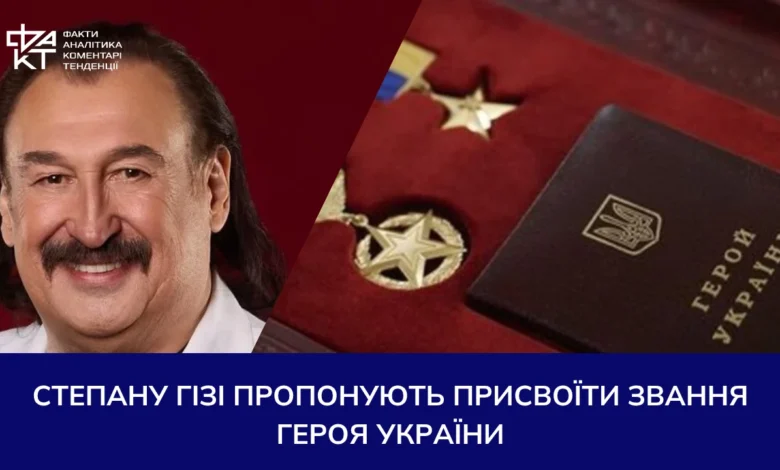
The appearance on the website of the Office of the President of the petition on the award of the title “Hero of Ukraine” posthumously to People’s Artist Stepan Giza, which gained the required number of votes, immediately provoked a lively discussion in society. While some consider this a worthy honor for the singer, others see it as a dangerous precedent that devalues the essence of the highest state award. We are on the verge of a substitution of concepts, when sincere sympathy for the work of artists and nostalgia for the hits of past years are equated with heroism. The title Hero of Ukraine is a state award, the highest degree of distinction, which is awarded to citizens for performing a significant heroic deed or outstanding labor achievement. However, awarding it for stage merits blurs the line between honor and heroism.
Heroism or professional integrity: why the petition about Giga sparked lively discussions
The lively discussion around the initiative to award Stepan Giza the title of Hero of Ukraine is a real mirror of a deep value crisis in the system of state awards. Some Ukrainians actively support awarding the title to their beloved singer, believing that he deserves it. However, another part of society believes that in times when the nation pays for its sovereignty daily with the blood and health of its citizens, an attempt to equate stage activity with the act of self-sacrifice on the battlefield looks like a dangerous symptom of the devaluation of the highest state recognition. Traditionally, the status of a Hero, especially with the awarding of the “Golden Star”, in the mass consciousness is reserved for those who cross the limits of human capabilities in conditions of mortal risk, so the transfer of this arsenal to the plane of show business is negatively perceived by many.
The figure of Stepan Giga is at the peak of official recognition, as he holds the highest professional title – People’s Artist of Ukraine, which, according to the logic of the state hierarchy, is the final point in assessing creative contribution. The attempt to add the title of Hero to this list resembles a desire to double recognition, which calls into question the very weight of previous regalia and creates a strange legal and ethical tautology. The singer’s biography does not contain any recorded acts of direct heroism, such as saving people or performing combat missions under fire, and his many years of loyalty to Ukrainian culture, although an important and respectable work, still remains within the framework of professional activity.
The author of the petition, Halyna Papazova, is trying to translate the discourse into the plane of “spiritual stability”, arguing that a decade of service to Ukrainian song is commensurate with the highest award for the defense of the state. The argument that Giga has been resisting the systematic displacement of Ukrainian products by Russian-speaking surrogates for decades is indeed correct in the context of cultural self-identification, but it blurs the line between high-quality professional work and an extraordinary achievement that changes the course of history. If every successful and popular professional activity that helps a nation hold on is labeled as “heroism,” then the very concept of feat is devalued.
This question sounds extremely acute against the background of the fact that hundreds of real defenders who receive serious injuries or give their lives in war often remain unnoticed by award committees or wait for recognition for years.
Which Ukrainian stars have the title of “Hero of Ukraine”
Over the decades, the institution of Ukraine’s highest state award has turned into a bizarre mirror of national history, where gold stars for sacrifice border on State Orders awarded for dubious political maneuvers or industrial achievements of past eras. When we leaf through this honorary list, a real cultural anthology appears before our eyes, where, next to the tragic fate of Vasyl Stus, whose life was cut short in Soviet camps due to his indomitable spirit, the names of those who built the pop foundation of independence coexist. Stus’s posthumous recognition in 2005 was an act of belated state redemption, while the awarding of figures such as Ihor Poklad in 2021 emphasized the continuity of generations through his legendary music for “Cossacks” and dozens of musicals that have become part of our genetic code.
The artistic pantheon of heroes of Ukraine is striking in its versatility, because here is the magical voice of Nina Matvienko, the popularity of Sofia Rotaru, the noble baritone of Dmytro Hnatyuk, and the folk sincerity of Raisa Kyrychenko. Each of them at one time received the highest award of Hero of Ukraine for enriching the spiritual treasury of the country. A special place in this row is occupied by Vasyl Zinkevich, the enigmatic man of the Ukrainian stage, who, together with Volodymyr Ivasyuk and Nazariy Yaremchuk, once made Ukrainian song extremely popular. However, Ivasyuk and Yaremchuk received their stars only posthumously, as if the state was trying to catch up with time and repay the debt to those who burned out too soon, but left behind an immortal legacy of the level of “Chervona Ruta”.
This list becomes even more emotional when the name of Andriy Kuzmenko appears on it, whose death became a personal tragedy for millions, and the award in 2020 is a symbol of the fact that you can be a hero simply by remaining “your” person, speaking the truth to the face. Along with him on the list are such intellectual giants as Ivan Dzyuba, a dissident and literary critic who analyzed modern culture until his death on the eve of a full-scale invasion, and Ada Rogovtseva, whose acting talent became a standard of dignity for an entire nation. No less significant is the contribution of Yuriy Rybchinsky, whose words for decades became songs that the whole country sang, not always even realizing who was behind these lines.
At the same time, the famous poet Lina Kostenko refused the title of “Hero of Ukraine”, explaining this with the words: “I don’t wear political jewelry!”.
“Heroes of Ukraine” with a dubious reputation: which politicians and businessmen received the title
In Ukraine, there is a long-standing practice when the title of “Hero of Ukraine” is received by businessmen with a dubious reputation or those involved in corruption scandals. It is difficult to realize that the same award belongs to the deceased poet-patriot, and to such odious figures as Vyacheslav Boguslaev (Motor Sich) and the unchanging people’s deputy Yuriy Boyko, whose names are today inextricably linked with the pro-Russian vector or cases of high treason.
When we see next to the names of the fugitive businessman Konstantin Zhevago (Ferrexpo), who is suspected of creating a criminal organization, legalizing income and illegal mining of ore, and Crimean collaborators, Oleksandr Batalin or Borys Deich, it becomes clear that the status of Hero of Ukraine has long been used as a bargaining chip in the political games of past decades.
Today, this list resembles a battlefield for meanings, where the title of “Hero of Ukraine” was awarded to a representative of the UOC-MP, Metropolitan Longyn, who was awarded in 2008 for charity, despite his scandalous statements against Ukraine, or Volodymyr Lytvyn, whose award raised many questions in society. Among the Heroes of Ukraine are also Petro Poroshenko, Viktor Topolnytskyi (“Livarny Zavod”), Oleksandr Slobodyan (“Obolon”), Mykhailo Reznikovich – the former director of the Lesya Ukrainka Theater, who supported pro-Russian positions and moved to the Russian Federation, Boris Deich – the late regional deputy who supported the annexation of Crimea, and others.
Award as a Reputation, Not a Privilege: Why Western Systems Work Differently
The global practice of honoring outstanding cultural figures demonstrates a completely different approach to defining the role of an artist in the hierarchy of state values, where instead of the title of “Hero of Ukraine”, there are extensive systems of titles and orders. Instead of a unified status, foreign institutions offer differentiated awards, each of which has its own historical continuity and specificity of recognizing creative contribution.
Great Britain preserves the tradition of transforming a successful artist into a part of aristocratic society through the granting of the titles of knight-bachelor or dame, which allows Elton John, Paul McCartney or Anthony Hopkins to officially use the prefixes “sir” or “dame” before their names. An interesting example is Angelina Jolie, who received an honorary title as a foreigner, which emphasizes the flexibility of the British award system in assessing global humanitarian impact. However, the true pinnacle of recognition is considered to be the Order of the Chevaliers of Honor, an extremely hermetic community, the number of which is strictly limited to 65 people, which places the writer J. K. Rowling among the most influential intellectuals of our time.
In the United States, the highest expression of state gratitude is the Presidential Medal of Freedom, which the head of the White House presents for an exceptional contribution to the cultural life of the nation or other significant state efforts. Along with the National Medal of Arts, this award fixes the names of Steven Spielberg, Meryl Streep and Bob Dylan as figures who have shaped the modern American code.
At the same time, France uses the authority of the Order of the Legion of Honor, founded by Napoleon Bonaparte, to recognize cultural leaders of the level of Charles Aznavour or Jean-Paul Belmondo. It is characteristic that the French Republic actively integrates foreign geniuses into its honorary space, as evidenced by the awarding of Lina Kostenko in 2022 and Svyatoslav Vakarchuk in 2024.
Japan offers a unique paradigm for the perception of a creative personality through the system of “Living National Treasures”, where Kabuki actors, musicians and artisans are officially recognized as “Guardians of Important Intangible Cultural Values”. Unlike Western orders, this status does not simply record past merits, but imposes on the artist the mission of preserving traditions, which is reinforced by an annual state scholarship. This approach demonstrates state support aimed at the survival of unique techniques and knowledge.
Analyzing these systems, it becomes obvious that the Western and Eastern models of awarding are devoid of the social and everyday content that is inherent in the Ukrainian title “Hero of Ukraine”. If in our country the status implies benefits and payments, then abroad the award remains a symbolic capital, which is converted into reputation and public authority, and not material dividends. In addition, these systems are much less susceptible to political expediency, since they are based on a long-term career and world recognition, which makes the awarding procedure a natural result of a professional path, and not an instrument of loyalty to the current government.
The real problem is not whether a particular artist deserves the title of “Hero of Ukraine”, but in the collective unwillingness of Ukrainians to admit that professional integrity is not a feat. We have many heroic professions, when doctors, rescuers, risking their lives, work as energy workers. However, they are not heroes of Ukraine, but artists are heroes. Part of society is trying to canonize popularity, confusing emotional attachment to creative heritage with state recognition of truly heroic merits. If the highest award of the country becomes a “long service award” or “audience sympathy award,” it ceases to be a symbol of the nation.
Stage work cannot be equated with mortal risk at the front. By demanding the title of “Hero of Ukraine” for their pop idols, a part of society unknowingly commits an act of disrespect for those who are now giving their lives and health in the trenches and at the same time do not have this high award. Ukrainians must finally realize that full halls, applause, the titles of “Honored” and “People’s” Artist are the highest award for an artist, and the title of “Hero of Ukraine” should be awarded exclusively to those who have crossed the limits of human capabilities and distinguished themselves with a heroic act, often giving their lives for it.


