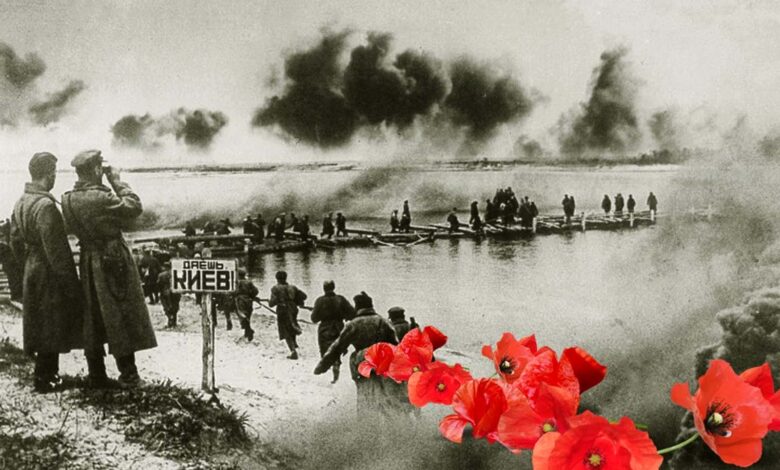
May 8 is the Day of Victory over Nazism in World War II and the Day of Remembrance and Reconciliation, as well as the International Day of the Red Cross and Red Crescent and Free Trade Day. On this day, world history combined political turning points, scientific discoveries, military events, disasters, cultural changes and decisions, the consequences of which were felt far beyond their eras.
Day of Victory over Nazism in World War II and the Day of Remembrance and Reconciliation
May 8 traditionally commemorates the end of one of the most terrible tragedies of the 20th century – World War II. This day has a double meaning: it is celebrated as the Day of Victory over Nazism and at the same time as the Day of Remembrance and Reconciliation. It is dedicated not only to victory, but also to deep sorrow for the millions of victims who were claimed by the global conflict of 1939–1945.
In 2004, the UN General Assembly proclaimed May 8 and 9 as Days of Remembrance and Reconciliation, recognizing these dates as the right of all peoples to honor the victims of war, regardless of which side of the front they were on. Thus, the world community focused not only on heroism, but also on tragedy. On this day, the memory of the civilian population who died during bombings, deportations, genocides, forced labor and hostilities is honored.
For Ukraine, this date has acquired special significance. Since 2015, our state has officially joined the European tradition and began to celebrate May 8 as the Day of Remembrance and Reconciliation. In 2023, the President of Ukraine Volodymyr Zelensky signed a decree stating that May 8 is celebrated as the Day of Remembrance and Victory over Nazism in World War II, and May 9 becomes Europe Day.
Ukrainians honor not only the millions who died, but also those who fought in the ranks of the Allies against Nazi Germany. The total human losses in World War II, according to various estimates, range from 50 to the most commonly cited 75 million deaths — both among the military and the civilian population. Of these, it is estimated that from 8 to 10 million were Ukrainians — that is, almost every fourth inhabitant of the then Ukraine, whose population at that time was approximately 40 million people.
Despite the fact that historians still do not agree on the exact number of Ukrainians who died in this war, the fact remains undeniable: millions of people fought against Nazism, and almost every Ukrainian family preserves the memory of the losses, suffering, and heroism of that time.
Now, in the conditions of a new full-scale war unleashed by Russia, this memory sounds especially acute. Ukraine is once again fighting an aggressor who is hiding behind symbols of “victory,” but is waging a war of aggression, destroying cities, deporting children, and justifying violence. Therefore, May 8 is not only a day of historical remembrance, but also a day of urgent rethinking of what the victory of 1945 was for.
Tragic facts
The official date of the end of World War II in Europe is May 8, 1945 — the day when Germany’s surrender came into effect at 23:01 Central European Time (00:01 Kyiv Time). That is why it was celebrated in the USSR on May 9.
The symbol of the Day of Remembrance and Reconciliation is the red poppy — a sign of mourning for the fallen and hope for peace. This symbol comes from the poem “In Flanders Fields” by Canadian military doctor John McCrae.
The war involved 80% of the world’s population and lasted 6 years.
Ukraine was one of the most devastated territories: 720 settlements were wiped out, and 10 million people were left homeless.
World War II was the bloodiest in human history: according to various estimates, from 60 to 85 million people died, more than half of them civilians.
In 1945, the surrender was signed twice in Berlin: first on May 7 in Reims, and then on May 8 in the Berlin suburb of Karlshorst at Stalin’s insistence.
Today, May 8 is officially celebrated in most European countries, the USA, Canada, Australia and Japan as the day of the end of hostilities in Europe. In France, it is a public holiday.
International Red Cross and Red Crescent Day
This day is associated with the activities of the international humanitarian movement, which helps people during wars, disasters, epidemics, famine and other emergencies. Its main idea is to protect the life, dignity and health of people regardless of their nationality, origin, religion or political views.
The day was chosen in honor of Henri Dunant, a Swiss humanist who, after the Battle of Solferino in 1859, was struck by the number of wounded soldiers left without help. His book “The Memory of Solferino” became the impetus for the creation of the Red Cross and the development of international humanitarian law.
Interesting facts
Henri Dunant was not a doctor or a soldier. He was an entrepreneur, but an accidental sighting of the Battle of Solferino changed his life and became the beginning of one of the most famous humanitarian movements in the world.
The first committee from which the Red Cross grew consisted of only five people. It was created in Geneva in 1863.
The symbol of the Red Cross originated as a reverse combination of the colors of the Swiss flag: a red cross on a white background instead of a white cross on a red background.
The Red Crescent began to be used in Muslim countries, because the red cross was often perceived as a religious symbol there, although officially it has no religious meaning.
Henri Dunant became the first Nobel Peace Prize laureate in 1901, but he spent most of his life after the creation of the movement in poverty and oblivion.
During the First World War, the Red Cross organized large-scale work on registering prisoners of war and searching for missing persons, which became one of the most important areas of its activity.
The Red Cross Society has a long history in Ukraine, and during the Russo-Ukrainian war, its volunteers helped evacuees, the wounded, the elderly, displaced persons, and families who had lost contact with loved ones.
One of the most important functions of the Red Cross during war is to restore family ties. The organization helps people search for missing relatives, relay messages, and obtain information about prisoners of war or evacuees.
The International Committee of the Red Cross has a special mandate to visit prisoners of war, but such work is possible only when the parties to the conflict grant access.
During the full-scale war in Ukraine, humanitarian missions often work in extremely difficult conditions: under shelling, near the front line, in places of mass evacuation, and in communities where people lack water, medicine, food, and basic medical care.
Free Trade Day
This day is dedicated to the idea of open international trade without excessive tariffs, restrictions and trade barriers between countries. Supporters of free trade believe that it promotes economic development, increased choice of goods, competition, investment and job creation. At the same time, discussions around this topic remain relevant due to risks for individual industries, dependence on imports and economic inequality.
For Ukraine, the issue of free trade is of great importance due to the export of agricultural products, metal, IT services and integration into the European market. The Association Agreement with the European Union and the Deep Free Trade Area were one of the country’s biggest economic steps after gaining independence. After the outbreak of full-scale war, the issue of international trade gained even greater importance due to the blockade of ports, new logistics routes and the dependence of Ukrainian exports on the support of partners.
Interesting Facts
One of the most famous symbols of the fight for free trade was the Boston Tea Party of 1773, when American colonists protested against British trade policies by dumping a cargo of tea into the harbor.
After World War II, many countries began to gradually reduce tariffs among themselves in order to avoid economic crises and trade conflicts that had often exacerbated international tensions in the past.
The European Union has created one of the largest common markets in the world, where goods can move between most countries without customs controls.
Ukraine is one of the world’s largest exporters of sunflower oil, and Ukrainian grain is supplied to dozens of countries on different continents.
After the start of a full-scale invasion, Russia blockaded Ukrainian seaports, which caused world grain prices to skyrocket and raised fears of a food crisis in some countries.
In 2022, the European Union temporarily lifted tariffs and quotas on Ukrainian goods to support the Ukrainian economy during the war.
World trade is heavily dependent on maritime transport: approximately 80–90% of the world’s goods are transported by sea.
Container shipping has changed the global economy so much that the standard shipping container is considered one of the most important inventions of the 20th century for international trade.
During the war, Ukrainian exports were partially reoriented to railways and Danube ports, which allowed small ports on the Danube to handle much larger volumes of cargo than before.
Some countries in the world still have very high import duties on certain goods to protect their own producers from cheaper foreign products.
Historical events on this day
1541 – Spanish conquistador and traveler Hernando de Soto reached the Mississippi River, which he called the “River of the Holy Spirit.” His expedition was one of the first major European voyages deep into the North American continent, although for the indigenous peoples these lands had long been a developed space with their own roads, settlements and trade.
1606 – the wedding of False Dmitry I with Marina Mnishek took place in Moscow. This marriage had not only personal, but also political significance, as the Polish noblewoman found herself at the center of the struggle for the Moscow throne during the Time of Troubles.
1660 – Charles II was proclaimed King of England, ending a long period of civil strife, republican rule, and political instability following the execution of Charles I. The restoration of the monarchy changed the balance of power in the state, but did not return England to the old model of unlimited royal power.
1713 – by decree of Peter I, the capital of the Moscow Kingdom was moved from Moscow to St. Petersburg. The new city was built as a “window to Europe,” and the transfer of the capital was intended to demonstrate Muscovy’s imperial ambitions and its orientation to the Baltic.
1773 – the ruler of Egypt, Ali Bey, a Mamluk of Abkhazian origin, died in an armed clash with the Ottomans. He tried to weaken Egypt’s dependence on the Ottoman Empire, but his political project ended in defeat.
1794 – In France, chemist Antoine Laurent Lavoisier, one of the founders of modern chemistry, was executed by guillotine. The reason for the persecution was his work in the tax office of the General Redemption, and a request to be given time to complete a scientific experiment did not save him from the sentence.
1838 – In Great Britain, the “People’s Charter” was published, a program of political demands of the Chartists. The document demanded wider suffrage, secret balloting and more equal conditions of representation, which made it an important stage in the struggle of British workers for political rights.
1842 – A passenger train carrying representatives of the French elite caught fire near Versailles. Due to the design of the carriages and the closed doors, many people could not escape, and the disaster became one of the worst railway tragedies of the time.
1846 – The American army defeated the Mexican troops at the Battle of Palo Alto. This battle was one of the first major clashes of the Mexican-American War, which later significantly changed the map of North America.
1847 – Scottish inventor Robert Thomson received a patent for a pneumatic rubber tire. His idea was ahead of its time, but such tires gained real mass importance later, with the development of bicycles and automobiles.
1886 – Pharmacist John Pemberton in Atlanta first sold his healing elixir, which later became known as “Coca-Cola”. The drink was initially sold in a pharmacy, and its formula was sold for $ 2,300 a few years later.
1892 – In the Congo, restrictions were introduced on the use of natural resources, in particular rubber and ivory, in settlements with other states. Such decisions became part of a harsh colonial system of exploitation of resources and the local population.
1895 – China ceded Taiwan to the Japanese Empire after its defeat in the First Sino-Japanese War. The transfer of the island was a consequence of the Treaty of Shimonoseki and the beginning of a long period of Japanese colonial rule in Taiwan.
1898 – Joshua Slocum completed the first solo circumnavigation of the world on the sloop Spray. His journey proved that one person could circumnavigate the world under sail, although the risks of such a voyage were extremely high.
1900 – Andrey Sheptytsky was appointed Metropolitan of Lviv. His ministry became an important part of the history of the Ukrainian Greek Catholic Church, Ukrainian cultural life, and the social self-organization of Galicia.
1902 – during the eruption of the Mont Pele volcano on the island of Martinique, a burning cloud destroyed the city of Saint-Pierre. Tens of thousands of people died, and the city itself, which was called the cultural capital of the island, practically ceased to exist in a few minutes.
1903 – the airship “Lebodi” made its first flight over a distance of about 37 kilometers. It became one of the early examples of controlled aircraft, which at the beginning of the 20th century were considered a promising direction in aviation.
1919 – the Central Russian People’s Council adopted the Uzhgorod Memorandum on the accession of Transcarpathia to Czechoslovakia. This decision became an important episode in the fate of Transcarpathia after the collapse of Austria-Hungary.
1923 – Great Britain presented the USSR with ultimatums, known as the “Curzon Ultimatum.” It was about stopping anti-British activities in the East and respecting international obligations, which caused serious diplomatic tension.
1926 – the first air flight over the North Pole took place. Polar flights were then not only a technical achievement, but also an element of prestige between states and researchers.
1933 – Mahatma Gandhi began a hunger strike against British rule in India and social discrimination. For him, hunger strike was a way of moral pressure and political protest without the use of violence.
1937 – President of Czechoslovakia Edvard Beneš sent a message to Stalin warning of a possible conspiracy among the top leadership of the Red Army. Soon, large-scale repressions against the military leadership began in the USSR.
1940 – German sabotage groups in the form of Dutch soldiers crossed the border and seized strategic bridges. This was part of the preparation for the Wehrmacht’s offensive on the Netherlands during World War II.
1942 – the Wehrmacht launched an offensive in Crimea. The fighting on the peninsula became one of the most difficult pages of World War II for Ukraine, and the defense and subsequent losses had serious consequences for the military and the civilian population.
1942 – 2,735 people were evacuated in the Coral Sea after the American aircraft carrier Lexington was damaged. This operation was one of the largest rescue operations at sea during the war.
1943 – the Warsaw Ghetto Uprising ended. It became one of the most famous acts of armed resistance of Jews to the Nazi policy of extermination, although the rebel forces were incomparably smaller than the German ones.
1944 – Adolf Eichmann offered the Allies an exchange of Hungarian Jews for trucks. This offer became one of the most cynical episodes of the Holocaust, when the lives of hundreds of thousands of people were tried to be turned into a bargaining chip.
1945 – in the suburb of Berlin Karlshorst, representatives of the German command, led by Wilhelm Keitel, signed the act of unconditional surrender of the German armed forces for the second time. The document came into force at 23:01 Central European Time and secured the end of the war in Europe.
1945 – in Setif, Helm and other areas of Algeria, French forces brutally suppressed anti-colonial demonstrations. The death of civilians was one of the factors that strengthened Algeria’s future struggle for independence.
1947 – France withdrew from the International Monetary Fund. This decision reflected the difficult financial and political circumstances of post-war Europe.
1949 – The parliamentary council in Bonn adopted the “Basic Law” of the Federal Republic of Germany. It became the constitutional basis of West Germany after World War II.
1951 – Ivan Drach published his first poem. Later, he became one of the most prominent Ukrainian poets of the sixties, who renewed literature and advocated for the cultural identity of Ukraine.
1952 – The trial of the leaders of the Jewish Anti-Fascist Committee began in Moscow. It became part of Stalin’s anti-Semitic campaign and ended with severe sentences for many of the accused.
1953 – The French tiltrotor “Sud-West SO 1310 Farfade” made its first flight in helicopter mode. Such aircraft were supposed to combine vertical take-off with the capabilities of an airplane, but technically remained very complex.
1954 – The Asian Football Confederation was created. It became the organizational center for the development of football in Asia and later united dozens of national federations.
1959 – The Canadian province of Ontario banned corporal punishment of prisoners. This decision was part of a gradual revision of penitentiary practice towards limiting physical violence.
1961 – In Great Britain, diplomat George Blake was sentenced to 42 years in prison for spying for the USSR. His case became one of the most high-profile spy stories of the Cold War.
1962 – The last trolleybuses in London stopped running. The city finally switched to a different model of public transport, although the trolleybus network was once one of the largest in the world.
1970 – The Beatles’ album “Let It Be” was released. It was the last studio album released during the band’s life as an active group, although some of the material was recorded before “Abbey Road”.
1973 – The 71-day standoff in Wounded Knee between the US federal authorities and members of the American Indian Movement ended. The occupation of the settlement drew attention to the violation of indigenous rights and unfulfilled treaties.
1976 – Swedish group ABBA with the song “Fernando” again topped the British charts and stayed at number one for several weeks. The song became one of the group’s most successful international hits.
1984 – The USSR Olympic Committee refused to participate in the Summer Olympics in Los Angeles. Officially, security issues were cited as the reason, but the decision was a political response to the boycott of the 1980 Moscow Olympics.
1984 – Dennis Lautier opened fire in the Canadian Parliament building, killing three people and wounding more than ten. The attack was one of the most serious security incidents in the history of the Canadian Parliament.
1988 – France held a second round of presidential elections, after which François Mitterrand received another seven-year mandate. His re-election consolidated the influence of the Socialists in French politics in the late 1980s.
1989 – The first issue of Gazeta Wyborcza was published in Warsaw. The publication became an important voice of Polish democratic change on the eve of the elections that accelerated the fall of the communist system in Poland.
1994 – Azerbaijan joined the ceasefire agreements in Karabakh. This was an important stage in ending the active phase of the First Karabakh War, although the conflict itself remained unresolved.
1996 – South Africa adopted constitutional amendments that established equal civil rights for representatives of all races. This was part of the dismantling of the legacy of apartheid after the country’s transition to democratic rule.
2004 – German police arrested the 18-year-old author of the computer virus “Sasser”. The virus infected hundreds of thousands of computers in different countries and showed how vulnerable the global digital infrastructure had become.
2021 – A car bomb exploded near a school in Kabul, killing dozens and injuring more than a hundred. The attack was particularly striking because the victims were mostly schoolchildren and civilians.
2025 – The Vatican elected a new Pope, Robert Francis Prevost, who took the name Leo XIV. He became the 267th Pope of the Catholic Church and the first pontiff from the United States.