The National Multi-Subject Test in Ukraine has been taking place in wartime conditions for several years, where the course of the exam can be affected by circumstances beyond the participant’s control. An air raid warning, a sudden power outage, an Internet outage, or a technical failure at the testing point can disrupt the normal pace of work, so for such cases, the UCEQA has provided a separate procedure. Its essence is that the applicant does not lose the chance to pass the test due to circumstances beyond his control.
What situations are considered force majeure
Tetyana Vakulenko, Director of the Ukrainian Center for Education Quality Assessment said that during the NMT, mechanisms are provided that allow either to compensate for lost time or to postpone testing to an additional session if it was impossible to complete or even start the exam within the main session.
During the NMT, force majeure circumstances primarily include technical failures, lack of power supply, problems with Internet access, as well as prolonged air raids. All of these factors directly affect the ability to perform tasks in the established mode, so the procedure for responding to them is determined in advance.
Separately, there are situations in which the delay lasts relatively short and testing can be continued after the problem is eliminated. This category includes, in particular, short-term network or electricity outages. At the same time, there are circumstances in which continuing the exam within the current session makes no sense, in particular, a long air alarm or blackout, due to which the test is actually stopped for an indefinite period.
What to do if the participant loses power or the Internet during the test
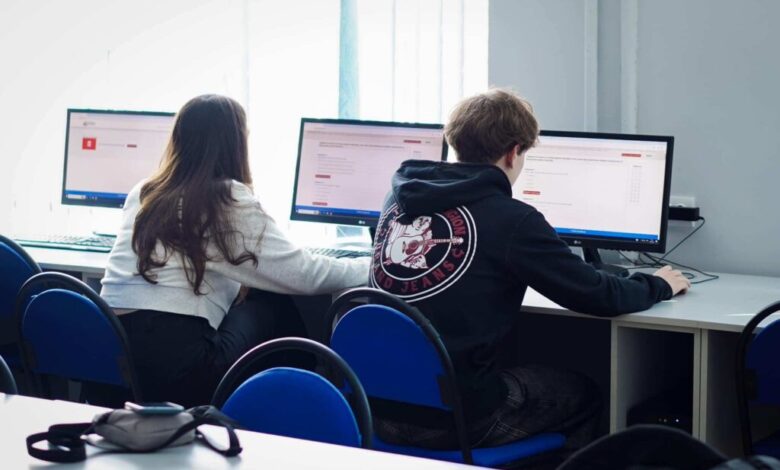
In the event of any problems in the classroom, the participant must immediately contact the instructor. At the same time, the examination center staff records the circumstances due to which the testing was interrupted or slowed down, so it is not worth keeping quiet about the problem or trying to wait for it to end on your own. The subsequent processing of the situation and the ability to protect the right to correctly pass the NMT depend on timely notification.
If the technical failure can be eliminated, the time spent on solving the problem is added to the total limit for completing tasks. This approach is necessary so that the applicant does not lose minutes due to interruptions that arose due to circumstances at the testing point, and not due to his actions or the pace of work.
In which cases can the test be postponed
The possibility of transferring the NMT to an additional session is provided for those situations in which it is no longer possible to continue testing within the main session. This includes, in particular, a long air alarm lasting more than 2.5 hours, or a blackout due to which the participant was unable to fully start or complete the exam.
In such cases, the applicant is entitled to one more attempt during the additional session. The idea of this mechanism is that the exam result should be determined by the participant’s knowledge, and not the scale of an external failure that completely changes the conditions for passing the test.
What is the procedure for submitting an application for an additional session
In order to get into an additional session, an applicant must submit an application to the regional center for the assessment of the quality of education. This is allocated three working days after the main session, so you should not delay submitting documents, since a missed deadline may complicate the consideration of the application.
The decision on admission is made by the regulatory commission, which takes into account the records in the examination center’s documents. That is why it is important that the circumstances of the failure, delay or interruption of the test are properly recorded on the day of taking the NMT. An additional condition is the cancellation of the previous, i.e. incomplete, result by the appeal commission at the UCEQA.
In cases where there are technical failures or a forced suspension of the test, documentary confirmation of what exactly happened in the classroom and how it affected the course of the NMT is of key importance. It is the examination center records that become the basis for further decisions, so the participant must act carefully and immediately report the problem to the staff.
Such a procedure is necessary in order to separate real force majeure from any controversial situations where there is no confirmation of the circumstances. For the applicant, this means a fairly simple rule: as soon as the test is interrupted due to electricity, the Internet or other technical reason, the problem should be voiced immediately, without pauses and hopes that everything will be resolved by itself.
Will there be generators at the testing points
The NMT testing points are created on the basis of educational institutions, so the issue of backup power depends on whether a particular school or university has its own sources of electricity. If such an institution is equipped with a generator or other backup power, it will be involved during the test.
At the same time, the centralized provision of each examination center with generators is not within the competence of the UCEQA. That is why the capabilities of different points may differ depending on the technical base of the institution where the NMT is organized.
It is most important for the applicant to understand a few basic things. If a technical failure occurs during the exam, the instructor should be immediately notified, since the time lost due to the problem can be added to the total limit. If the testing is interrupted due to a long alarm or a large-scale power outage that made it impossible to pass the NMT, the participant has the right to apply for an additional session.
This entire system is built on the fact that force majeure circumstances do not cancel the result of several years of training and preparation for admission. That is why during the NMT, calmness, attentiveness to the procedure, and timely contact with the staff who record the course of events at the testing point are important.