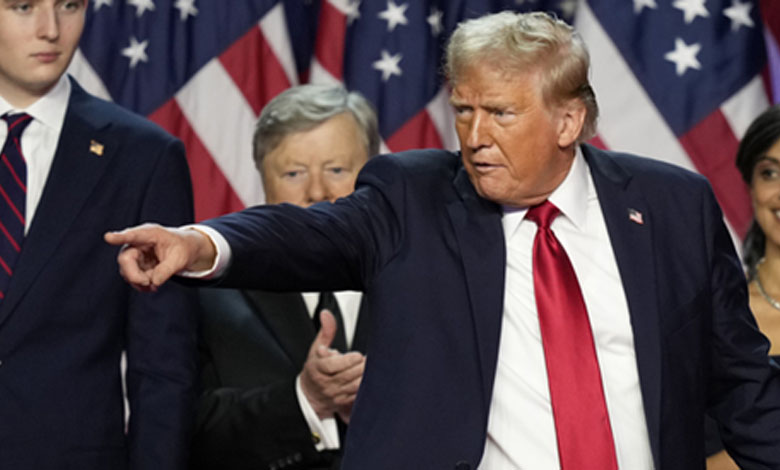
During his election campaign, Donald Trump made sure to look like a revolutionary in the energy industry. He doesn’t believe in global warming, he doesn’t see green energy as an important sustainable development challenge and, most importantly, he wants to appeal to voters who are currently suffering from high fuel prices. Trump assured that he would be able to halve them within a year. Therefore, the winner of the American elections sets himself an ambitious goal – to collapse oil prices, reduce bureaucratic restrictions and create favorable conditions for the development of the oil and gas industry in the USA.
At the same time, the impact of these Trump measures can reach far beyond the US. The plan of the Republican leader to lower oil prices to $30-40 per barrel can significantly change the global oil market. For Russia, which finances much of its military aggression against Ukraine with revenues from energy exports, this could be a major financial blow, causing a budget deficit and jeopardizing its military ambitions.
Is Trump ready to implement his plans, what steps are necessary for this, and what consequences will this have for the world economy and Kremlin policy? Let’s consider the possible scenarios of the development of events and the risks associated with them.
“Drill, baby, drill”
President-elect Donald Trump has repeatedly expressed his support for the US oil and gas industry.
His campaign slogan “Drill, baby, drill” not only went viral in the media, it signaled his intention to increase fossil fuel extraction and revise climate policy and regulations aimed at reducing US carbon emissions. Trump promises to focus efforts on strengthening the country’s energy independence, simplifying processes for oil companies and creating new jobs in the fossil fuel sector. Environmentalists are sounding the alarm, because such an approach carries serious consequences for the climate commitments of the United States. Loosening environmental regulations can significantly increase greenhouse gas emissions. Trump’s plans also raise many questions on the international stage, as scaling back US climate initiatives could undermine the global community’s efforts to combat climate change.
The US is the leader in oil production, but this is not enough for Trump
“From day one, I will install new rigs, new pipelines, new refineries, new power plants, new reactors, and we will cut red tape.” – said Donald Trump at the beginning of the election campaign.
Experts point out that the United States has been the world’s largest producer of oil and gas for years, despite existing restrictions on land leasing and resource extraction, which, in fact, Trump is going to fix after he returns to the Oval Office.
Infographic: IA “FACT”
On the infographic for data Energy Information Administration we can see that since 2018, the USA has been consistently ahead of Russia and Saudi Arabia in terms of oil production, which is due to the efficient exploitation of shale deposits and the development of energy infrastructure. Saudi Arabia’s production has been stable with some fluctuations due to its role in OPEC+ regulating market prices. For its part, Russia has shown relative stability in production, but its growth rate is increasingly lagging behind the US as economic and political sanctions affect its oil industry.
Vulnerabilities of Russia
If we talk about global energy dynamics, the US has the potential to further increase production, and this could affect global oil prices. At the same time, Russia has significant vulnerabilities: with low oil prices and sanctions, its economy faces significant challenges, especially in financing public expenditures. As a key player in OPEC+, Saudi Arabia uses its production volumes to influence the balance of supply and demand.
The infographic confirms that changes in US energy policy (such as Trump’s policy to increase production) can have a significant impact on the global oil market.
Trump, in accordance with his pre-election promises, plans to increase the volume of oil production and reduce oil prices as much as possible.
“One step the Trump administration could take is to relax all of the restrictions that currently exist“, — considers energy and climate policy expert Brian Murray. “This would allow for a rapid increase in the production of oil, natural gas and coal in the United States. In addition, the administration could apply to Congress to repeal the Antiquities Act, which protects national monuments and prohibits the extraction of minerals, oil and gas in these areas.”
“I will implement the policy of energy surplus”
“I will end the anti-energy policies of Kamala Harris and implement a strategy of energy surplus, independence and even dominance“, ambitiously stated Donald Trump speaking at the Economic Club of New York in September 2024. He emphasized that the United States has huge oil reserves that exceed those of Russia and Saudi Arabia. Trump’s plan envisages at least halving energy prices already within the first year of his presidency, which, in his opinion, will be a powerful stimulus for the economic revival of the country, which has not yet been seen in its history.
Trump’s rhetoric demonstrates his willingness to bet on traditional energy resources, including oil, natural gas and coal, as the main driver of the economy. However, such a policy raises debate about the impact on the environment, US climate commitments, and the global energy market.
For in words expert Hennadiy Ryabtsev, “the price of Brent oil at $60 per barrel means severe economic restrictions for Putin, $50 – serious difficulties, and $40 – a real disaster“.
Achieving such low prices would require a significant increase in world supply or a significant decrease in demand. While U.S. policies (eg, increasing production, lifting restrictions on oil exports) may increase supply, these measures alone may not be enough to keep prices this low in the long term. The already mentioned OPEC+ can counter US actions by cutting production to stabilize prices. Historically, the coordinated efforts of OPEC+ have been effective in keeping prices above $40 per barrel. However, U.S. shale oil producers, which are key to increasing U.S. production, typically need prices in the $40-$50 per barrel range to break even. A prolonged drop in prices to $30-40 could hurt local producers, making such a strategy economically risky. Actions aimed at sharply reducing oil prices may cause resistance and complicate US relations with oil-producing countries.
You can negotiate with the Saudis, but what about China?
Expert Dubovik notesthat the efforts of the United States alone are not enough to reduce oil prices to $40 per barrel. This requires cooperation with Saudi Arabia, with which Trump has traditionally had good relations. If he turns to them with a request, the Saudis may temporarily agree to such a move, which will help lower the price of oil.
China also plays an important role in the oil issue, as low prices stimulate its economic growth. However, for Trump, China remains the main rival, which he seeks to weaken economically, notes Mykhailo Gonchar, president of the Center for Global Studies “Strategy XXI”.
The prospects outlined by the US president-elect’s team look threatening to Russia and Iran, which depend on petrodollars to finance the war. However, the implementation of these plans raises many questions, the expert adds.
Russia is building up a shadow fleet of oil tankers
Despite the drop in Brent crude prices from over $90 per barrel in April 2024 to nearly $70 per barrel as of November 14, as well as the sanctions imposed against Russia, the Kremlin continues to receive significant revenues from oil exports. It is no secret that Russia uses shadow channels to circumvent sanctions and continue to export oil, in particular with the help of a fleet of so-called “shadow” oil tankers that transport oil to countries ready to buy Russian “black gold” despite restrictions. This hidden mechanism allows Russia to steadily receive significant income even in the face of economic pressure from the West. By data Kyiv School of Economics (KSE), in September alone, 112 “shadow” tankers loaded with crude oil left Russian ports. 79% of these tankers are over 15 years old. Two super-large crude oil tankers are also involved, which due to their size cannot be loaded directly in Russian ports. They were used to pump oil by the ship-to-ship method, which allows bypassing restrictions and transporting Russian oil in large quantities. In its report, KSE calls on partners to take decisive action to curb the shadow fleet.
Now that Donald Trump is president-elect, he will likely have to extend sanctions to this illegal export stream as well, to cut off the possibility of circumventing sanctions and create real financial hardship for the Kremlin.