
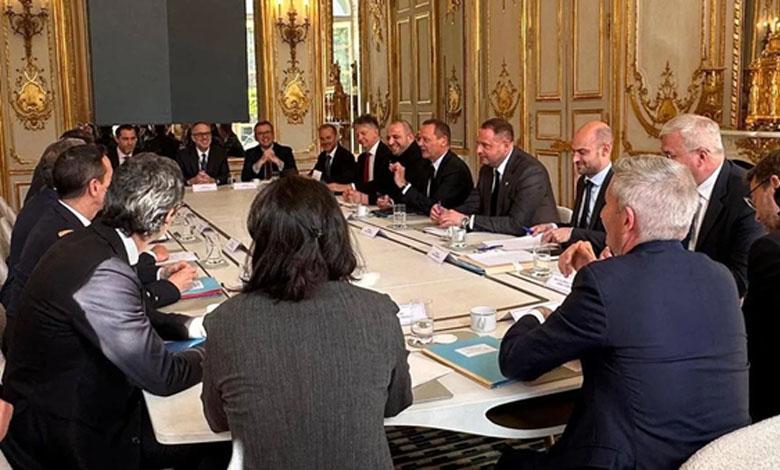
On April 17, in Paris, the Ukrainian delegation was handed a confidential document — a new peace initiative to settle the war between Russia and Ukraine. As reported The Wall Street Journal, the authors of the proposal were US Secretary of State Marco Rubio and Trump’s special representative Pete Witkoff. The basis of the plan is a ceasefire along the current front line. The US actually agrees to recognize Crimea as part of Russia, while four more regions remain legally Ukrainian, although in practice Russian troops retain control over the occupied territories.
Among the key conditions is Ukraine’s refusal to join NATO. At the same time, unlike the previous agreements in Istanbul in 2022, this plan does not provide for the reduction of the Ukrainian army, does not question Western military aid and does not prohibit the placement of foreign troops on the territory of Ukraine. A separate item concerns energy security: the US proposes to declare the surrounding area around the Zaporizhzhia NPP neutral, placing it under American control. At the same time, the station should supply electricity both to the territory controlled by Ukraine and to the occupied regions.
A field for negotiation
I wonder what WSJ quotes a high-ranking representative of the State Department, who emphasizes that these options are not ultimate – “either yes or no”. This is a field for negotiations, to which Kyiv must respond already this week during a tripartite meeting of the USA, Ukraine and European partners in London. If the positions converge, the Americans will pass the proposals to the Russian side.
However, despite diplomatic fluency, the essence is clear: the plan involves the actual loss of Crimea, the freezing of the war and the preservation of the status quo at the front. Without deoccupation. Without NATO. Without returning to the pre-war state.
The fact that the plan is really being actively discussed is also confirmed by Bloomberg and CNN, which were the first to report on the recognition of Crimea and Ukraine’s “neutrality” as key points of the proposal. Subsequently New York Post reported that Ukrainian Defense Minister Rustem Umyerov allegedly told American officials about Kyiv’s “90% support” for the plan. However, this statement was quickly denied by the Ukrainian Ministry of Defense in a comment Sky News: the department, they say, does not make political decisions, and therefore could not provide any “percentage estimates”. This fake is similar to a deliberate leak of information to put pressure on the Ukrainian authorities from the side of the Americans.
At the same time, another no less important thing: the key question still remains in the proposal — whether Kyiv will be required to legally secure concessions, in particular the recognition of Crimea. If not, it looks like a situational compromise. If so, this is already a strategic decision with all the consequences: constitutional changes, referendum, recognition in the UN. Such a scenario would be more reminiscent of the Finnish case of 1940, when Finland lost 11% of its territories to the USSR and declared neutrality in order to preserve its sovereignty. And it joined NATO only 83 years later.
However, even if Ukraine says yes, it does not guarantee Moscow’s consent. Putin has repeatedly stated that “all objectives of a special military operation must be achieved“, and therefore, it is not just about territories. In this context, a compromise “peace under Trump” may turn out to be unacceptable for the Kremlin.
However, the very fact of the appearance of such a plan is a signal of a change in the role of the United States in the war. For the first time since the beginning of the full-scale invasion, Washington is moving from the role of arms supplier to the initiator of the political scenario. This changes the rules of the game — both for Ukraine and for the whole of Europe.
Meanwhile, the US is signaling more and more clearly: if there is no progress, Washington may withdraw from the process. Secretary of State Marco Rubio warned that the patience of the American administration is not unlimited. And President Donald Trump said that “there is a very good chance of a cease-fire,” but that requires a sincere desire on both sides.
Currently, negotiations are taking place in several venues – in addition to London, the USA is also preparing a separate meeting with Moscow. If the positions of Ukraine, the West and the Russian Federation converge at least partially, the plan can be officially handed over to the Kremlin.
In the fourth year of the war, the world was once again on the threshold of an important choice: either a new stage of diplomacy, or another prolongation of the conflict due to insurmountable red lines.
Putin on direct negotiations with Ukraine
For the first time in a long time, the President of Russia, Vladimir Putin, is in public stated about readiness for direct negotiations with Ukraine. This happened against the background of growing international pressure, in particular from the United States, which insists on reaching a truce. Putin expressed a “positive attitude to any peace initiatives” and noted that Moscow is ready to discuss ending attacks on civilian infrastructure. However, he also stated that these objects are allegedly used for military purposes, but did not traditionally provide any evidence. The President of Ukraine, Volodymyr Zelenskyy, in response confirmed his readiness for negotiations, if they contribute to the end of the war and the protection of the civilian population. He proposed a 30-day ceasefire, including a halt to missile and drone attacks on civilian targets. Russia has not yet reacted to this initiative.
Such statements were made after the 30-hour “Easter truce”, which both sides accused each other of violating. Zelensky noted, that Russia is trying to create only the appearance of a truce while the attacks continue.
Putin’s press secretary Dmytro Peskov statedthat “if there is a desire and openness on the part of Ukraine, Kyiv should take steps that will legally remove obstacles to negotiations with Russia“, RIA Novosti reports. We will remind you that in October 2022, the President of Ukraine Volodymyr Zelenskyi put into effect decision The NSDC, which noted the impossibility of conducting negotiations with Vladimir Putin.
How are the Europeans feeling?
Key negotiations between representatives of Ukraine, the United States and the European Union regarding a peaceful settlement of the war are scheduled for this week in London. If the parties reach an agreement, the proposed terms may be forwarded to Russia for further consideration.
Former British Defense Minister Ben Wallace a warning, that if the US withdraws from the peace process, the country risks becoming an “observer” or even a “supporter of Russia”. He emphasized that without the active participation of the USA, Europe should be ready to take on greater responsibility in supporting Ukraine.
The European capitals — Paris and Berlin — have clearly expressed their position regarding the American peace initiative for Ukraine, emphasizing the inadmissibility of compromises that undermine the sovereignty and territorial integrity of Ukraine. French Foreign Minister Jean-Noel Barro stated, that European countries have given the USA a list of “inviolable positions” regarding a potential peace agreement between Ukraine and Russia. He emphasized that the main priority for France and Europe is the protection of their own interests and security, so it is necessary to clearly communicate their “red lines” to the USA. Acting German Chancellor Olaf Scholz emphasized that a peace agreement cannot be imposed on Ukraine. He emphasized that peace is possible only if the sovereignty of Ukraine is ensured.
European countries already show readiness strengthen its role: the increase in military aid, the expansion of defense cooperation with Ukraine and the reform of the defense procurement system are discussed. The possibility of using frozen Russian assets to finance the reconstruction of Ukraine is also being considered.
President of Ukraine Volodymyr Zelenskyi expressed concerns about some aspects of the American proposals, in particular about US access to Ukrainian resources. He also accused Trump’s special envoy, Steve Witkoff, of spreading pro-Russian narratives during the Paris talks.
Against the background of these developments, the future of the peace talks remains uncertain. The results of the London meetings could be decisive for the further course of the war and diplomatic efforts.
The energy component of “Trump’s peace”
The clause about neutrality around the ZNPP deserves special attention – it is a precedent: for the first time, an object of strategic infrastructure can come under the direct control of the United States. It can cause both resistance from Russia and resistance from Ukrainian energy companies.
As you know, in March 2025 during phone conversation U.S. President Donald Trump and Ukrainian President Volodymyr Zelenskyi discussed the issue of the Zaporizhia Nuclear Power Plant (ZAEP), which has been under Russian control since 2022. Trump proposed that the US take control of the ZNPP to ensure its safety and modernization. Zelenskyy confirmed that the discussion was only about the ZANP and did not include other Ukrainian nuclear power plants. He emphasized that all nuclear facilities of Ukraine are state property and cannot be transferred to the ownership of another country.
Zelenskyi also noted that Ukraine is ready to consider the possibility of US participation in the restoration and modernization of the ZNPP after its return to Ukrainian control. However, he emphasized that the station will not be able to function while it is under Russian occupation, and that for its full operation it is necessary to restore the infrastructure and ensure the safety of the personnel.
The idea of transferring control over the US nuclear power plant caused concern both in Russia and among Ukrainian experts. Russia categorically rejected the possibility of transferring the station, considering it a strategic object. Ukrainian experts also express doubts about the advisability of transferring control over a key energy facility to a foreign state, even an ally. This is not just about restoration or neutrality — it is the de facto establishment of the extraterritorial status of the facility in the war zone.
Thus, the issue of control over the ZNPP remains open and depends on further negotiations and the development of the situation at the front.


