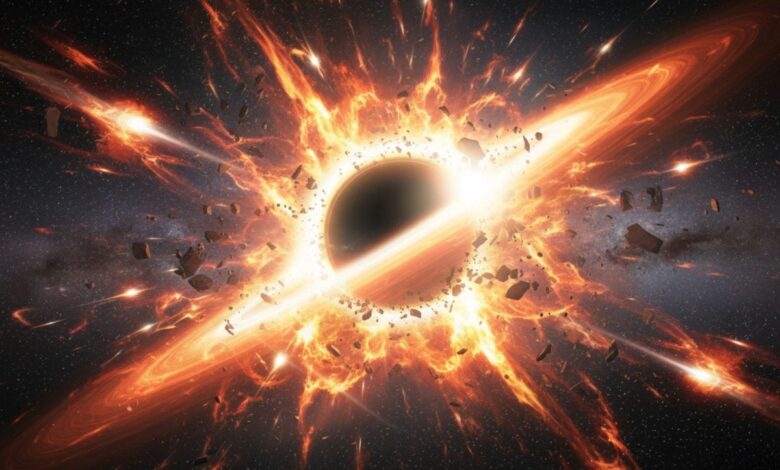
Physicists from the University of Massachusetts suggest that the explosion of a black hole may happen in this or the next decade. In their opinion, such an event can overturn the idea of physics and actually rewrite the history of the universe. This is reported by SciTechDaily.
It is generally believed that black holes end their existence in rare explosions that occur no more than once every 100,000 years. However, the results of a new study indicate that we will probably have to wait for the next explosion much less.
Scientists claim that the next explosion may occur in the next ten years, and the probability of this reaches 90%. They emphasize that space and ground-based observatories must be prepared in advance to record this event.
Researchers hope to confirm the existence of “primordial black holes,” which have not yet been directly observed. According to the theory, they could have formed less than a second after the Big Bang 13.8 billion years ago. Such an explosion could reveal a complete list of all subatomic particles in the universe: from electrons and quarks to the Higgs boson. The main intrigue is that dark matter particles can also be detected.
Previously, it was thought that the chances of seeing the explosion of a primordial black hole were extremely small. During the research, the team studied the “dark quantum electrodynamics model”. It is a reflection of the usual electromagnetic interaction, but includes a hypothetical heavy type of electron – the “dark electron”. Normally, black holes have no charge, and primordial black holes were also thought to be electrically neutral.
“We made another assumption. We show that if a primordial black hole is formed with a small dark electric charge, the model predicts that it should stabilize temporarily before the final explosion, said co-author of the study Michael Baker.
In this case, scientists could observe such explosions not once every 100,000 years, but about once every decade.
“We’re not saying it’s bound to happen this decade, but there’s a 90% chance of it happening. Since we already have the technology to monitor these explosions, we should be ready, Baker concluded.