Since the outbreak of the war in Ukraine, the number of people with disabilities has increased significantly.
The situation is particularly worrying for children who become disabled as a result of hostilities and shelling of peaceful cities. This disability now has a new nature – it is caused by war-related injuries, not just natural or medical factors.
According to the State Statistics Service, more than 160,000 children in Ukraine have disabilities, and these children face numerous challenges in society, schools, and even on playgrounds.
Lack of inclusiveness and understanding, as well as a lack of educational facilities and psychological support, often lead to children with disabilities becoming isolated and subject to social pressure. They need an adapted environment that will help them not only gain knowledge but also become full members of society.Unfortunately, however, this environment is far from perfect.The FACT news agency has examined the main problems faced by children with disabilities and possible ways to solve them.
Peer exclusion and social isolation
One of the most painful problems faced by children with disabilities is rejection and alienation from their peers. Children often do not want to play and communicate with those who look different or have special needs. The reason for this is lack of awareness and fear of the unknown, which is sometimes reinforced by the example of adults.Cases of children with disabilities being bullied are not uncommon. It happens both in schools and outside them, and often even adults, instead of supporting them, add fuel to the fire.
Cases of mothers accompanying their children to and from school every day to protect them from insults vividly illustrate this problem. Children with disabilities can suffer not only from peer bullying, but also from the reluctance of adults to explain why these children are different. This creates a vicious circle of rejection that is difficult to break without proper support from the school and community.
Lack of societal readiness to accept children with disabilities
The lack of acceptance of children with disabilities is often the result of ignorance and lack of experience of interacting with such children. There is a strong prejudice among both children and adults that children with disabilities are ‘different’ and therefore require special conditions or placement in specialised institutions.This leads to social isolation and to the child being either pitied or ignored.For example, one girl with a disability said that her classmates either felt sorry for her or simply ignored her.This, in turn, creates a sense of invisibility and powerlessness.
Unhealthy school climate and the role of adults in building tolerance
A lot depends on the atmosphere in the school.If a healthy atmosphere prevails in a school, where students and teachers respect each other, the level of tolerance towards children with disabilities increases.However, if there is tension or hostility in the team, it is useless to expect understanding.According to psychologists, it all starts with the example of adults: if teachers demonstrate a tolerant attitude, students also adopt these values.
To ensure a favourable environment, schools need to conduct awareness-raising activities and teach students how to interact with children with special needs. This could include training for teachers and informative lectures for students to help them better understand children with disabilities.
To prevent overly emotional reactions, teachers should explain to students that disability is not the child’s fault, but a feature that they live with.
Partial access to education and communication limitations
One of the biggest barriers for children with disabilities is limited access to education. The lack of adapted curricula and materials to help these children makes it difficult for them to learn in regular classes.In most schools, inclusive education is only at an early stage of development, and many institutions lack adequate infrastructure or trained staff.
Recommendations for parents of children with disabilities
Preparing children for social life. It is important for parents to help their child with a disability to adapt to society, develop their social skills and self-confidence.Preparation for interaction with other children can include role-playing, explaining behavioural situations and learning to respond appropriately to negative behaviour from others.
Involvement in joint activities. Joint activities involving children with disabilities and their peers help to reduce barriers to communication. For example, sports games, creative workshops, and joint projects help children adapt better and create a friendly atmosphere.
Involvement of specialists.Psychologists and social workers can help children with disabilities cope with psychological difficulties related to integration into the team, as well as teach peers about interaction and tolerance.
How to raise children to communicate properly with children with disabilities
Fostering tolerance and compassion in children begins with the example set by parents. In order to teach a child to communicate properly with children with disabilities, it is important to instil in them the understanding that all people have their own unique traits and needs.Here are some recommendations that will help parents to raise their children to be respectful and friendly towards children with special needs.
- Explain what a disability is.Communication with children with disabilities becomes easier when the child understands that a disability is simply a feature that can affect behaviour or physical abilities.Explain that it does not make the other child worse or better. Use simple words and examples to show that difference is normal.
- Teach friendliness and respect.Explain to your child that all children need to be treated with respect and care, regardless of their differences.Talk about the importance of support and that everyone deserves to be treated kindly.
- Teach your child to be patient, especially if a friend has difficulty communicating or moving.
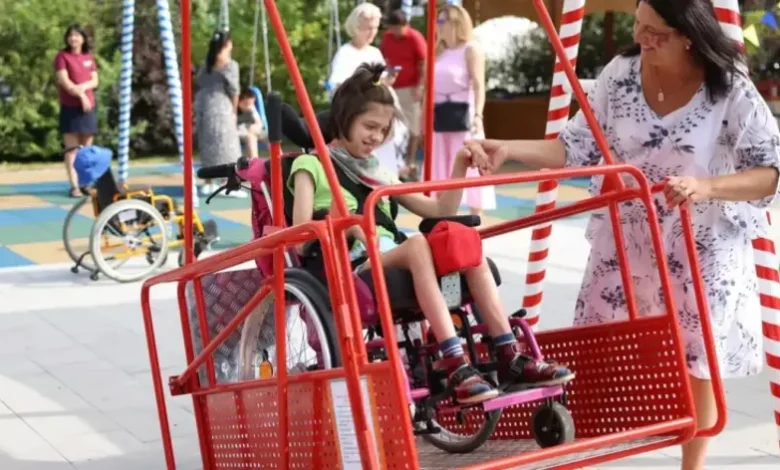
- Encourage compassion. Help your child understand what compassion is. For example, if your child notices that their classmate in a wheelchair cannot participate in certain games, suggest other games or activities that they can do together. This helps develop the ability to find solutions, support and promote inclusion.
- Do not show pity or condescension. Explain to your child that children with disabilities do not need pity – they want to be accepted as equals among equals. The child should understand that any form of excessive leniency or superiority can be offensive to their friend.
- Encourage joint play and activities. Organise games and activities that bring children together. This will help build friendships and promote natural communication. Tell your child that everyone can be a good friend, regardless of their physical or social characteristics.
- Talk about positive role models. Give examples of people with disabilities who have succeeded and talk about how important it is to support friends in their development. This can be a fun way to show that disability is not a barrier to success or happiness.
- Lead by example. Children often imitate the behaviour of adults. If parents show an example of tolerant and friendly attitude towards people with disabilities, the child will see this and transfer it to his/her communication with peers. Be open to communicating with people with disabilities so that the child can also see the normality of this approach.
Teaching children to communicate properly with peers with disabilities will help to create a culture of acceptance and support in society. This will help to raise a generation that knows how to value every person, regardless of their physical or social characteristics.
The problems of children with disabilities in Ukraine require a systematic approach that will cover all aspects of their lives: from education and social adaptation to psychological support and the creation of a tolerant environment. It is important not only to create conditions for comfortable learning, but also to work on changing the attitude of society towards children with disabilities, creating a culture of acceptance and respect. This is the only way to create a society where all children feel protected and equal.