Children’s space as a tool of state ideology: Russian authorities launch ideological program for preschoolers “Good Games”

Зміст
ToggleChildren who find themselves in temporarily occupied territories live in a reality where the usual mechanisms of state protection, access to Ukrainian education, and a stable social environment are significantly limited or completely absent. Under these conditions, school, kindergarten, and even extracurricular space cease to be neutral environments for development, as they function within a system that imposes other rules, other programs, and a different interpretation of events.
The attempt to spread state ideology to the preschool education environment demonstrates the intention of the Russian authorities to work with an audience that is only beginning to be socialized and does not yet have established mechanisms for critically interpreting information. This is about the launch of the “Good Games” program in kindergartens, which is a continuation of the system of ideological classes in schools.
Introduction of the “Good Games” program in kindergartens
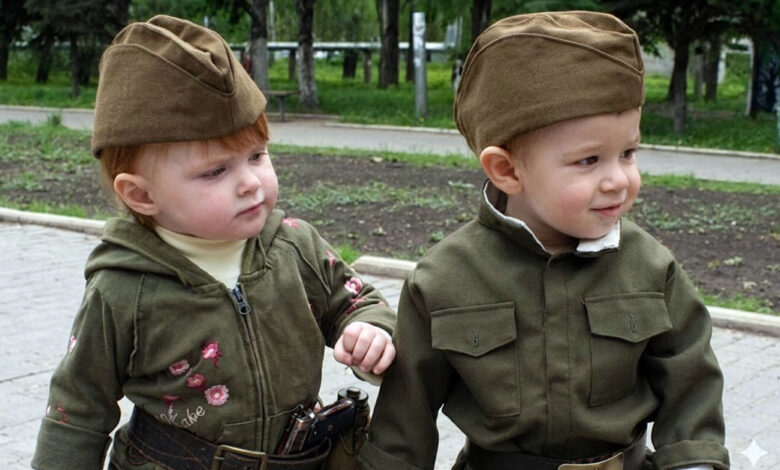
The Russian authorities on TOT initiate the implementation of a program called “Good Games” in preschool institutions, which has an ideological orientation and is focused on forming in children a loyal attitude towards state policy and the perception of war as a familiar component of reality.
On the introduction of the initiative reported the Center for Countering Disinformation at the National Security and Defense Council, noting that the new project actually expands the boundaries of the influence of state propaganda policy on young children. If previously mandatory classes “Conversations about Important Things” were introduced for schoolchildren from September 2022, now they plan to integrate a similar approach in content into preschool institutions.
The Center notes that the new initiative is actually an updated version of the program “Conversations about Important Things” – mandatory classes of ideological content that have been held in Russian schools since September 2022. According to the report, through “Good Games” it is planned to spread the government’s interpretation of “cultural values”, “patriotism” and the war against Ukraine among preschool children.
From school lectures to preschool classes
The “Good Games” initiative is positioned as an updated or renamed version of the “Conversations about Important” program, which has been a mandatory part of the educational process in Russian schools for several years. According to the Center for Countering Disinformation, the new program is aimed at forming ideas about so-called “cultural values”, “patriotism” and the war against Ukraine among preschool children.
The transfer of the ideological component to kindergartens means that the state policy of influencing worldviews extends to an audience that is at the stage of initial formation of ideas about society, the state and the role of man in it. At this age, a child learns basic behavioral patterns through play, imitation, and the authority of adults, so the integration of ideological content into an entertainment format creates a special model of influence.
Militarization as a systemic approach
The report by the Center for Countering Disinformation emphasizes that Russia is consistently militarizing and ideologizing children from a very young age. This approach is seen as a way to maintain social control, since the formation of loyalty at the early stages of development reduces the likelihood of a critical rethinking of state policy in the future.
Within this logic, war is presented not as an exceptional or tragic state, but as a component of state reality that cannot be doubted. The consolidation of such attitudes through educational or quasi-educational programs creates an environment in which alternative assessments of events are gradually displaced or marginalized.
The peculiarity of the “Good Games” program is the use of an entertainment format that corresponds to the age characteristics of preschoolers. According to the Center for Countering Disinformation, the initiative is a tool of ideological influence disguised as a game activity, which is traditionally perceived as neutral and safe for the development of the child.
Through play, the child learns to relate himself to the team, learns the idea of ”his” and “others”, and also adopts symbols and narratives that adults present as socially significant. If the content of such activities is filled with political meanings, then it ceases to be just a way to develop communicative or cognitive skills and acquires a distinct ideological dimension.
Control over the future generation
The goal of such programs, as the Center for Countering Disinformation notes, is to educate a generation that will not question the actions of the authorities, will perceive war as the norm, and will trust state propaganda. This approach involves a long-term strategy in which the educational space is used to consolidate a certain picture of the world even before the child has the ability to analyze information from different sources.
Given that the militarization of children and youth in Russia in recent years has been increasingly disguised as general educational or social initiatives, the expansion of ideological work to the preschool level seems to be a logical continuation of the processes already underway. Thus, the educational system is turning into a tool for long-term loyalty formation, in which upbringing and political doctrine are increasingly intertwined.