
Shadow employment of the population: how “salaries in envelopes” affect the losses of the State Budget


While the tax service’s digital algorithms are trying in vain to squeeze the economy into a rigid framework of transparency, almost 2 million Ukrainians each year become part of an invisible financial circulation, receiving remuneration for their work “in envelopes”. The volume of this shadow market has reached an impressive 250 billion UAH, turning the usual cash payment into the most powerful and stable of all known “gray” schemes, which continues to grow despite the de-shadowing policy and the introduction of risk-based checks.
Such a retreat into the shadows acts as an instinctive, albeit budget-destructive reaction of business to fiscal oppression and administrative barriers that entrepreneurs consider disproportionate to the real quality of state services. However, in the realities of a grueling war, this huge resource vacuum turns into a critical internal threat, literally bleeding the country’s defense. The current scale of payroll tax evasion poses a tough choice: whether to continue to tolerate the usual “gray” rules of the game, or to admit that every hryvnia hidden in an envelope directly reduces the chances of the nation’s survival.
Shadow arithmetic of the labor market: millions without contracts and hundreds of billions outside the state budget
Official statistics of Ukraine as of March 2026 resemble a complex mosaic, where the State Statistics Service or the State Tax Service are forced to operate with indirect markers due to the impossibility of directly accounting for financial flows that, by definition, remain in the shadows. Despite the lack of a single figure, anomalies in reporting clearly outline the contours of an economic parallel world, where out of 22 million economically active people, only 14 million officially pay taxes, leaving a huge gap of 8 million people who are either unemployed or in a state of full informal employment.
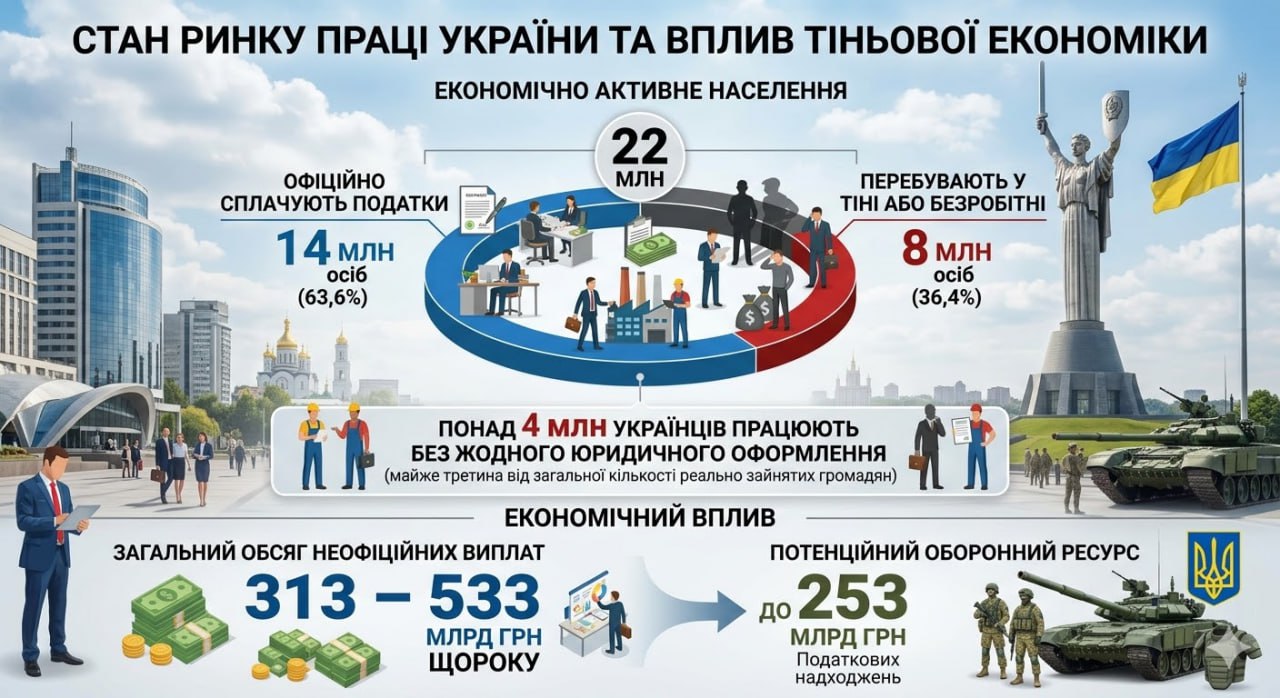
The depth of this problem is confirmed by data from the Institute of Demography, according to which more than 4 million Ukrainians work without any legal registration, which is almost a third of the total number of actually employed citizens. The methodological difficulty lies in the fact that the State Statistics Service is forced to rely on household surveys, since violating enterprises ignore reporting, creating the illusion of a legal vacuum. At the same time, the tax service draws attention to another category, which is more than 650 thousand workers, who formally exist on the verge of survival with a minimum wage of 8,647 UAH, although in fact they receive additional payments disguised as official poverty.
The most telling indicator of this imbalance is the retail sector, demonstrating a fantastic gap in wages within one industry, where average incomes in the top 50 chains can vary from a modest 8 to a solid 60 thousand UAH per month. This discrepancy has nothing to do with differences in the productivity of cashiers or logisticians; instead, it directly indicates the scale of selective business transparency, due to which budget losses in retail alone have increased to UAH 37.2 billion compared to the pre-war UAH 13 billion. The total volume of unofficial payments nationwide is estimated by experts at a staggering UAH 313–533 billion each year, which is equivalent to a potential defense resource of up to UAH 253 billion in tax revenues.
The reasons for such a mass flight into the “shadow” lie not so much in the innate cunning of entrepreneurs as in critical tax pressure, where an effective rate of 37% and a tax-to-net payment ratio of 53% make legal work an excessively expensive luxury. The situation became more complicated after the military levy was raised to 5%, which was the last straw for many in making the decision to switch to cash payments as a rational form of survival in conditions of strict fiscal control.
However, the choice in favor of informal employment in modern Ukrainian realities looks like a dangerous compromise, where instant benefit in the form of “live” money overrides fundamental social guarantees. The lack of insurance experience and the inability to confirm the origin of funds to banks turn the employee’s life into constant maneuvering, where blocked access to mortgages or consumer loans is only the tip of the iceberg. Depriving oneself of legal status, a person finds himself in a legal vacuum, where the right to annual paid leave or protection from unjustified dismissal depends solely on the goodwill of the business owner, and not on the letter of the law.
The motivation for such a choice is often rooted in a deep crisis of trust in state institutions. When an employer offers a conditional 20 thousand UAH in cash instead of 15 thousand after paying all taxes, the lack of a clear connection between current deductions and future social assistance pushes people into the shadow sector. Studies by OLX Robota and the European Business Association confirm this trend: although 62% of job seekers declare a desire to have an official status, for 80% of respondents the determining factor remains the size of the salary, not the transparency of labor relations.
The corporate sector also demonstrates heterogeneity, as only slightly more than half of companies in Ukraine choose the path of full legality, while the rest balance between “gray” schemes and complete disregard for the Labor Code. The most common model remains the payment of the official “minimum wage” with additional payments in envelopes, which affects approximately 16% of all employees. Given that the average “net” salary reaches UAH 17,300 with a minimum of UAH 8,000, the volume of shadow cash circulating outside the banking system is measured at a colossal UAH 196 billion per year, which creates a tax hole of almost UAH 100 billion.
Additionally, the labor market is deformed by more than a million unregistered entrepreneurs and the practice of using “pseudo-FOPs”, when full-time employees are registered as independent contractors solely to minimize taxes. Such manipulations deprive the budget of another UAH 35 billion per year, closing the circle of the shadow economy, where the state loses resources, and the citizen loses social security. Although judicial practice is increasingly taking the side of workers in conflict situations, the solution to the problem lies not so much in the area of sanctions, but in the need to create a transparent system, where legal work will be not only legally correct, but also economically feasible for both parties.
The choice of an “envelope” salary in Ukraine is determined not only by the desire to receive more money “in hand”, but also by a combination of economic, social and institutional factors that form a complex perception of risk and benefit. If an employer allocates 40,000 hryvnias to an employee, the official salary will be about 31,500 hryvnias, and the rest of the amount will remain unaccounted for. For many, this means the opportunity to rent housing or cover a significant part of consumer expenses, which makes “shadow” payments attractive in the short term.
However, these short-term benefits mask significant risks that manifest themselves immediately in certain life situations: during illness or vacation, the employer can pay only the officially registered part of the salary or refuse to pay, and attempts to obtain a mortgage, installment payments for equipment or other loans without confirmation of white income are practically futile; in addition, workplace injuries leave the worker alone with medical expenses, depriving him of any state compensation.
The “high shadow wage” provides advantages only under the conditions of youth, health and the absence of the need for large credit obligations, while in the case of the need for social guarantees, insurance payments or long-term financial obligations, its disadvantages become critical and can lead to significant economic losses. The choice between “white” and “shadow” in this context turns into a balance between short-term liquidity and strategic security.
Shadow employment acquired a special color in 2026 due to the factor of military registration, when a significant part of the male population deliberately avoids official employment so as not to get into state registers in the midst of mobilization processes. The State Labor Service is trying to counteract these trends with an aggressive penalty policy, setting the price for one unregistered worker at the level of ten minimum wages, which is 86,470 UAH, but these measures often break down against the logic of business, which chooses the risk of a one-time fine over guaranteed financial exhaustion due to high taxes.
These data indicate that the shadow economy does not work as an isolated sector, but as a destructive filter that withholds resources necessary for the functioning of the social sphere and infrastructure. Compared to other countries in Eastern Europe, where the share of the shadow wage fund is gradually decreasing due to the digitalization of control, the Ukrainian model demonstrates high resistance to reforms. A smooth transition from coercion to stimulation of legal work remains the main challenge, since every hryvnia in the “envelope” today will turn into an underfunded hospital or an unrepaired road tomorrow.
From Soviet Monopoly to Tax Evasion: How the Shadow Wage Market Was Formed
The transformation of the Ukrainian labor market from Soviet statism to post-Soviet capitalism was accompanied by the emergence of a specific financial symbiosis, known as “envelope wages.” This phenomenon did not become an accidental error of the system, but turned into a fundamental survival mechanism in conditions when the old rules no longer applied, and new ones were only being formed on the ruins of the planned economy.
The foundation of the Soviet economic model was based on the absolute monopoly of the state, which acted as the sole customer, arbitrator, and cashier for millions of citizens. In such a hermetic environment, private initiative was outside the law, which automatically deprived the market of the main resource for “gray” schemes — uncontrolled cash mass.
Strict centralization through the State Bank created a system where each ruble had its intended purpose, and enterprises operated in a strict non-cash settlement mode. It was technically impossible to obtain paper money in excess of the established limit for the payroll fund, since any attempt to withdraw cash for “economic needs” with subsequent distribution to personnel was qualified as a serious economic crime. The system of tariff scales and job ranks operated like railway tracks, where a step to the side meant not just a financial violation, but “theft of socialist property,” which entailed severe criminal consequences.
Despite the official rhetoric about general equality, shadow bonuses still existed, but they were elitist, not mass, in nature. The highest party nomenclature used a system of “special rations” and envelopes, cynically called “packages.” These payments were made without the official accounting system, and even symbolic party contributions were not deducted from them, making the party leadership the first prototype of modern beneficiaries of shadow schemes. While the average engineer depended on a penny bonus, party functionaries were already practicing financial autonomy hidden behind closed office doors.
Gaining independence and the rapid transition to market relations in the 1990s destroyed former barriers, but did not offer transparent rules of the game in return. A deep economic crisis and hyperinflation forced the nascent private sector to look for ways to minimize tax pressure, which, combined with weak legislation, made legal activity practically unprofitable.
The factors that legitimized shadow work at that time were:
- deregulation of cash circulation: the emergence of the first commercial banks and cooperatives allowed businesses to accumulate “black cash”, which became the main fuel for unofficial payments;
- tax dissonance: high rates of social contributions were perceived by entrepreneurs as a punitive measure, which encouraged them to take part of their income into the shadows to maintain competitiveness;
- erosion of the social contract: citizens, disillusioned with the state’s ability to provide decent old age or medical care, agreed to money “here and now”, ignoring future pension risks.
Today’s “salary in an envelope” is a complex legacy of the transition period, where the former state tightness gave way to complete anarchy, which over time became a habit. This phenomenon demonstrates both gaps in tax administration and a deep psychological gap between the individual and the state, where the envelope becomes a symbol of distrust in official institutions.
Detinization without pressure: how tax reform can return billions to the State Budget
In the realities of 2026, official employment is often perceived as an unwanted “digital footprint” for territorial recruitment centers, which creates a specific security barrier that is difficult to overcome only with calls for honesty. At the same time, the current system of social support paradoxically punishes transparency, because the absurd connection between official income and the right to housing and communal subsidies forces vulnerable segments of the population to avoid legalization, so as not to lose critically important assistance from the state.
However, instead of a strategy of punitive “tightening the screws” through astronomical fines, which for repeated violations exceed a quarter of a million hryvnias, the expert community insists on a fundamental revision of the social contract through systemic reform. The main step should be a radical reduction in the tax pressure on the payroll fund to a consolidated figure of 20%, which will allow real income to be brought out of the shadows without losing the competitiveness of business. It is proposed to compensate for the loss of budget revenues not by putting pressure on small businesses, but by revising taxes on real estate and land, which is a fairer and more stable basis for filling the state treasury during the recovery period.
The transformation of labor relations through the adoption of a new Labor Code and the introduction of a free labor contract mechanism for small businesses should finally consign anachronistic Soviet bureaucratic norms to the dustbin of history. The ability of entrepreneurs to independently determine the terms of cooperation with personnel without a pile of paper reports and orders will create conditions under which legal work will become simpler and safer than “gray” schemes. Projects like the “Territory of High Tax Trust” are already proving that transparency can be beneficial, providing conscientious taxpayers with immunity from inspections and priority service, which is a much more effective incentive than the fear of State Labor Inspection inspections.
If the state does not dare to take these decisive steps in the near future, the chronic underfunding of the front due to the shadow economy will only deepen, undermining the country’s defense capabilities. Real de-shadowing in 2026 lies not in the plane of strengthening control, but in creating a model where the official salary does not deprive of subsidies, does not create excessive mobilization risks and does not eat up almost half of what is earned. Only through a reasonable state strategy, tax relief and legalization of modern forms of employment will Ukraine be able to turn the billions lost by the State Budget into economic growth and social stability.


