Solar Orbiter spacecraft shows the Sun’s south pole for the first time in history (video)

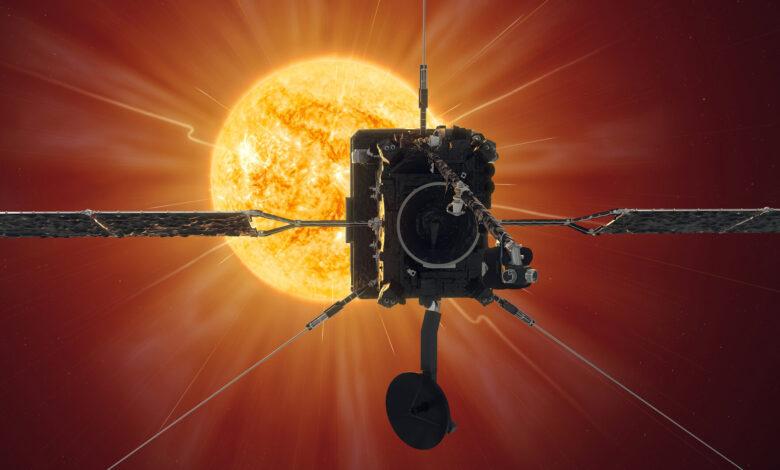
The Solar Orbiter spacecraft, created by the European Space Agency, transmitted the first-ever videos and pictures of the Sun’s south pole to Earth. About this informs BBC.
These images open up new opportunities for research, as they will help scientists better understand how the Sun transitions from periods of intense activity to quieter phases. Such knowledge is important because strong solar activity can affect the operation of satellites and power grids on Earth.
The new images show the sun’s bright, shimmering atmosphere with temperatures up to a million degrees Celsius. Next to it are darker gas clouds, which, although much cooler, still reach temperatures of more than one hundred thousand degrees.
Professor Carol Mundell, ESA’s Director of Science, emphasized that these are the most detailed and closest images of the Sun ever taken, which will help to understand how our star works.
“Today we are showing the first images of the solar pole in human history. The Sun is the closest star to us, the source of life and a potential disruptor of modern space and terrestrial energy systems, so it is extremely important to understand how it works and learn to predict its behavior.”“,” Carol Mandell explained.
From Earth’s surface, the Sun looks like a bright disk, but with the help of special filters and observations at different frequencies, it appears as a dynamic, boiling ball with distorted magnetic fields that create flares and gas emissions. These magnetic fields determine when the Sun enters periods of storms and ejects streams of charged particles toward Earth.
Scientists know that the Sun has stable phases, when its magnetic fields are ordered and its north and south magnetic poles are fixed. At this time, the Sun does not cause powerful explosions. However, about every 11 years there is a reorientation of the fields, which leads to chaos and active phases.
During such periods, the Sun struggles to reduce internal complexity, and this struggle is spilled outward in the form of solar storms that can affect infrastructure, while also causing beautiful auroras.
Professor Lucy Green from the University of London emphasizes that until now it has been difficult to predict such activity due to the lack of data on the movement of magnetic fields towards the poles. Now the situation has changed.
“Now we have a missing piece of the puzzle. Changing polar magnetic fields on the Sun has been one of the great open questions in science, and what we’ll be able to do with the Solar Orbiter is measure for the first time the really important fluid flows that pick up parts of the magnetic field around the Sun and transport them to the polar regions“, said Lucy Green.