
Strike on Fordow: US uses most powerful anti-bunker “mother of bombs” – Iran prepares tough response

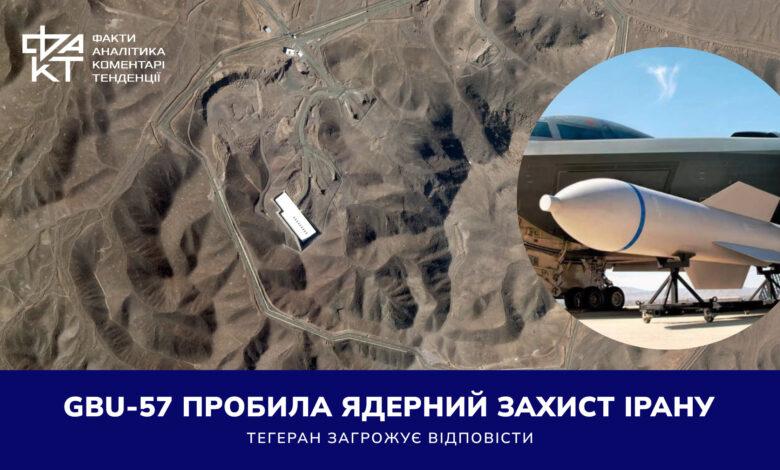
On June 22, 2025, the world found itself on the threshold of a new geopolitical tension. United States inflicted an unprecedented attack on three key nuclear facilities of Iran – in Fordo, Natang and Isfahan. This airstrike marked a turning point in the Middle East conflict, finally crossing the line at which diplomacy gives way to force. For the first time in history, the top-secret GBU-57 anti-bunker bomb was used – a weapon that had been the subject of legends for years. Its attack on the underground facility in Fordow demonstrated not only the technological superiority of the United States, but also the intention to change the course of the confrontation over Iran’s nuclear program. This moment may go down in history as the beginning of a new phase in the global struggle to control the region’s nuclear future. At the same time, some mass media it is reported that Tehran received early warning of the strikes and a large part of Iran’s stockpile of enriched uranium was evacuated.
The bomb that pierced the mountain
According to Donald Trump, the strike was “very successful” – especially with regard to the facility at Fordow, which was previously considered almost impregnable. To destroy it, the US used six GBU‑57 (Massive Ordnance Penetrator) anti-bunker bombs for the first time in combat conditions – each weighing more than 13 tons. These super-heavy munitions were specially designed to penetrate tens of meters of rock and concrete to strike underground nuclear facilities like Fordo, located beneath Mt.
In addition, 30 Tomahawk cruise missiles were fired at nuclear facilities in Natang and Isfahan, aimed at uranium enrichment infrastructure.
Pressure by force: Washington does not hide its goals
According to CBS, the United States expects strikes on American bases in Iraq in response. At the same time, US special envoy Witkoff is scheduled to meet with Iran’s foreign minister for the sixth round of talks today. “Remember: we still have many goals,” Donald Trump emphasized, warning Iran of a possible escalation in the event of a response.
As writes In a column for The New York Times, war correspondent David E. Sanger, for Mr. Trump, the decision to attack the nuclear infrastructure of an enemy country was the biggest – and perhaps the most dangerous – adventure of his second term as president.
He reckons that the US will be able to repel any response from the Iranian leadership against the more than 40,000 US troops stationed at bases across the region. All of these sites are within range of Iran’s missile arsenal, even after eight days of continuous Israeli attacks. He also hopes to deter a much-weakened Iran from using its usual methods of terrorism, hostage-taking and cyberattacks as an indirect form of retaliation.
Although the official Tehran has so far refrained from direct comments, Iranian state television has already declared a violation of the country’s sovereignty: “The facilities in Fordow are part of Iran’s legitimate project. With its actions, the United States violated Iran’s airspace and committed a crime against our country.”
The loudest statement was made live on an Iranian TV channel: “Mr. President of the USA, you started it, and we will finish it. After this, America has no more place in West Asia.”
At the state level, it is emphasized that the USA has crossed the “red line”, and the response will be tough and inevitable. Analysts predict strikes on American facilities in the region. Washington is preparing for a possible response. According to The Washington Post, Iraqi security forces surrounded the diplomatic quarter in Baghdad, fearing attacks by pro-Iranian groups. According to CBS, the most likely target of the attack could be American military infrastructure in Iraq. As written BBC, about 40,000 US troops are stationed in the region. They will be on extremely high alert.
Axios informs, that Iran’s Atomic Energy Organization confirmed the attack on three nuclear facilities and condemned “America’s enemy” for “a cruel act contrary to international law.” The organization said that “despite the malicious plots of its enemies”, Iran will not refuse to continue the development of its national nuclear energy.
Israel is in the shadows, but in action
Israeli Prime Minister Benjamin Netanyahu praised Trump’s actions, calling them “courageous” and emphasizing “full coordination” between the two countries. Israeli sources report that the facilities have indeed suffered severe damage, and this could significantly slow or halt Iran’s nuclear program.
Commenting on the strikes on Iranian nuclear facilities, Israeli journalist Serhii Auslender wrote: “Well, as I assumed. Trump and the Israelis were inspired to play the fool, pretending to be at odds – for two weeks, if anything, ourselves and such – until the bombers moved closer. As for the Fordo being destroyed, let’s wait for the final confirmation, this is now the number one operational task for the Mossad.
Now a lot depends on the response of the Iranians. While they are launching ballistics at us with heavy animal-like fervor, wasting their most expensive resource – launchers. But they may decide to block the Strait of Hormuz, through which tankers are currently rolling at all speeds in order to have time to slip through. If so, the Americans will have to greatly expand their participation.”
In recent days, according to Iranian reports, more than 400 people have been killed in Iran and more than 3,000 have been injured as a result of Israeli strikes that began on June 13. In response, at least 24 people were killed in Israel due to Iranian strikes.
What about radiation? After the large-scale attacks, there were fears of a radiation leak. However, as reported by the IAEA, no signs of an increased level of radiation outside the facilities were found.
A blow that can rewrite the map of the region
The use of GBU‑57 became a historical precedent, both from a military and a political point of view. The US took the unprecedented step of backing up diplomacy with force, but now finds itself on the brink of a large-scale armed conflict with a country that has ambitions, resources and numerous allies in the region.
Whether it will be possible to keep the situation under control depends on the events of the coming days. For now, one thing is clear: the conflict is gaining momentum, and the Middle East is once again on the edge of the abyss.
How the weapons of the future work
The GBU‑57 Massive Ordnance Penetrator is the most powerful non-nuclear bomb in the US arsenal, weighing more than 13 tons and measuring more than 6 meters in length. Its main goal is not mass destruction, but the fulfillment of one extremely difficult task: to break through the strongest fortifications, which seem impenetrable.
This point-and-shoot weapon uses modern technology: GPS guidance, intelligent fuze, and massive kinetic energy to penetrate tens of meters of rock or concrete. The explosion occurs exactly where the critical target is hidden – a centrifuge, an underground hall or a bunker.
The carrier of such a bomb is only one aircraft in the world – the strategic stealth bomber B-2 Spirit. There are only 19 such aircraft in the US arsenal. Thanks to this single but sophisticated strike, there is no need for a large-scale air operation.
The GBU‑57 is a real breakthrough in military technology, a new generation weapon for point warfare. It is dropped from a great height, and the GPS system and inertial control ensure hitting accuracy up to several meters. The bomb, hitting the target, due to its mass and steel body, penetrates up to 60 meters of concrete or rock.
The feature is a “smart fuse” that detects cavities within – tunnels, rooms, technical levels – and detonates in the most optimal location for maximum destruction.
If a single blast isn’t enough, multiple such bombs can be dropped in sequence, each penetrating deeper and deeper, causing cascading damage to even the deepest and most fortified structures.
Although the GBU‑57 is super heavy, it is not a weapon of mass destruction like a nuclear bomb. It is designed to eliminate a single, but critically important target that other means simply cannot reach. This is the weapon of the future – accurate, well-thought-out and powerful, designed for decisive blows to the heart of the enemy’s infrastructure.
Why Ford?
The Fordow nuclear facility is one of the most protected in the world. Located under a mountain southwest of Tehran, it is considered the heart of Iran’s uranium enrichment program. Fordo has concrete tunnels, blast doors and tens of meters of rock above key installations.
Conventional weapons do not reach here. Even Israel, having the most modern missiles at its disposal, recognized that Fordow was “out of reach”. However, not for the GBU‑57.
Iran did not hide that it was enriching uranium to 60% at this facility, which is almost the threshold required to create a nuclear warhead. The strike on Fordow had not only military, but also political significance: it was a signal that the US was ready to act if diplomacy with Iran reached a dead end.
At the same time, the British independent media platform Amwaj Media informs, that the US warned Tehran about the strikes. And, importantly, a senior source also confirmed to the paper that the targeted facilities had been evacuated and “the majority” of Iran’s stockpile of enriched uranium was kept in safe locations.
This shows that, despite the magnitude and suddenness of the strike, the parties tried to avoid the complete destruction of Iran’s nuclear infrastructure and loss of life. Such a move could also indicate a desire by the US to carry out a demonstration operation with a pinpoint strike, while leaving room for diplomacy, as negotiations over the nuclear program continue at the same time as military action. At the same time, the evacuation and protection of key stockpiles means that Iran retains the ability to quickly restore some of its nuclear capabilities, exacerbating geopolitical tensions in the region.


