
The Cabinet of Ministers opened the doors to foreign scientists and teachers: funding through the President’s Fund and risks for Ukrainian science

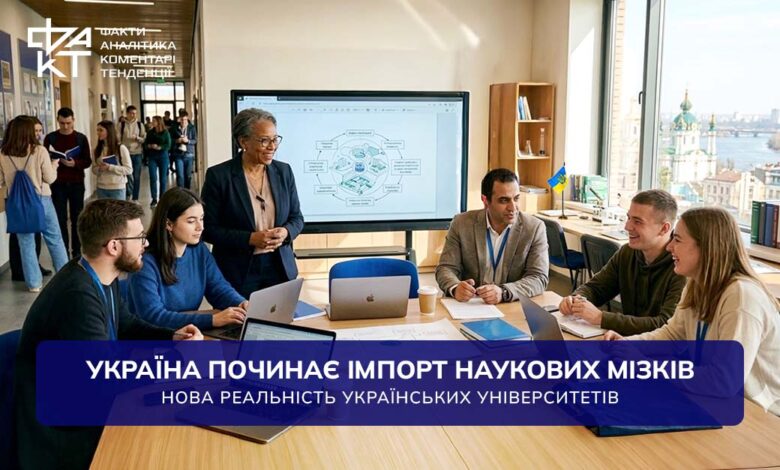
Ukrainian science is on the verge of a paradox: the state opens its doors to foreign scientists and generously finances them through the President’s Fund and the E-grant system, while its own researchers are forced to survive on crumbs from the grant pie and meager salaries. The new mechanism promises to strengthen teams, transparent competitions, and integrate world experience. However, a serious dilemma arises: will universities be able to use these resources to develop their own scientific school, or will the new rules create a system in which the strategic goals of our scientists will remain in the background, which will ultimately displace Ukrainian intellectual capital? While the government boasts of transparency and innovation, the reality of domestic universities is radically different: the mass exodus of talented personnel, chronic underfunding, and inequality of conditions create the risk that Ukrainian education and science will find themselves in an even greater crisis instead of strategic development.
The E-Grant System and the President’s Fund: a Model for Direct Import of Foreign Scientific Personnel
The Cabinet of Ministers of Ukraine officially opened the doors to foreign scientists and teachers by approving the mechanism of their direct funding through the President’s Fund. From now on, through the E-grant system, the state will pay specialists from the EU and NATO countries for their work at Ukrainian universities. The Cabinet of Ministers’ approval of the mechanism for attracting foreign intellectual capital through the Fund of the President of Ukraine for the Support of Education, Science and Sports marks an attempt to radically reformat the domestic academic environment.
As promised, this instrument, aimed at directly financing specialists from abroad, actually implements a model of direct import of competencies, where state grants become the main lever of influence on the staff of universities and scientific institutions. Instead of the usual declarations of cooperation, the state offers a practical algorithm according to which foreign scientists, teachers and independent experts will be integrated into the Ukrainian system to implement specific applied developments and educational programs.
According to officials, the introduction of the E-grant system as a single digital platform for competitive selection is designed to provide the same transparency that internal academic processes have lacked for years. The selection procedure, developed by the Foundation and approved by the Ministry of Education and Science, should become a filter through which only those requests that meet the strategic goals of Ukraine’s recovery will pass. However, such an approach creates a precedent when external expertise receives priority access to resources, which in conditions of limited budgets can be perceived as a challenge for local scientific schools, which are forced to compete for the attention of the state on unequal terms.
The government believes that the involvement of scientific and pedagogical staff of foreign higher education institutions, public representatives and employers from EU and NATO countries brings Ukraine to the level of an active stakeholder, capable of dictating its own conditions in the educational services market. As Deputy Minister Mykola Trofymenko emphasizes, the predictability of funding and a clear focus on joint projects should interest the world community in joining the Ukrainian context not as observers, but as direct participants in research processes. At the same time, such an “open door” strategy carries both the potential for a technological leap and the risk of gradually eroding the authenticity of Ukrainian science if the domestic resource does not receive similar support to retain its own talents.
The key feature of the new mechanism is that the selection of foreign specialists will be carried out strictly in accordance with the requests of the institutions themselves, focusing on research areas that work for economic and infrastructural revival. This means that universities become customers of “specific brains for specific tasks”, but this is where the fine line lies between strengthening teams and forming a dependence on imported knowledge. The effectiveness of this initiative will depend on whether Ukrainian scientific institutions can use these grants as a catalyst for their own development, or whether they simply become a convenient platform for the development of funds by specialists whose experience will not always be adapted to the specific realities of a warring state.
Dynamics of attracting foreign scientists in EU countries: from quantitative indicators to systemic changes
The modern architecture of higher education increasingly resembles a global intellectual network, where the mobility of scientists has turned from an optional advantage into a fundamental marker of the viability of academic institutions. The European space today acts as the main locomotive of this integration, demonstrating not just declarative openness, but also a concrete digital expansion of international human resources into national educational systems.
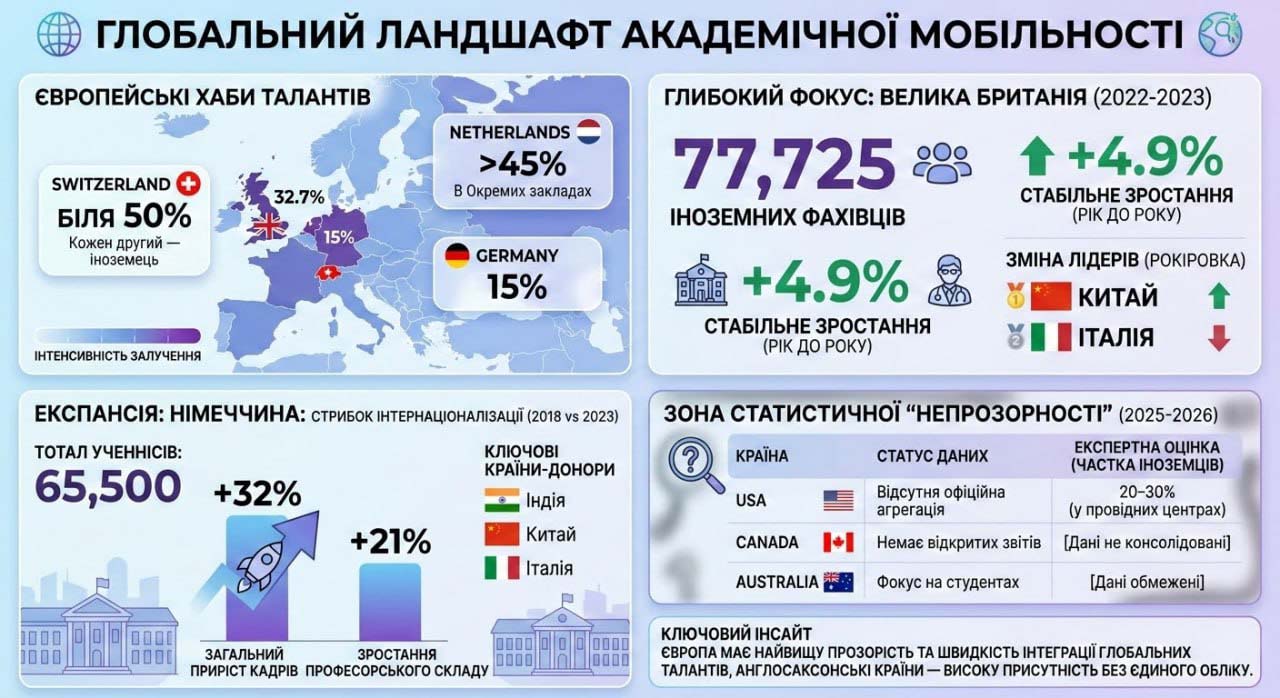
Analyzing the dynamics of industry leaders, it is worth paying attention to the United Kingdom, where as of the 2022–2023 academic year, the foreign contingent reached 32.7% of the total number of academic staff, which in absolute terms is equal to 77,725 specialists. This indicator shows a steady growth of 4.9% compared to the previous period, and there was a significant shift in the structure of international representation, where China overtook Italy, becoming the main supplier of academic talent to British universities.
A similar vector of development is demonstrated by Germany, where in 2023 the number of foreign researchers and teachers reached 65,500 people, which is approximately 15% of the total staff. The pace of German internationalization is even more impressive when you consider that since 2018 the total number of foreign staff has increased by 32%, and the number of professors by 21%, attracting mainly experts from India, China and Italy.
Small countries in Europe, despite limited internal resources, demonstrate even deeper integration into the global scientific space, effectively turning their universities into international hubs. In Switzerland, almost every second higher education employee is foreign, and in some institutions in the Netherlands, the share of international teaching staff exceeds 45%, which indicates a complete blurring of national boundaries within individual academic schools.
At the same time, the situation in the USA, Canada and Australia looks less transparent for analysis, since these countries do not publish publicly available aggregated state statistics on the percentage of foreign teachers for 2025–2026. Although expert estimates indicate the presence of 20–30% of foreign scientists in leading US research centers, the lack of official consolidated reports makes direct comparison with the European model of openness difficult.
The presence of foreign specialists in technical and engineering fields in the UK or scientific centers in Germany not only strengthens the reputational position of universities, but also provides them with access to high-quality funding within joint EU projects. The high concentration of global intelligence stimulates interdisciplinary research and enriches the student experience through the collision of different scientific cultures, but such an idyllic picture has its downside, associated with serious adaptation challenges. University administrations are forced to invest enormous resources in language support and the development of complex bureaucratic protocols, since a foreign teacher must not only perfectly master the academic language of the host country, but also synchronize his teaching style with local educational standards.
The deep divergence between academic traditions, where, for example, the lecture format of one country may conflict with the interactive seminars of another, requires universities to implement special mentoring programs and training to harmonize assessment standards. In addition to methodological difficulties, social and political risks associated with the balance between attracting external stars and supporting local staff who may feel competitive pressure come to the fore. Social security issues, differences in pension systems and insurance add to the burden on human resources services, turning the management of an international team into a difficult balancing act between global ambitions and national interests.
The lack of uniform data collection standards in EU countries creates significant obstacles to strategic planning and assessing the effectiveness of budget expenditures on international mobility. Without clear statistics, it is impossible to objectively determine how exactly the foreign presence affects the local labor market and scientific ecosystem in the long term, which can lead to fragmented management decisions. However, the success of international integration depends not so much on the number of invited professors as on the ability of the state and universities to create a transparent system of accounting, linguistic and cultural adaptation and fair competition that would combine world experience with national strategic goals.
The trap of “academic tourism”: the risks of temporary contracts and the lack of scientific heritage
The introduction of a government mechanism for attracting foreign scientists and teachers through the tools of the Foundation of the President of Ukraine will inevitably provoke a deep tectonic shift in the traditionally conservative structure of domestic higher education. This initiative, despite its ambitious goal, forces the academic environment to confront a fundamental discrepancy between established local paradigms and diverse educational standards that are imported together with foreign specialists.
The integration of international experience into the Ukrainian educational landscape requires universities not just formal hospitality, but a radical restructuring of internal methodological processes to overcome conceptual discrepancies in assessment and teaching systems. Higher education institutions will be forced to create complex linguistic support systems and mentoring platforms on their own, since without a deep adaptation of foreign methods to Ukrainian realities, communication between invited experts and the student community risks turning into a series of formal lectures without real knowledge acquisition.
Administration of grant flows through the Fund imposes an unprecedented level of responsibility on resource recipients, which requires jeweler-like precision in issues of targeted use of funds and legal registration of international partnerships. The combination of flexible logic of grant funding with strict bureaucratic requirements of the state treasury creates risks of operational delays that can neutralize the interest of top specialists in cooperation with Ukrainian institutions.
In addition, the economic dissonance caused by a significant difference in the remuneration of foreign specialists and domestic teaching staff lays the foundation for a hidden social conflict within academic teams. A situation in which a foreign specialist receives a much higher remuneration for a similar amount of work can demotivate local scientists, turning the university environment into a space of unequal opportunities, where local staff can feel like “second-rate” specialists.
The effectiveness of using budget resources will directly depend on the state’s ability to develop transparent and measurable criteria for assessing the effectiveness of the experts involved, since the lack of clear KPIs (key performance indicators) opens the way to ineffective spending. Without a strict audit of competencies, there is a danger of attracting specialists whose real scientific achievements do not correspond to the strategic priorities of Ukrainian science, which will ultimately lead to the dispersion of grant assets without a tangible qualitative breakthrough.
The temporary nature of grant support creates the illusion of rapid development, but at the same time it complicates the formation of a stable personnel strategy, since foreign experts do not provide institutional succession. University administrations find themselves faced with a difficult choice when it comes to focusing on short-term prestigious projects involving foreigners, or investing in the long-term growth of their own scientific schools, trying to balance these vectors in conditions of limited financial resources.
Thus, the initiative of the Cabinet of Ministers to directly finance foreign scientists does not look like a strategic development of the world and science, but a painting in its own insolvency. While the state enthusiastically rolls out the red carpet and the “E-grant” system for foreign specialists, thousands of Ukrainian teachers and scientists who have been building domestic scientific schools for decades have been left behind. The country itself has pushed its intellectual capital abroad through chronic underfunding, shamefully low salaries, and an outdated base, and is now trying to patch up the holes with expensive “brain imports.” This situation is direct evidence not of a talent shortage in the country, but of a catastrophic lack of state respect for its own specialists. Instead of supporting domestic intellectuals, the authorities choose the path of least resistance – replacing devalued Ukrainian professionals with expensive foreign resources.
Creating a “financial paradise” for foreign specialists against the backdrop of the survival of local scientists will inevitably lead to the final degradation of the national scientific elite. We risk getting the so-called “academic tourism”, when foreign guests will willingly take advantage of the high fees of the President’s Fund, but are unlikely to be sincerely interested in the development of Ukrainian science. It is quite likely that for them such work in our universities will simply be a profitable short-term contract without obligations to the future of this country.


