
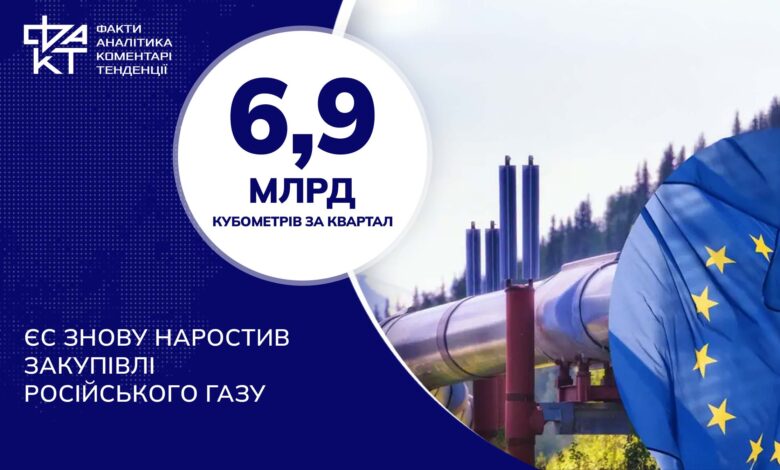
The European Union has been declaring its intention to abandon Russian gas for several years, but statistics for the first quarter of 2026 show a contradictory picture: pipeline dependence is decreasing, but supplies of Russian liquefied natural gas are increasing to the highest level since the start of the full-scale war against Ukraine.
According to a study by the American energy think tank IEEFA, in January-March 2026 the European Union imported 6.9 billion cubic meters of Russian LNG. This is 16% more than in the same period last year.
This figure has become the highest since 2022, although it was after the start of the great war that the EU began to quickly restructure its energy policy and look for a replacement for Russian supplies.
The largest buyers of Russian liquefied gas in Europe were France, Spain and Belgium. Purchases increased especially noticeably in France, which imported the most Russian LNG among European countries in the first quarter of 2026, and set a new record in January.
April statistics did not change the general trend. IEEFA analysts recorded that imports of Russian LNG to the EU in April were 17% higher than a year earlier. This means that the growth did not look like a one-time jump at the beginning of the year, but continued after the end of the first quarter.
Liquefied natural gas has become one of the main tools for Europe to replace pipeline supplies from Russia. It is transported by tankers, delivered to terminals, then converted back into a gas and fed into the grid. In 2025, according to the European Commission, LNG already provided 45% of all natural gas imports to the EU.
Despite diversification, Russia remains the second largest supplier of LNG to the EU. This creates a politically awkward situation for Brussels: the European Commission plans to completely stop importing Russian gas by 2027, but part of the European market still buys Russian volumes via sea deliveries.
Against the background of this dependence, the US is rapidly strengthening its position. According to IEEFA estimates, American LNG could become the main source of gas for Europe as early as 2026, and by 2028 its share could reach 80% of all liquefied gas imports to the EU.
If we consider not only LNG, but all natural gas imports including pipeline deliveries, Norway remains the largest supplier to the EU with a share of 31%. The US has 28%, and Russia remains in third place with 14%.
These figures show that the EU’s gas dependence on Russia has changed shape, but has not disappeared completely. Europe has reduced the role of Russian pipelines, but some Russian fuel continues to flow through LNG terminals, and the EU’s largest economies are still among the buyers.


