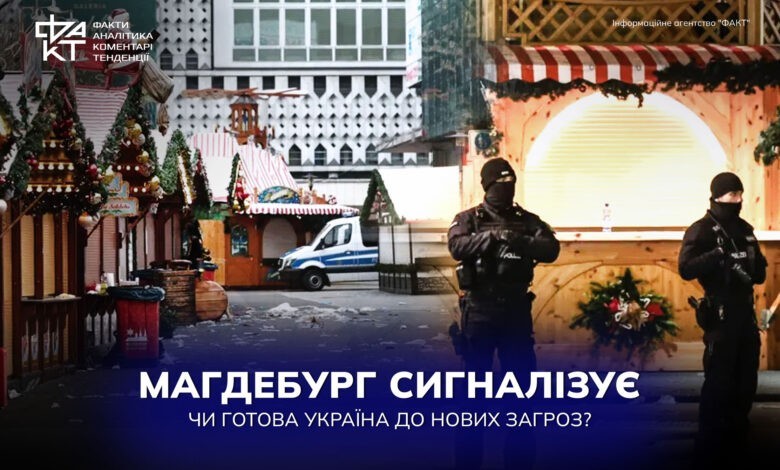
The tragic incident at the Magdeburg Christmas market shook not only Germany, but the whole world. It became a painful reminder of how suddenly cruelty can break into the very heart of peaceful life. European countries once again found themselves in the face of a new reality, where radicalization, the weakness of integration policy and the inaction of law enforcement officers create the ground for tragedies. This blow to the security of Europe sounds like a warning for Ukraine as well. We are in a zone of constant tension – from war to growing internal threats. Magdeburg demonstrates how easily fires of terror flare up where society is not ready to react immediately. For Ukraine, this is a signal for action: the need to immediately review approaches to security, strengthen preventive measures, and adapt to new forms of threats. This is not just someone else’s tragedy, but a scenario that may repeat itself on our streets if the correct conclusions are not made today.
The tragedy in Magdeburg: the bloody consequences of personal and political ambitions
The Christmas market in Magdeburg, which was supposed to be a symbol of joy and unity, turned into a place of tragedy due to the actions of a 50-year-old psychotherapist who decided to express his dissatisfaction with the world in the most brutal way. Five dead, including a child, and two hundred wounded, including a Ukrainian woman, became the price of his conflicts with society, the authorities and himself.
According to official data, the perpetrator of the tragedy was born in Saudi Arabia, but in 2006 he moved to Germany, where he studied, and later received refugee status. Outwardly integrated into society, he worked as a psychotherapist in the penitentiary system, but his public statements paint a completely different picture. The self-proclaimed “most aggressive critic of Islam,” he was noted for his extremist posts on social media. His position combined strong anti-Islam sentiments, support for the right-wing Alternative for Germany (AfD) party, and at the same time deep hostility to German institutions. In his posts on social networks, he accused the police and the government of “supporting Islamism”, and also repeatedly claimed persecution by the German authorities.
As reported by foreign media, the social networks of the alleged criminal were literally teeming with alarm signals. In May 2024, he wrote about his desire to “die this year” for the sake of justice, and in August he threatened “war on Germany.” His rhetoric was laced with aggression and calls for radical action, but as is often the case, his words went unnoticed or underestimated. Users who interacted with his posts may have suspected the possibility of danger, but did not contact the police. And although the German authorities already had the experience of terrible attacks on Christmas markets, this time it was not possible to avoid the tragedy.
That the perpetrator supported the AfD and used their rhetoric to justify his actions opens up a debate about political responsibility. A party that often advocates limiting immigration has become a tool in the hands of a man seeking to justify his extremist beliefs. This raises questions about the influence of populist political forces on the radicalization of individuals. Can such parties, using aggressive rhetoric, incite vulnerable people to violence?
It should be noted that the Ministry of Foreign Affairs of Saudi Arabia quickly condemned the terrorist attack, stressing the inadmissibility of such actions. German Chancellor Olaf Scholz expressed his condolences to the families of the dead and victims, promising that the case will be investigated with maximum thoroughness. Christmas markets in Germany have already become a symbol of the holiday, but at the same time a potential target for terrorist attacks. The country has previously experienced a wave of terrorist attacks linked to radicalized migrants. For example, in 2016, a truck drove into a crowd at a Christmas market in Berlin, killing 12 people. At the time, Tunisian Anis Amri, who was refused asylum, was driving. However, the Magdeburg tragedy has a unique context: this time the perpetrator was not an Islamist, but a staunch anti-Islamist.
German law enforcement agencies are working on the investigation, but at the same time the case makes all countries think about systemic problems. The tragedy presents them with new challenges, where they are increasingly faced with the need to find a balance between freedom, openness and security.
Furthermore, the tragedy in Magdeburg laid bare not only the problem of social integration, but also a much wider phenomenon: how technology, politics and personal mental disorders can create an explosive mixture that turns violent. The authorities of the countries must react quickly and decisively, but at the same time analyze how to prevent similar events in the future. This case was another reminder that the line between words and actions is very thin. And its violation can cost dozens of human lives.
The bloody result of the multi-year policy of multiculturalism and indifference
The Saudi authorities have repeatedly warned Germany about the danger of the perpetrator of the tragedy. His extremist statements, threats on social media and open hostility to Islam could be grounds for close surveillance or even deportation. But in Germany, which has become the main refuge for refugees and migrants over the past decade, these signals have been ignored.
It should be remembered that in 2015, against the background of the war in Syria and the migration crisis, Germany became an attractive country for hundreds of thousands of migrants during the leadership of Angela Merkel, for which she was hotly criticized. This move caused both admiration in left-liberal circles and a wave of indignation among the conservative part of the population. Opponents of the open-door policy warned of rising crime, social strain and a divide between cultural groups. Merkel’s decision provoked a wave of anti-migrant protests in many cities of the country. People expressed dissatisfaction with growing social burdens, cultural conflicts and a sense of loss of control over the situation. A wave of terrorist attacks, many of which have been linked to radicalized migrants, has only added fuel to the fire, increasing social tensions and deepening divisions in society.
“We were deceiving ourselves, thinking that these people would go. But they stayed. And multiculturalism, which aimed at harmonious coexistence, has completely failed.” — this is how Angela Merkel herself described the situation, recognizing deep structural problems in the approach to migration.
However, the roots of the problem go back to the 1960s, when Germany began to actively invite foreign workers. Then it was expected that these people would do the necessary work and later return to their countries. But the reality turned out to be different: the majority stayed, and within decades they became part of German society. The policy of multiculturalism, which envisioned the peaceful coexistence of different cultures without their integration, eventually showed its failure.
This failure led to serious consequences: the creation of cultural and social enclaves, rising crime rates, radicalization and political confrontation. Germany, which aspired to be an example of tolerance and openness, faced a reality where old approaches no longer work and new solutions still do not exist.
So, Germany has been building a model of a multicultural society for decades, accepting migrants, attracting foreign workers and promoting ideas of tolerance. But Merkel’s words became a sentence for this model: “Multiculturalism has failed.” The level of crime related to migrants is increasing in the country, and areas are emerging where the police barely control the situation. At the same time, any attempt to criticize these phenomena is met with accusations of racism or Nazism.
Similar problems have long been familiar to France, which has been inviting workers from Africa and the Middle East for decades. In some areas of Paris and Marseille, there are now more people of African descent than native French. Social tensions have reached a boiling point: riots, clashes with the police and crimes committed by youth of immigrant origin have become regular events.
Lessons of the Magdeburg tragedy for Ukraine
The Magdeburg terror attack was a reminder that terrorism not only exists, but also adapts to modern realities. This tragedy demonstrates how vulnerable society is to so-called “homemade terrorism.” Such attacks are difficult to predict and almost impossible to prevent completely, as they are carried out by individuals without clear coordination with organized groups.
One of the most important lessons of the tragedy is that radicalization occurs where society becomes polarized. Divisions between political, religious or cultural groups contribute to the formation of extreme views and feelings of isolation. The Magdeburg perpetrator of the tragedy operated in a space where the contradictions between different ideologies became too deep, and this created a fertile ground for radicalization. This shows that any uncontrolled ideology that divides society becomes dangerous. In addition, it is important for Ukraine to understand that preventing radicalization consists not only in controlling migration flows, but also in creating conditions for social unity. Political forces, media and public organizations should promote dialogue and not exacerbate contradictions. For Ukraine, which is constantly faced with heated political debates, it is important to create a public space where political and social rhetoric will be responsible, and radicalization will be unacceptable.
Germany, trying to abandon strict restrictions, has created an environment where extreme views develop both among supporters of multiculturalism and among its opponents. The Magdeburg criminal, who opposed Islamization, used the rhetoric of right-wing forces to justify his actions.
Saudi authorities have repeatedly warned Germany about the suspect’s dangerous behavior. However, even in a country with developed security services, these signals were ignored. In today’s world, where social media has become a platform for radicals, the lack of monitoring is a catastrophic mistake. Ukraine should learn from this experience and implement systems for early detection of threats. This includes monitoring social media, analyzing public statements and establishing clear coordination between law enforcement and international partners.
The Magdeburg tragedy is the result of many years of mistakes in Germany’s migration and social policy. It clearly demonstrates that carelessness in matters of integration, lack of systematic control over migrant flows and ignoring warnings can have catastrophic consequences. Angela Merkel opened the borders to hundreds of thousands of people without a clear strategy for their integration. Moreover, Germany has still not been able to create an effective system of controlling migrant flows. Millions of people entered the country without verification of their intentions, ideology, or ability to integrate. This became a catalyst for social and criminal problems. As a result, immigrant ghettos appeared, crime increased, and society became divided. Ukraine, which is gradually opening its doors to labor migrants, should take these mistakes into account and work to stay ahead. The migration policy should provide for strict rules for their integration: knowledge of the language, common social values and respect for the country’s laws. It is imperative to ensure mechanisms to check migrants to avoid potential threats. This is the only way to avoid the isolation of certain groups and social conflicts.
The popularity of the AfD party in Germany demonstrates how political rhetoric can fuel hate. Her slogans are often used by radicals as a justification for their actions. At the same time, political opponents radically criticize any attempts to discuss migration policy, calling them racism or xenophobia. Ukraine also risks falling into this trap. Political leaders must approach the topic of migration responsibly, avoiding hate speech, but not ignoring the real challenges associated with social and cultural integration.
One of the main goals of terrorism has always been and remains to create a sense of fear and defenselessness. The Magdeburg attack struck at the very heart of the European tradition of Christmas markets, places that symbolize joy, peace and unity. Attacks on such symbolic events have a huge psychological impact, because they demonstrate that no one is immune. Ukraine, like any other democratic country, must recognize that a free society cannot be completely protected from such attacks. However, this does not mean that the state should abandon security measures. On the contrary, it is important to create conditions under which even vulnerable places will be protected as much as possible, while maintaining an atmosphere of freedom.
The Magdeburg tragedy emphasized the need to increase vigilance among the responsible services and citizens. Terrorists use non-obvious methods that can go unnoticed if there is not a sufficient level of preparedness. It is important that law enforcement agencies have the resources to analyze risks, monitor potential threats, and respond quickly. Citizens must also play an active role in ensuring security. Reporting suspicious behavior or situations can save lives. Ukraine should popularize the culture of responsibility among the population, because joint actions are an effective tool against terrorism.
So, the tragedy in Magdeburg demonstrates that the political and social crisis in Germany has reached a critical point. The utopian ideas of multiculturalism have turned into a source of conflict, and even those who once sought refuge in Germany are becoming enemies of the system. The case with the Saudi psychotherapist is not just a story about one crime, but another alarm signal for all countries that risk becoming victims of their own illusions about tolerance and integration.
Ukraine, which is building its security policy in the conditions of a democratic society, should learn key lessons from this tragedy. Avoiding radicalization and polarization of society, effective security measures, well-thought-out migration policy, vigilance, responsibility, social unity and clear risk management are the tools that will help reduce vulnerability and confront threats. A free society will never be completely immune to attacks, but it can be prepared for them by minimizing risks and preserving its core values.