The Ministry of Education and Science is changing the division of classes into groups: why is this important for children studying during the war

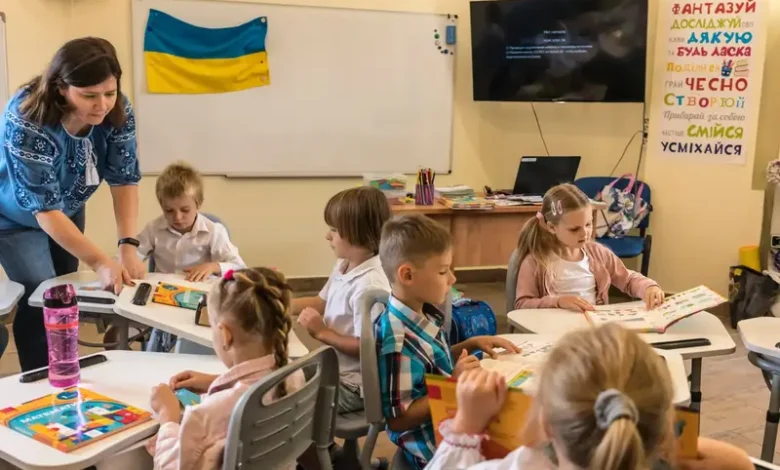
Ukrainian schools have long been operating in conditions where the quality of education depends on how flexibly an educational institution can organize work with children of different ages, levels of preparation, and educational needs. The war has exacerbated problems that were previously often pushed to the background: large classes make it difficult to provide individual attention to a student, the distance learning format increases the gap in the pace of learning, and the constant fatigue of children forces schools to look for more precise and calmer models of educational interaction. Under such circumstances, even changes in the organization of the classroom have special weight, because they determine how carefully the school can work with a child who is studying in an unstable and exhausting environment. The decision of the Ministry of Education and Science opens up more opportunities for schools to flexibly structure education, taking into account the real needs of children, rather than a rigid scheme that applies equally to everyone.
What do the new rules from the Ministry of Education and Science of Ukraine provide for?
The Ministry of Education and Science of Ukraine changed the rules for dividing classes into groups, emphasizing that this will help teachers work more effectively with students in small groups. The innovations will come into effect in 2027 in all educational institutions simultaneously with the implementation of the reform of specialized high schools.
As noted by the Ministry of Education and Science, the updated rules provide for a broader approach to dividing classes into groups, thanks to which schools will be able to organize education more flexibly and accurately than before. For children studying in wartime, such a change has practical significance, because the larger the class, the more difficult it is for the teacher to see who has fallen behind in the learning pace, who has not mastered the material after missing classes, and who is silent not because of indifference, but because of fatigue, anxiety, or insecurity.
The ministry explains the new approach by saying that dividing into groups gives teachers more space for quality work with children in a smaller circle. For a modern Ukrainian school, this sounds quite objective, since a small group makes it possible to check understanding of the topic more often, listen more to students’ answers, notice gaps faster, and not reduce the lesson to a mechanical presentation of the material to the whole class, in which some children have already fallen behind, and some have long lost concentration.
Why is this important for children studying during the war
The full-scale war has dramatically changed the very quality of school life, because learning for a large number of children has long ceased to be a continuous and predictable process. One student has changed schools several times due to evacuation, another has been studying remotely for months, a third has returned to the classroom after a long period of isolation, and someone interrupts lessons every day due to anxiety and goes down to the shelter. In such circumstances, a large class often turns into an environment in which a weaker student gets lost even faster than in peacetime.
Division into groups in this situation becomes a way to reduce losses that accumulate imperceptibly, but have a long-term effect. A child who finds it difficult to read, express an opinion, keep up with the pace, or get involved in work after another break has a better chance of getting the teacher’s attention in a smaller group and returning to the learning process without feeling hopelessly behind. For a school operating in conditions of exhaustion of children and adults, such an approach seems much more appropriate than trying to fit everyone into the old organizational framework.
Primary school and languages as the most vulnerable place
The most noticeable change concerns primary school, where it will be allowed to divide students into groups to study Ukrainian and foreign languages, if there are 24 or more children in the class. For secondary and high school, the threshold of 27 students remains. This difference is logical, since it is at a younger age that basic language skills are laid, without which all further learning begins to sag – from reading the conditions of the task to the ability to formulate an answer, write a coherent text or understand the teacher’s explanation.
In the reality of war, language training has become even more sensitive, because a significant part of children learn with gaps, lose the consistency of practice and return to class with an uneven level of preparation. One student reads fluently, another confuses basic constructions, and someone else is embarrassed to speak out loud after a long distance period. In a large class, these differences only deepen, while working in a smaller group makes it possible to go through the material more slowly, more attentively and more meaningfully, which for younger students is the basis for further learning.
Distance learning is no longer perceived as an exception
It is especially important that the division of the class into groups is also provided for during distance learning. For the Ukrainian school, this means recognizing the obvious fact: the distance format has long been no longer a temporary superstructure, but a permanent part of the educational reality for a large number of children. In many regions, it is precisely because of the security situation that the school cannot work stably only in person, so any solution that ignores the distance format would be disconnected from life from the beginning.
On the screen, the problems of a large class only worsen, because a child can be present at the lesson technically, but actually drop out of it. In a virtual classroom, it is even easier to get lost, it is even easier to remain silent, it is even more difficult to ask a clarifying question, especially if the connection is unstable, it is noisy at home, and attention is exhausted. Division into smaller groups gives the teacher the opportunity to work more accurately and calmly, and the student – to join the lesson more often not as a silent square on the screen, but as a full-fledged participant in the learning process.
High school will receive more freedom of choice
According to the Ministry of Education and Science, another important part of the new rules is related to the specialized high school, which will be operational from 2027. Institutions participating in the pilot implementation of the reform will be able to form interclass groups to study specialized subjects and integrated courses, and each such group must have at least eight students. This means that the unification will take place not only within one class, but also in accordance with the educational interests of schoolchildren.
For high school students who, in the conditions of war, are trying to maintain at least some certainty about the future, this approach is of particular importance. A teenager who wants to study a certain subject in more depth gets more chances to build his studies meaningfully, without being tied to a random set of students in a particular class. In such a model, the school begins to focus not only on the schedule and number of hours, but also on what the student, who is already faced with the choice of further education or profession, really needs.
The ability to create interclass groups is important not only for the organization of a specialized school, but also for a fairer distribution of educational opportunities. Within the same class, the interests of children often differ very noticeably: someone gravitates towards the exact sciences, someone towards languages, someone wants to study integrated courses that combine several areas. If the school gets the right to gather a separate group of students from different classes, it can more accurately respond to this request and not fit everyone into a single template.
The Ministry of Education and Science believes that for children whose education takes place in a stressful environment, such flexibility is also important because it restores a sense of subjectivity. The student ceases to be part of an array that moves by inertia and begins to see that his interest in the subject can influence the actual organization of education. At a time when war is narrowing the space of choice every day, even such a school change has a much deeper effect than it might seem at first glance.
Updating the rules in such a situation is important because the school is increasingly moving away from a rigid model designed for the same pace and the same conditions for all students. For children who study under the pressure of war, anxiety, distance breaks and accumulated educational losses, a more flexible approach to organizing education becomes an important condition for normal work in the classroom. If such changes really work in school practice, they will make it possible to make the educational process more attentive to the child, his capabilities, his fatigue and his real educational needs.