The modern Ukrainian labor market: shortage of men, the new role of pensioners and gender inequality


The full-scale war radically reshaped the Ukrainian labor market: some went to the front, some went abroad in search of safety, and many are still looking for work without results. Today, the economy looks like a complex mechanism from which key parts suddenly disappeared, and the remaining parts are forced to work at the limits of their capabilities. Under the pressure of staff shortages and mobilization, businesses are forced to reconsider old approaches: if a year ago the age limit for candidates was strict, now companies are opening their doors even to workers over 60.
How mobilization risks are reshaping the Ukrainian labor market
Data from the Ministry of Economy of Ukraine from March 11 sound the alarm, because 80% of all registered unemployed in Ukraine are women. Among young people under 30, the situation is even more absurd, since 70% of girls are officially unemployed. This is a diagnosis of a system that has found itself in a paradoxical trap. While companies are looking for at least someone to fill their jobs, millions of able-bodied women remain hostages of the “invisible front,” where unpaid care for children and elderly parents, professional segregation, and the lack of basic infrastructure that would allow them to leave the house to work prevail.
In general, the country has now found itself at a point where its survival depends on whether we can turn women from a “reserve” into the main player in the economy. After all, while the labor market is “starving,” millions of hands remain tied by outdated lifestyles and the lack of flexible solutions that the state and business have not yet been able to offer.
The transformation of the Ukrainian labor market as of March 2026 has acquired signs of a deep structural crisis, where a chronic shortage of qualified personnel is becoming the main barrier to the recovery of the national economy. The extension of martial law and general mobilization until May 4, 2026 has fixed a state of constant uncertainty, in which traditional strategies for hiring and retaining personnel have finally lost their effectiveness. Business has found itself in a vice between the need to maintain operational activities and the strict requirements of the state for military accounting, which has effectively divided the market into a transparent but scarce “white” sector and a “shadow” segment hidden from the radar.
The total digitalization of control through the “Oberig” ecosystem and the “Rezerv+” mobile application has turned employment into a complex multi-vector quest, where each new employee becomes the object of close attention of territorial recruitment centers. For many men of working age, the risk of receiving a summons directly from the human resources department outweighs the advantages of an official salary and social package, forcing them to choose low-paid but “invisible” employment. Large corporations, accustomed to working exclusively in the legal field, are forced to watch as their potential human resource pool is washed away into the informal sector, where military document requirements are ignored in order to preserve workers.
The most critical situation is observed in industries that have traditionally relied on male labor – construction, logistics and energy, where the shortage of “blue collar” workers has reached the scale of a real personnel famine. The shortage of heavy transport drivers has led to the emergence of a vicious circle, where logistics companies are forced to constantly increase personnel costs, trying to lure specialists from competitors, which automatically increases the cost of each kilometer of transportation and burdens the final cost of goods. A similar degradation of technical potential is occurring in the energy sector and infrastructure restoration, where the lack of a sufficient number of welders and installation engineers is hampering critically important projects to reanimate destroyed facilities.
The institutional memory and managerial stability of the business are being hit by the mobilization of experienced middle management in the “40+” age category, which leads to the emergence of a dangerous administrative vacuum. Young specialists who replace industry veterans often have a theoretical base, but do not have the specific crisis experience that allows them to keep complex systems in working order during wartime. The situation is made worse by the impossibility of any long-term planning, since even the mechanism of 100% reservation for strategic enterprises often gets bogged down in bureaucratic labyrinths or is leveled by a sudden revision of the “criticality” criteria by the government. In addition, companies are increasingly refusing to invest in expensive personnel training, since the risk of mobilizing a specialist immediately after completing the training course makes such expenses economically inexpedient.
Geographical disparities add the final touch to the picture of market imbalance, creating conditions under which front-line regions are literally bleeding to death due to the outflow of talent. Specialists migrate either to the western regions, where the concentration of enterprises with the right to reserve is higher, or they enter a mode of complete self-isolation, avoiding any public manifestations of activity. Such a territorial imbalance is increasingly deepening the economic gap between the regions and calls into question the possibility of rapid stabilization of the labor market, even if mobilization processes are mitigated in the future.
The new role of pensioners in the labor market
Against the background of all the forced transformations of the labor market, the older generation is emerging from the shadow of demographic stereotypes to the position of a strategic personnel reserve. From now on, employers are forced to reconsider their priorities, relying on experience, which was previously mistakenly considered ballast. Today, pensioners are becoming not just a temporary solution to close “holes” in the staff, but a reliable support for business, capable of ensuring the stability of processes in times of turbulence.
Current legislation stimulates such activity through the mechanism of automatic recalculation of payments for every 2 years of additional experience, which adds confidence in the future. A special role is played by the system of bonuses for postponing retirement, when each month of work above the norm increases the size of future payments:
- by 0.5% for each month of postponement up to 60 months;
- by 0.75% – over 60 months.
Such a pragmatic approach allows older people to convert their experience into real capital, while simultaneously satisfying the growing market demand for skilled labor.
The current practice of large players, such as Sense Bank or the KFC restaurant chain, confirms that inclusiveness and a diverse team generate higher efficiency than homogeneous youth teams. In the banking sector, where more than two hundred employees have already crossed the 60-year mark, senior specialists are involved both in support units with the possibility of retraining and in performing complex expert tasks. Gastronomic retail, in turn, sees pensioners as a stable support, where the balance and systematicity of experienced employees harmoniously complement the dynamism and creativity of young people.
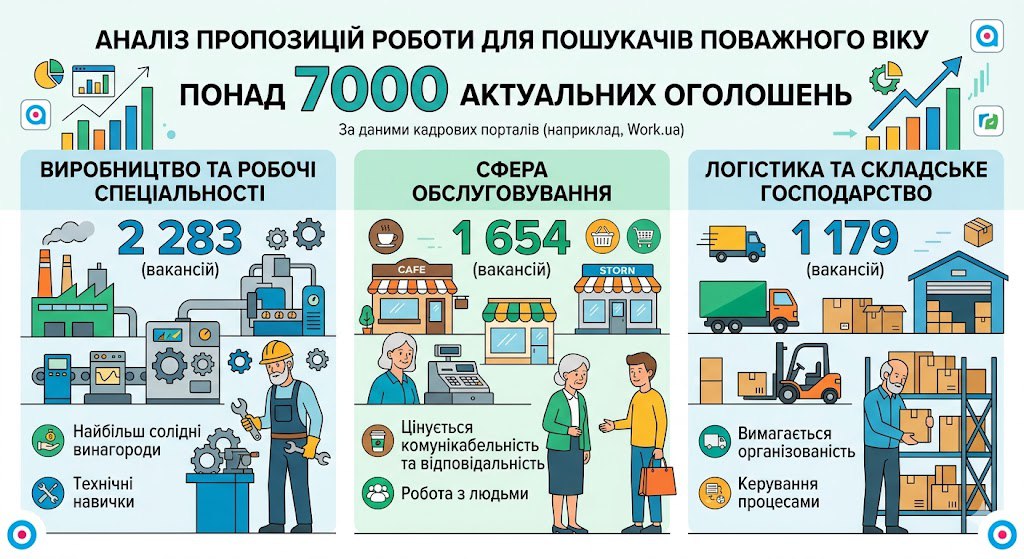
Analysis of offers on leading personnel portals, in particular Work.ua, reveals a huge layer of opportunities, which includes more than 7 thousand relevant ads for searchers of a respectable age. The demand structure is clearly segmented:
- production and working specialties lead in terms of the number of requests (2,283 vacancies), offering the most solid remuneration;
- the service sector takes a confident second place (1,654 vacancies), where sociability and responsibility are valued.
- logistics and warehousing close the top three (1,179 vacancies), requiring primarily organization.
It should be noted that the financial aspect of cooperation with pensioners debunks the myth of cheap labor, because the average offer on the market reaches 27.8 thousand UAH, and in some highly specialized niches the figures become truly impressive. For example, professionals in the field of facade installation can count on an income of up to 240 thousand UAH, while door installation masters claim amounts from 120 to 180 thousand UAH. Such indicators indicate that the market is ready to pay for specific skills and results, regardless of the date of birth in the candidate’s passport.
Despite the general positive trend, islands of age discrimination still persist in the business environment, which are manifested in frankly illegal restrictions on vacancies. Examples of companies such as “Mebli Stil Ukraina” or “Royal_rosarium”, which set age requirements of up to 30 or 45 years, demonstrate an outdated approach that ignores real competencies. Instead of prescribing formal numbers, a progressive employer should focus on physical endurance or specific technical skills, because a 50-year-old specialist can often be ahead of a 45-year-old colleague in terms of training and productivity. The rejection of ageism in a modern civilized country should be not only a matter of ethics, but above all a requirement of economic survival in conditions where every experienced employee is a critically important asset.
The paradox of the Ukrainian labor market
At the same time, the processes of gender replacement, within which women master the professions of heavy equipment operators, trucks or drones, demonstrate the incredible adaptability of Ukrainian society, but they have their own natural and technological limits. In such energy-intensive and physically exhausting industries as metallurgy or underground mining, women’s labor can only partially compensate for the loss of male resources, without solving the problem of a global decline in labor productivity.
Today, 64% of domestic enterprises integrate women into work processes in positions that were historically considered “male,” which demonstrates a significant jump compared to last year’s figure, which barely exceeded half of the market. The adaptation process continues, as another 9% of employers declare their readiness to open vacancies for female specialists in the near future, forming a new employment architecture.
The most pronounced dynamics of substitution are demonstrated by the agricultural sector, industrial production and the sphere of public administration, where the need for skilled hands and bright minds is forcing businesses to reconsider outdated selection criteria. These changes are reflected in the figures of the Ukrainian Gender Equality Index, where over the years 2022–2025 the country has systematically reduced the distance between the sexes in key niches – from education to politics. The current index score of 61.4 points out of 100 possible serves as a litmus test that Ukraine is confidently moving towards European standards, although the path to complete symmetry is still far away.
Despite the active development of technical and production specialties by women, financial remuneration still does not demonstrate a dynamic in solidarity with professional achievements. Statistics from early 2026 indicate a deep imbalance, as the average salary in the country, which was recorded at UAH 27,975 (before tax), hides a significant gender gap.
In January, this overall indicator dropped by 9.5% compared to December 2025, which, against the background of the minimum wage of UAH 8,647, makes the issue of fair pay even more acute. The difference in incomes between men and women remains inert, because if at the start of the full-scale invasion the official gap was 18.6%, then as of 2026 the situation had actually stabilized. In the context of individual industries, this gap becomes even deeper, ranging from the average market 18% to a critical 55%.
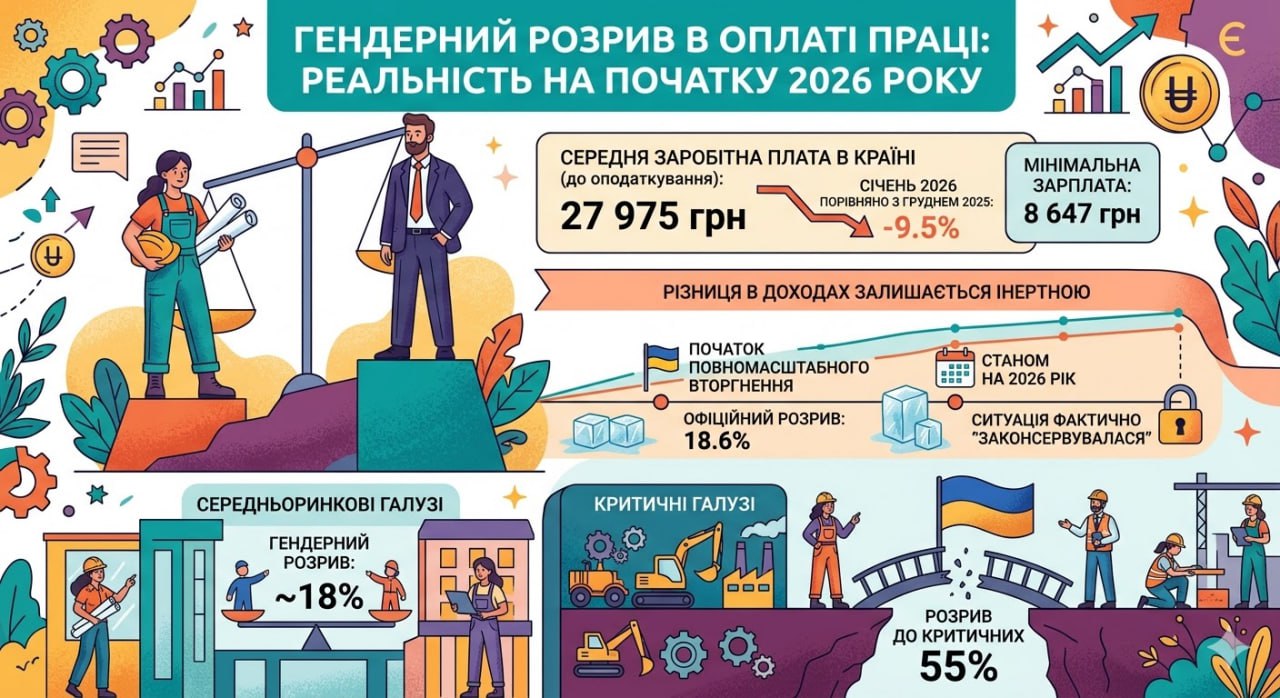
This is explained by two factors:
- women continue to dominate in the budget sector, where tariff scales are traditionally lower, and also more often agree to less favorable financial conditions during employment.
- in certain segments of the economy, women still receive 41.4% less than their male colleagues, even performing an identical amount of work.
The government’s azimuth for the future provides for ambitious reduction of the wage gap to 13.6% by 2030, which is recorded within the National Strategy. However, legislative initiatives are only a framework, while the real content depends on the transformation of the internal culture of private and state-owned companies. While there is a massive transition of women to technical and production areas for the sake of higher incomes, the systematic overcoming of inequality is hampered by the habit of business to save on the wage fund at the expense of women’s resources.
As we can see, Ukraine today resembles Atlanta, which is trying to hold the sky of the economy, with one hand firmly tied to its back. We admire women at the helm of combines and pensioners at machine tools, but we do not notice the main absurdity up close, because the country is suffocating from personnel “hunger”, keeping millions of able-bodied women on the bench. If business and the state continue to perceive a woman or a labor veteran as a “cheap substitute” for a mobilized man, rather than as an equal player, our economic engine will stall completely.