The Prime Minister of Saxony has called for a review of the system of social assistance payments to refugees

After the start of Russia’s full-scale war against Ukraine, millions of Ukrainians sought protection in Europe. Germany became one of the main receiving countries: the government quickly provided Ukrainians with temporary protection, access to housing, medicine, education and social benefits. However, over time, the political and economic situation in Germany itself began to change, and with it, the approach to refugees from Ukraine is gradually transforming. New statements from German politicians point to a potentially tougher course. This especially applies to the sphere of social assistance — one of the most sensitive and at the same time important topics for tens of thousands of Ukrainian families.
The initiative from Saxony: a cost critique and comparison with other countries
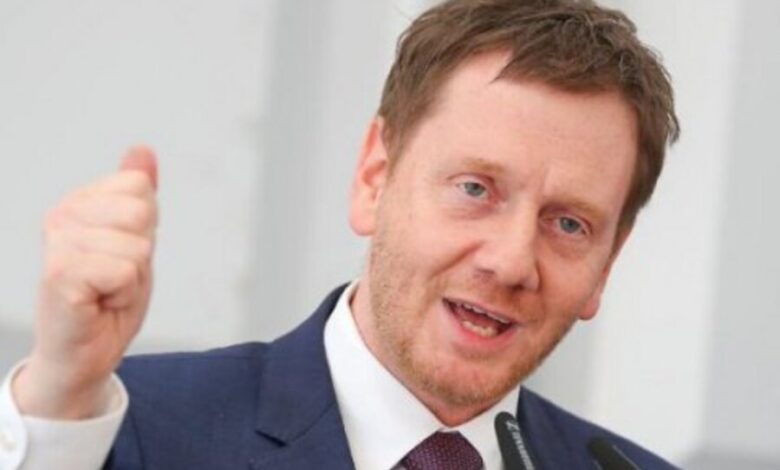
The prime minister of the federal state of Saxony, Michael Kretschmer, took the initiative to review the current system of social benefits in Germany. In a statement quoted by the publication t-online, he emphasized the excessive spending of the federal budget: according to him, Germany spends 47 billion euros on social assistance, and this amount is, in his opinion, unacceptable in the conditions of the modern economy.
Kretschmer made it clear that the problem concerns not only Germans, but also those who came to the country for protection. He stated:
“I think it’s clear to everyone that it can’t be right. That number has to be reduced.”
In this context, he mentioned Ukrainian refugees, noting that there are many people who receive state aid, although objectively they do not need it.
The Prime Minister of Saxony emphasized the comparison with other EU countries: in France, Poland, the Czech Republic and the Netherlands, according to him, the share of Ukrainians who have found employment is much higher than in Germany. This thesis actually voices a new political line — to question the effectiveness and expediency of the current format of support for Ukrainian refugees.
Political wave: signals from Bavaria and Berlin
Kretschmer is not the only high-ranking official who speaks openly about the need for change. Earlier, the Prime Minister of Bavaria, Markus Söder, directly called for the abolition of the so-called “Bürgergeld” (Bürgergeld) for Ukrainian refugees – the state aid received by people who are looking for work or whose income does not cover basic needs. According to Zöder, it is these payments that deter Ukrainians from actively looking for work, as they create a “comfortable social cushion” that reduces the motivation to integrate into the labor market.
His position is part of a wider debate that has been going on in Germany for the past six months. Chancellor Friedrich Merz, the leader of the Christian Democratic Union, announced the introduction of stricter rules for receiving social assistance back in the spring. Actually, his words were a direct signal: a political consensus is forming in Germany regarding the need to change social policy, in particular in the attitude towards Ukrainian refugees.
This is not an isolated political surge. Even under the previous government, which was headed by Olaf Scholz, there were statements about the need to intensify labor participation of Ukrainians. The chancellor urged hundreds of thousands of refugees from Ukraine to find work, stressing the importance of integration through economic independence.
A new focus: help is only for those who need it
The key focus of the current discussion is not to deprive Ukrainians of protection in general, but to limit payments to those who are truly unable to provide for themselves. In the public space, the number of statements about so-called “pseudo-needs” – people who formally receive assistance, although they are able to work, is increasing.
According to some German politicians, the system of social support in its current form creates distortions. This gives rise to a new rhetoric: Ukrainians are no longer perceived only as victims of war — they are increasingly seen as economic migrants who must fulfill their obligations to the society that received them. Such a change in tone inevitably affects public opinion, political initiatives and legislative proposals.
Krechmer’s arguments regarding the level of employment of Ukrainian refugees in neighboring countries are a separate important line of discussion. In Poland, for example, the share of employed Ukrainians is much higher: many of them were ready to work immediately upon arrival, often accepting unskilled or seasonal work. France and the Czech Republic had stricter conditions for receiving social benefits from the beginning, which stimulated activity on the labor market.
In Germany, the situation is different: a high level of payments, access to medical services, free housing in some regions — all this created conditions in which a part of the refugees was really in no hurry to integrate economically. This is now the focus of criticism.
What’s next: the threat of cuts and the demand for change
Current statements are a sign of a potential transformation of integration policy. If Söder’s or Kretschmer’s initiatives gain support in parliament or at the level of the federal states, Ukrainian refugees can expect new requirements: mandatory registration at employment centers, transition from Bürgergeld to basic payments, limitation of the validity period of some benefits.
Formally, Ukrainians remain under the protection of the EU Directive on temporary protection, which is valid until March 2026. However, even within the limits of this directive, Germany has the right to change the mechanisms of social support, and this is already being done at the level of discussions and normative projects.
Consequently, social payments, which until recently were considered a tool of humanitarian support, are gradually turning into a point of political conflict. Ukrainian refugees in Germany found themselves between two realities: on the one hand, the need for security and support, on the other hand, the increasingly clear demand to integrate, work, and not depend on aid.