The State Service for Food and Consumer Protection named the reasons for the locust invasion in Ukraine

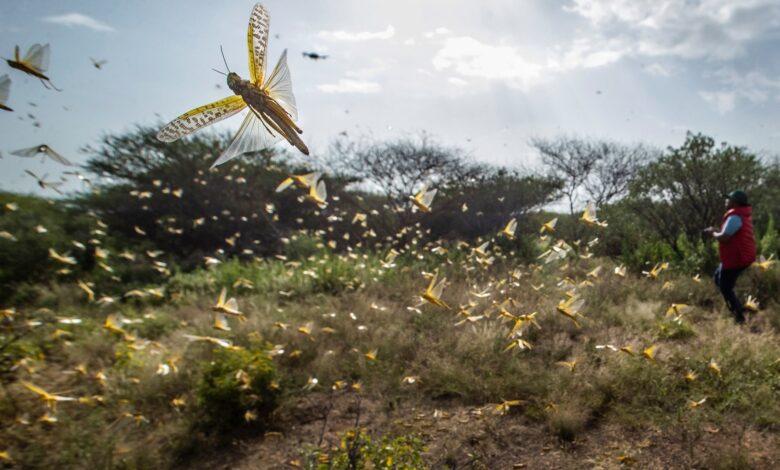
The locust infestation recorded in some regions of Ukraine is not a catastrophic phenomenon — the situation remains under control and is caused by war, climate change, and disruption of ecosystems. About this stated deputy head of the State Production and Consumer Service, Vadym Tchaikovsky.
According to him, the problem does exist, in particular in the territories near the front line, but this is not a new phenomenon – outbreaks of locusts are recorded every year, and this year’s situation did not get out of control.
“The invasion of locusts is a consequence of Russia’s ecocide against Ukraine. And not only against Ukraine, but also against the whole world.” — emphasized Tchaikovsky.
Among the main reasons for the spread of locusts, he named the increase in average daily temperatures, changes in natural and climatic conditions, the consequences of the destruction of the Kakhovskaya HPP, military actions and abandoned agricultural lands in the war zone.
In 2024, the regime of phytosanitary protection was implemented on the territory of the Slobozhan settlement council of the Chuguyiv district of the Kharkiv region. Previously, centers were found in Zaporizhzhia, Kherson, and Donetsk regions, and before that in the southern regions: Odesa, Mykolaiv, and Dnipropetrovsk.
Tchaikovsky also reported that in the Zaporizhzhia region, ducks actively eat locusts and, according to local residents, refuse other food. Such natural methods of pest control have already shown effectiveness, in particular in Pakistan. Currently, in the Zaporizhzhia region, experts are recording the movement of locusts in the southeast direction — towards the front line.
We will remind you that on July 11, a nest of migratory locusts was discovered for the first time on the territory of Kushugumsk community of Zaporizhzhya region. In the Communarsky district of Zaporizhzhia, a regime of phytosanitary protection was implemented on an area of 6,110 hectares, of which about 50% are infected. It mainly concerns recreational areas, non-agricultural land and the coastal zone of the Dnipro River.
At the same time, experts have already recorded a decrease in the number and activity of the pest — 7–10 individuals per square meter. The Department of Phytosanitary Safety in the region continues to monitor the situation. The State Production and Consumer Service reported that after carrying out effective extermination measures in the Kherson region, the possibility of canceling the special plant protection regime is being considered. The locust was also successfully eradicated in the Odesa region, and in Dnipropetrovsk its population currently does not pose a threat.