
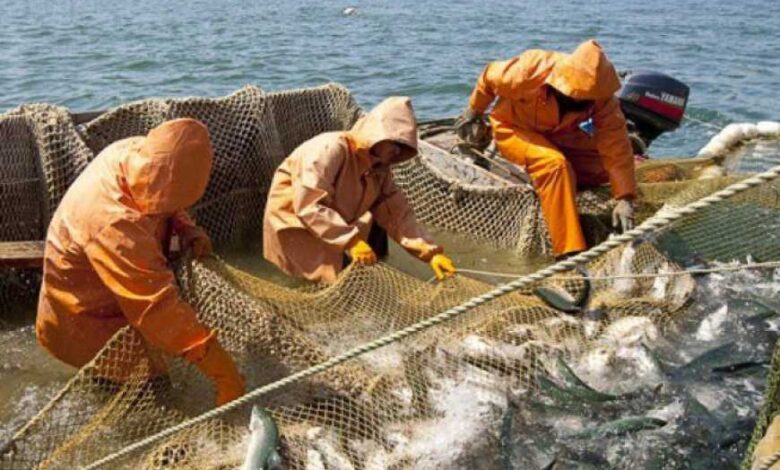
During January-September, commercial fishermen caught 5,915 tons of aquatic bioresources in Ukrainian waters. This was reported by the State Agency of Ukraine for the Development of Reclamation, Fisheries and Food Programs.
The largest share was traditionally made up of silver crucian carp – 2,030 tons. The basis of the fishery also included bream (1,198 tons), roach (784 tons), flatfish (540 tons), pike-perch (271 tons), silver bream and grass carp (247 tons), common perch (158 tons), Black Sea herring (144 tons), bluegill (115 tons), catfish (89 tons) and carp (81 tons).
“The above fish catch indicators, despite the complete cessation of marine fishing due to the military aggression of the Russian Federation, emphasize the strategic importance of fishing in inland waters. In wartime, the effective use of the potential of our reservoirs, estuaries and rivers becomes a key factor in strengthening the food security of the state. Each ton of fish caught is a direct contribution to the saturation of the domestic market, providing the population with an affordable and useful protein product, as well as an effective tool for gradually reducing Ukraine’s dependence on imported fish products,” said Igor Klymenok, head of the State Fish Agency.
Due to the blockade of the Black and Azov Seas as a result of the Russian Federation’s military aggression, commercial fishing of marine fish species is currently practically non-existent. These are species such as turbot, glos, mullet, anchovy, rapana, shrimp and pilengas, which in the pre-war years accounted for a significant share of the fishery.
However, since the beginning of the year, the largest number of aquatic biological resources has been caught in the Kremenchuk reservoir – 2,798 tons. 1,270 tons were caught in the Kamyansk reservoir, 505 tons in the Dnipro reservoir, 338 tons in the Kyiv reservoir, and 336 tons in the Kaniv reservoir. The catch also amounted to 280 tons in the lower reaches of the Dniester River (including lakes, the Turunchuk arm, and the Dniester Estuary) and 163 tons in the Dnieper-Bug estuary system.


