Two worlds – one country: why it is important to build a dialogue between the military and civilians

There is a lot of talk in Ukraine about how to help the military return to a peaceful life. Adaptation programs, courses, rehabilitation are very important in today’s realities. However, there is often one big blind spot in the center of this conversation: society is not ready for the fact that after a great war “peaceful life” itself will not be the same as before. We want the military to change and become calmer, “less military”, to return to the old framework of civilian life, but in fact it is not only them who need to change. The interaction between civilians and the military already often fails not because of them, but because of society’s reluctance to accept that communication should be different. An insistent return to “the way it was” is unlikely to be perceived by many as a path to normality, but rather as an attempt to hide from the new reality.
Statistics with a human face
For data of the Ministry of Veterans, there are now more than 1.2 million people with the status of combatant in Ukraine. In accordance with by the results of the all-Ukrainian survey conducted by the Sociological Group “Rating” on the order of the Ukrainian Veterans’ Fund of the Ministry of Veterans Affairs, 54% of respondents reported that among their relatives or relatives there are participants in the hostilities of 2014-2021. At the same time, 71% have in their close circle those who fought or continue to fight since February 24, 2022. Compared to previous waves of surveys, an increase in the share of those whose loved ones are currently at the front was recorded. At the same time, an online survey of the Ukrainian Veterans Fund showed, that more than 58% of veterans feel insufficient respect from society, which is significantly more compared to the previous year.
After returning from war, veterans face a number of serious challenges. Among the most common, experts note psychological instability, health problems, as well as difficulties with access to medical services. Added to this is the lack of an inclusive environment, the lack of adapted workplaces for people with disabilities, bureaucratic difficulties in obtaining social guarantees and strained relationships with the family.
Problems such as the negative attitude of society towards the military after communication with the TCC, unemployment, alcohol or drug use, as well as the incompatibility of combat experience with the conditions of peaceful life are also often mentioned. About 50% of respondents pointed to the threat of suicide among veterans and the possibility that some of them may break the law or become involved in criminal activities.
Compared to March 2024, those who consider alcohol or drug abuse as particularly risky, as well as criminalization, have increased. On the other hand, expectations regarding unemployment and suicides have decreased somewhat. Relatives of those who have served since 2014 and are currently participating in hostilities are most worried about these problems. These data indicate that support for veterans is not limited to medical or social services. Systematic work must be done to change public attitudes and reduce stigmatization.
Military and civilian: complex but necessary interaction
War is connected not only with combat operations at the front, it is primarily a great transformation of human destinies. After returning home, military personnel face a number of challenges that are often overlooked by society, not because of indifference, but rather because of an inability to communicate with and understand veterans. However, understanding these challenges first is key to building effective military-civilian interactions.
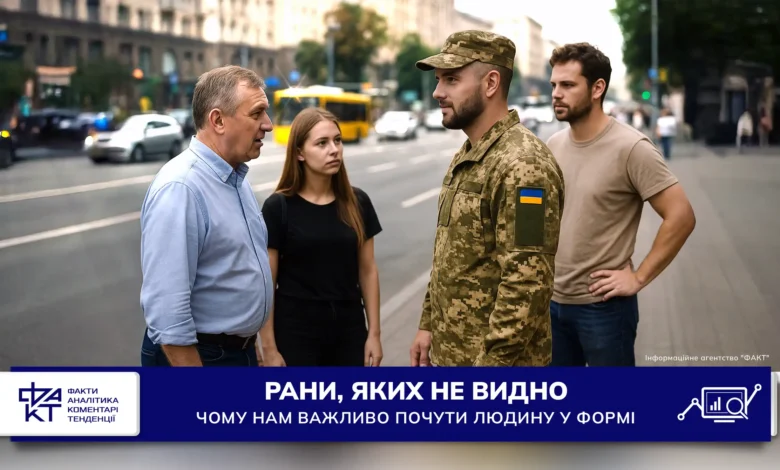
Sometimes the indifference of civilians to wounded soldiers is more painful than a splinter. He enters a crowded bus with a cane or a prosthesis, holding on to the handrail while those sitting next to him turn away from the windows or have their heads buried in their phones. At the checkout of the supermarket, he stands in line with small purchases, and no one would think of missing him. On the street, passers-by look at the scars on the face with interest, but turn away when they just need to support a conversation or ask how to help. Few people will approach a soldier lying on the sidewalk. People think that he is drunk and do not think that he is sick. The war became the background, and those who endured it, as if part of the scenery, which is convenient to ignore.
One of the most difficult issues veterans face is losing themselves. After a long stay on the front line, without changes in the environment and without vacations, a person stops recognizing his own limits and needs. When the long-awaited vacation comes, a soldier can quickly sleep, but after a few days he feels an urgent need to return to his comrades. Such an internal struggle becomes one of the least noticeable challenges, because everything seems normal on the surface.
Therefore, the need for psychological support becomes urgent in such conditions, but it is worth understanding that this is a very difficult and delicate work. It often occurs in conditions that are far from ideal. For example, the offices of psychologists are located several kilometers from the front, but this still does not guarantee complete security and peace. A military psychologist does not have the opportunity to apply standard therapeutic approaches to the full extent, because a person is constantly under tension and danger.
It is also important to understand that not all military personnel suffer from the classic post-traumatic stress disorder (PTSD), which society has become accustomed to ascribing to all those who return from the front. It is not uncommon to see that after severe injuries, a person changes not only painfully, but also positively, because there is a revaluation of values and even growth. There are veterans who, after amputations, find a new meaning in life and rejoice every day. Such a change is very subtle and does not lend itself to simple treatment schemes, because such a process requires understanding and support.
It should not be forgotten that the return of a military man becomes a real challenge both for him and for his family. War often destroys families, because loved ones are not always ready for the realities with which the veteran returned. Lack of common experience, misunderstanding of each other, often leads to divorces or emotional distance. It is important that both parties have a desire to work on the relationship and seek ways of understanding.
One of the least visible, but widespread methods of “survival” is withdrawal and alcohol consumption. Everyone is used to writing it off as a “bad habit”. But often this behavior becomes a normal attempt to cope with stress when there is no support nearby. The problem is exacerbated by silence, when neither the veteran nor his loved ones can open up to each other. It is important to create an environment where you can speak, even if you don’t know what to say, but are willing to listen.
What civil society needs
In order to build a healthy interaction, one should not expect that the veteran will return “the same”. It should be understood that war changes a person forever without exception. Accordingly, society must change to these new realities. This should apply not only to government programs, but also to everyday communication, workplaces, and infrastructure. Civilians should learn to recognize and respect these changes without imposing artificial norms or creating pressure.
Despite all state strategies and ministerial plans, the real adaptation of veterans should not begin with loud chatter and reports, but right here and now in your hometown, village, on the street, where you are recognized by your eyes. It is the community that is the first environment to which a person returns after the war, and it is here that one can either be gently picked up or painfully pushed away.
Most of the problems we talk about are manifested in loneliness, silence, misunderstanding. And they do not arise as a result of some “psychology of war”. They occur when a veteran returns to a world that lives as if nothing happened. And here it is very important to have those around who are not afraid to listen, do not pressure, do not pity, but simply is nearby and tries to hear and understand.
Some communities have already launched a simple but effective initiative: mentoring programs where a veteran and a civilian work in pairs. This is not “curation” or “guardianship”, but a horizontal relationship built on trust. Someone helps to navigate household trifles, and someone just regularly comes for coffee. Such things do not need a budget. They need attention and desire to be around. Often, it is precisely such meetings that become the most powerful “rehabilitation courses”.
Support groups become places where, during regular meetings, veterans can talk to those who understands without unnecessary questions and moralizing. There is no need to build a special building to organize such spaces. Meetings in a library, a club or even a garage can become real “points of support”. Sometimes it’s just enough to know that somewhere there is a person who was there too and had a similar experience.
Work also gives a sense of necessity, a structure of days, a feeling that you are part of society again. Retraining programs, benefits for employers, adapted vacancies give a chance to be useful again. And many veterans do not wait for a “place”, but create businesses, workshops, veteran coffee shops themselves. They just need support at the start, not sympathy from the outside.
Officials, doctors, teachers, even police officers, who in everyday life come into contact with people after the front, have to learn “another language”. Not according to textbooks, but at least on a basic level, what is anxiety, how triggers work, how not to overload a person with questions or bureaucracy in the first days of return. Such educational programs already exist, but it is only necessary to adapt them to local realities, because the worst thing is when we only have a formality at the most sensitive moment.
In the end, the main question is not whether the state will prepare the “infrastructure”, but whether we ourselves, in our communities, will prepare a space where a person will not be asked “When will you become normal?”, but will say: “How good that you are back.”
We often talk about returning veterans as a big challenge, but we forget that it’s also a big opportunity. Yes, war breaks, but it also exposes the essence. People who have passed through the front carry with them not only pain. They become bearers of invaluable experience that a peaceful society has never had. And this experience concerns not only issues of survival, but also reveals the essence of strength, dignity and active actions, even in emergency situations. Veterans can become not just “those who need adaptation”, but those who leads. Their return gives society a chance not to seal the cracks of the old system, but to build a new one with different values.
The front clearly cuts off the superfluous, because there is no time for hypocrisy and useless chatter. The military knows a clear line between truth and falsehood, between responsibility and indifference. And this experience comes home with people. If we are willing to listen, then we have a chance to rethink what is really important to us.
Most public institutions still work according to the logic of compromises, delays and formalities. Veteran communities often have an ethic of action based on the principle of “see a problem, solve it.” And this could become the new standard. The new cultural norm is to be direct, take responsibility, not hide behind the “system” and look for the guilty.
Many veterans have experience in command, decision-making under stress, responsibility for the lives of others. So they do not need “instructions from above”. If given the opportunity, they can become new leaders in communities, business, education and politics. And this is not pathos, but simple logic: those who survived the war will definitely be able to raise and hold the country.
How it works in other states: experience worth knowing
The return of the military to civilian life became a challenge not only for Ukraine. Other countries have also faced this, and each of them has chosen its own path. Somewhere he was successful, and somewhere he became quite controversial. The US has perhaps one of the most powerful systems of working with veterans in the world — VA System (Department of Veterans Affairs). It includes public clinics, education programs, housing loans and family support. Peer-to-peer programs, when one veteran supports another, are especially common. This helps to better understand the condition of siblings and not to lose touch with the environment.
However, at the same time, despite all the resources, the US has a large number of veterans with PTSD, high suicide rates, and addiction problems. All these shortcomings point to the fact that money and the bureaucratic machine cannot always close the deep wounds of war. A culture of perception is also needed. And here Americans have taught their society not to stigmatize their veterans. It is a part of identity, a respect, a history to be respected, not mocked or feared.
Israel has a different approach. Almost everyone is doing military service there. Because of this, returning from the army does not look like something “special” or “traumatic”, but fully integrated into the social fabric. Veterans have fewer barriers in communicating with civilians, because the experience of war or the army is understandable to the majority, which significantly reduces stigma and promotes better reintegration. Israel is also developing psychological support centers, often at universities or public organizations, where not only doctors but also former military personnel provide assistance. They follow the principle “you are not alone”, and it really works.
The post-Yugoslav experience shows us a completely different side of the coin. In Croatia and Bosnia, after the war of the 1990s, veterans found themselves in a situation where they were used as a political tool. In many cases, instead of rehabilitation, the state created privileges without real support. This led to the fact that part of the veteran communities became radicalized over time, while others simply remained on the sidelines. However, there were also positive steps. In particular, Croatia invested in social entrepreneurship programs where veterans created businesses with communities, which helped reduce isolation and give people a new meaning after the war.
It is clear that we will be coming back from this war for a long time. Some return physically, some in soul, and some will keep complete silence. But it is obvious that this return will be a long process and will concern not only the military themselves. After all, this is a great common path. And he is not about doing everything again “as it was”, because it will never be like that. We will have the opportunity to change what did not work before, we will get a chance to learn to live in a new reality not by touch, but with understanding, sensitivity and a desire to be close. It is only necessary to stop trying to “adjust” veterans for peace, and to change society so that it does not alienate those who have gone through the hardest.
This path will not be easy, because no real transformation is comfortable. But if we go through it together, then we have a chance to build a country where the experience of war will not be a stigma, but will become a point of growth, where pain is not hidden, but learned to act on it, and instead of alienation, a common language and a new meaning for living together appear.