
Ukraine has become the leader among European countries in terms of the projected increase in food prices: what does the balance with salaries and pensions look like?

The Ukrainian food market in 2026 was under pressure from anomalous inflation, which exceeds the average European and world indicators by almost three times. The growth in food prices, which is forecast at 9.2%, is the result of a combination of energy shortages, the destructive impact of shelling on critical infrastructure, and the shortage of human capital in manufacturing industries. In these conditions, nominal indicators of average wages and pensions become only a statistical illusion, and the real purchasing power of Ukrainians remains critically low. State statistics continue to paint a virtual picture of well-being in offices, but the real purchasing power of citizens has long since entered a free-fall mode, where the gap between the “average salary” in reports and an empty wallet at the cash register becomes insurmountable.
European Anti-Rating 2026: Why Ukrainian Price Tags Ignore Global Stabilization
Ukraine found itself at the epicenter of European food inflation in 2026, leading the region’s anti-rating with a projected price growth rate of 9.2%. According to analytical data Visual Capitalist and expert calculations by FAO, food inflation in the country could reach double digits, the highest in Europe. This actually makes Ukrainian dynamics anomalous against the backdrop of a global trend towards calming markets. While global average food inflation is expected to slow to 3.2% from last year’s 4.7%, domestic Ukrainian prices are showing resilience to declines due to logistics distortions and specific supply risks.
The global distribution of inflationary pressures reveals a colossal gap between stable and destabilized economies, with the Asia-Pacific region at one end growing at a meager 1% and countries with chronic financial crises at the other. The most radical jump is expected in Iran, where food prices could rise by a staggering 55.9% due to a critical depreciation of the national currency. Similar devastating scenarios are unfolding in Argentina (+33.2%) and Turkey (+25.1%), where multi-year inflationary spirals remain the main driver of price formation.
It should be noted that Malawi, Nigeria, Angola, Zambia and Ethiopia are among the countries with the largest projected jump in food prices. This indicates that the increase in food prices in Ukraine puts it on a par with countries with low economic development, in which food insecurity is a daily reality. And this makes the situation in our country particularly alarming.
The regional hierarchy of expected food price increases in 2026 is as follows:
- Middle East and North Africa: 8.9%;
- Latin America: 4.8%;
- North America: 4.3%;
- Europe and Central Asia: 4.2%;
- Sub-Saharan Africa: 3.8%;
- South Asia: 2.7%
It should be noted that the foundation for such unevenness is a combination of currency fluctuations, volatility in global commodity prices, and internal trade barriers, which hit countries with weakened financial systems the hardest.
It is worth understanding that food inflation remains the most inert challenge for households, since even if global markets stabilize, weather shocks and geopolitical risks can instantly provoke new price spikes. Despite the fact that in some countries even a decrease in food prices is predicted, the Ukrainian market in 2026 will remain a zone of increased tension, where price dynamics will significantly outpace the average European and world indicators.
Energy shortage and import dependence: causes of abnormal prices
The abnormal trajectory of prices on the Ukrainian food market was a direct consequence of the critical overload of the manufacturing sector, which is forced to adapt to the extreme conditions of energy shortage. While global economic processes tend to stabilize, the internal situation in the country is determined not so much by world commodity prices as by the ability of enterprises to maintain the vital activity of workshops in conditions of continuous attacks on infrastructure.
This gap between the expected cost of products and the reality on store shelves arises from a forced change in the cost structure, where the energy security of each individual plant is a heavy burden on the end consumer.
The devastating impact of shelling of energy infrastructure, which in early 2026 resulted in the use of over 300 missiles and 7 thousand drones by the enemy, has transformed from a domestic problem into a fundamental threat to food security. Constant power shortages force food producers to balance on the verge of a standstill, as modern lines require a continuous power cycle, and any sudden pause leads to spoilage of raw materials and the emergence of technological shortages.
The systemic crisis, which has intensified since the end of 2025, has turned episodic outages into a daily struggle for survival, where own generation is becoming not a luxury, but the only means of preserving jobs and market positions.
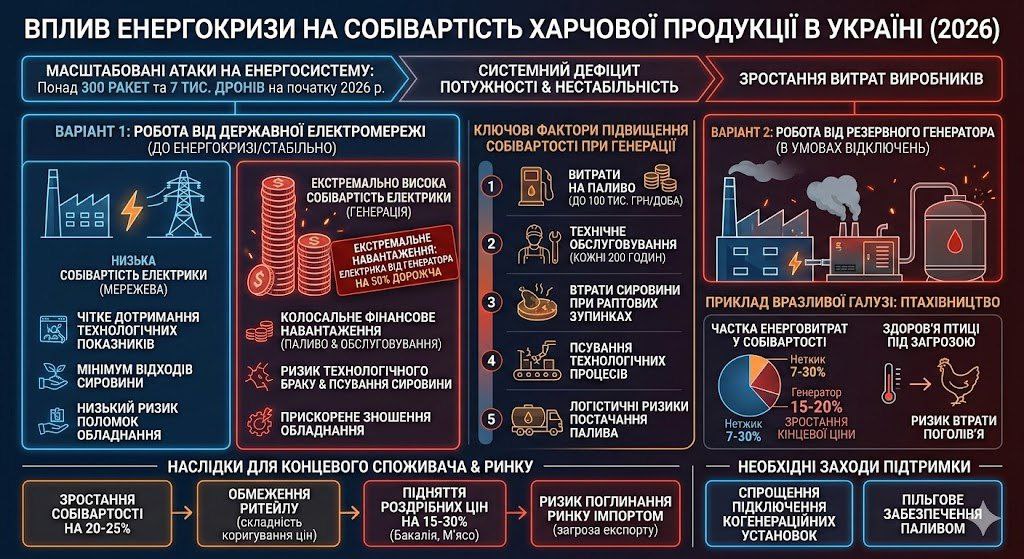
The use of diesel generators and alternative energy sources entails a colossal financial burden, because electricity from such installations costs enterprises 50% more than network electricity. Daily fuel costs alone for one powerful facility can reach 100 thousand UAH, to which are added the costs of maintenance every 200 hours of operation and the risks of logistical disruptions in fuel supply. For example, in the baking and flour milling industries, in order to maintain stable production, it is necessary to invest in generation systems with a capacity of up to 3 MW, but even such equipment is not designed for 24-hour operation for a long time and often fails.
Poultry farming turned out to be especially vulnerable to energy instability, where a violation of the temperature regime during incubation or growing threatens with a complete loss of livestock. Since the share of energy consumption in this industry varies from 7% to 30% depending on the type of product, the transition to backup power triggers a mechanism of exponential increase in prices at each stage of the production chain. Technological cycles lasting for months require ideal accuracy of indicators, which cannot be ensured in conditions where switching between the network and the generator is accompanied by dozens of failures per month, which directly affects the final cost of the product.
The economic pressure on producers is exacerbated by the rigid retail framework, which limits the ability to promptly adjust prices on store shelves, despite a 20-25% increase in cost. The combination of expensive energy costs, higher packaging costs, and logistical difficulties will inevitably lead to a 15-30% increase in retail prices for grocery and meat products in the near future. If support mechanisms are not implemented, such as simplifying the procedures for connecting cogeneration units or providing preferential fuel, the domestic market risks being absorbed by imports, which will subsequently require significantly greater investments to regain lost positions and restore the country’s export image.
An additional catalyst for price pressure that is pushing Ukraine to the peak of the European anti-rating is the progressive shortage of human capital, which in early 2026 turned from an operational difficulty into a critical economic factor. According to Agrohub industry research, more than 83% of agricultural companies are forced to include a significant increase in personnel costs in their budgets, and for scarce specialties, such as drivers and tractor operators, the increase in payments reaches 25%. Since the shortage of personnel in the sector has already exceeded the 30% mark, the consumer at the checkout is actually paying for the forced competition of businesses for specialists whose labor in the crisis has become not only more expensive, but also scarce.
Along with the personnel crisis, there is a deep deformation of internal logistics, reinforced by the new fiscal and market realities of the beginning of 2026. From January 1, another increase in excise duties on fuel (up to 300.8 euros per 1,000 liters for gasoline and 253.8 euros for diesel) combined with devaluation processes has led to the fact that retail prices at gas stations have become fixed at record high levels, in some places reaching 70 UAH per liter. This creates a double whammy, with producers spending more on energy generation and at the same time being forced to factor record transport tariffs into the cost of each batch of goods delivered to supermarkets.
An equally worrying factor is the change in the structure of foreign trade, where at the beginning of 2026 imports began to significantly exceed exports, creating additional pressure on the exchange rate. The reduction in areas under vegetable crops forced the market to reorient itself towards external supplies, which instantly affected the cost of a borscht set, because in January 2026 alone, certain categories of vegetables rose in price by 18.6%, and greenhouse products showed growth of over 30%. Such a binding of the basic consumer basket to currency quotes due to dependence on imported seeds, pesticides and fuel finally deprives domestic prices of immunity to global financial shocks.
Statistical hallucination: why the “average salary” and pensions are growing only in the Cabinet of Ministers’ reports
Against the backdrop of a significant rise in prices, the gap between official reports and the contents of Ukrainians’ wallets in 2026 is turning into a real test of endurance, where the beautiful percentages of indexation hide the daily struggle for survival. For millions of citizens whose incomes barely keep up with the subsistence minimum, each nominal “increase” that officials so willingly announce becomes just another figure that cannot keep up with price tags in supermarkets and payments for electricity generation.
The mathematical illusion of an average salary of UAH 27,975, recorded at the beginning of 2026, looks like a blatant mockery against the background of the real state of the wallets of most Ukrainians. While official statistics report sky-high incomes in the IT sector at the level of UAH 76.9 thousand, the reality for most citizens remains locked in the range of UAH 9-12 thousand and the minimum wage, which, although it increased to UAH 8,647, was instantly “eaten up” by tax pressure. This average salary indicator is a classic example of “statistical manipulation”, where the capital’s cosmic earnings (43.8 thousand UAH) are added to salaries at the survival level. For example, in Chernivtsi or Kirovohrad regions (about 19.9 thousand UAH), creating a picture of well-being that does not exist for the average worker.
Especially cynical against this background is the chronic epic with promises to educators, whose incomes have been the object of pre-election and budget manipulations for years. The government declared an ambitious phased increase in teachers’ salaries by 30% and 20%, promising an average level of 30 thousand UAH by September 2026. However, these figures remain only on paper, while the arrears in salary payments in the country have already reached a critical 3.4 billion UAH. Teachers have once again found themselves hostages of hopes, where the 21.7 thousand UAH announced at the beginning of the year is a ceiling rather than a guaranteed minimum, which, against the background of 9.2% food inflation, makes their real purchasing power lower than in previous years.
A similar situation is observed in the pension system, where the spring indexation of 2026 is turning into an accounting trap for more than 5 million Ukrainians. Although the average salary for calculating pensions has been increased to 9,992 UAH, this will not bring real relief for most elderly people.
Fiscal pressure on small businesses finally closes this circle, since the increase in the minimum wage automatically increased the tax burden on individual entrepreneurs, forcing them to include these costs in the cost of goods and services. Increasing the social security contribution to UAH 1,902 and introducing a military levy for entrepreneurs of the first and second groups in the amount of UAH 864.7 creates a situation where every nominal “improvement” in the reports of the Ministry of Finance turns into a real increase in the price of life on store shelves.
As we can see, the Ukrainian economy in 2026 operates in a mode of parallel realities, where salaries in the reports grow and are indexed, but in reality people are forced to balance between the illusory UAH 27,000 of the so-called “average” salary and the subsistence minimum of UAH 3,209, which does not even cover basic needs in the conditions of the energy crisis. Such a situation inevitably demonstrates a state of systemic exhaustion, when financial stability becomes the privilege of a few, and for the majority the only choice is what to save on this month — on light, heat or their own health.
People say: “a full person is not a friend to a hungry person.” It is not surprising that officials with their sky-high salaries are unlikely to understand the problems of the average Ukrainian. But still, the “servants of the people” need to come down from their lofty offices and face the truth, and not give out empty promises left and right.
If the situation with food prices and energy shortages remains unchanged, Ukrainians in 2026 will face a further decline in real purchasing power. At the same time, existing salaries and pensions will not cover basic expenses, and energy outages will make products and goods even more expensive. Households will be forced to reduce consumption and save on food, and small businesses risk losing production capacity due to the inability to maintain cost prices. Without urgent government intervention in this situation, domestic prices will continue to outpace European prices, and the crisis will become systemic, affecting every level of the economy.


