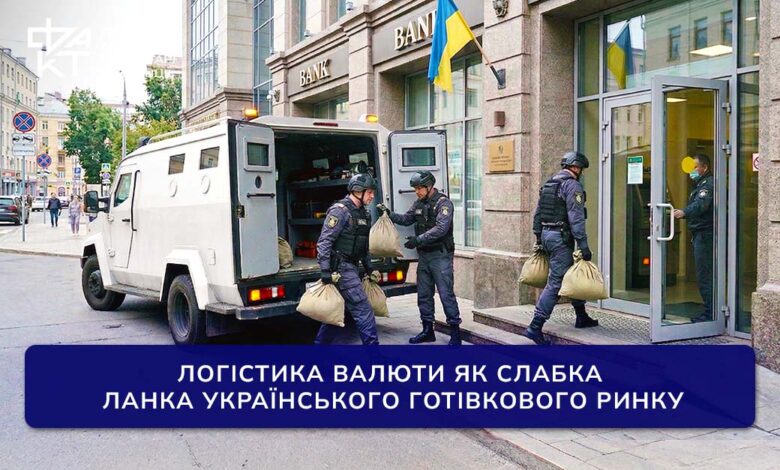
One incident on the European route suddenly showed how dangerous the Ukrainian currency market’s dependence on the physical transportation of cash is. While official statistics maintain the appearance of a restrained equilibrium, the real weakness of the system is manifested elsewhere. Once the supply chain broke down, the problem went far beyond banking logistics, affecting cash desks, exchange offices, exchange rates, and people’s trust in the very availability of currency. Behind the seemingly flat statistics of the first two months of 2026 lies a much harsher reality, revealing a market whose resilience has proven to be much more fragile than it seemed at first glance.
The situation where the stability of the national currency depends on the throughput of customs points is a critical vulnerability of the system. The March slump in cash dollar supplies is paving the way for another round of speculation, turning logistical obstacles into a direct factor of pressure hitting Ukrainians’ savings.
Hryvnia outflow to interbank: risks for government savings and the cash market
The current state of the Ukrainian foreign exchange market shows signs of a large-scale capital reversal, where the banking sector is the main driver of the flight from the national currency. Financial institutions have actually begun an aggressive migration from hryvnia assets, which is confirmed by the rapid leaching of liquidity from the National Bank’s instruments.
In January and February 2026, Ukrainian banks imported cash currency into the country for a total of $1.7 billion, but this indicator in itself looks calm only until it is put into a time context. January’s $0.8 billion and February’s $0.91 billion form a smooth, without jerks, trajectory of the beginning of the year, which corresponds to a moderate pace and does not create the impression of excitement. Such volumes are comparable to the level of 2023, but they do not reach the scale of 2024 and 2025, and therefore, the market enters 2026 without the reserve of intensity that was characteristic of the two previous periods.
In this dynamics, it is important not only the overall result, but also how it is distributed between individual months, because the difference between 0.8 and 0.91 billion dollars does not indicate a reversal of the trend, but rather shows the preservation of relative balance. In other words, banks continued to import cash currency without sharp jumps, when the market is not overheated, but also not in a state of contraction at the start of the year. However, such stability does not guarantee the continuation of the same line in March, since expectations for this month are no longer associated with the internal rhythm of demand, but with an external factor that can quickly break the neat statistics of the first two months.
The reason for the projected decline is logistical obstacles on European routes, and this factor is important because it affects not abstract estimates, but the cash supply channel itself. When the beginning of the year demonstrates stability, and the following month risks sagging due to transportation complications, this means that the market is faced with a limitation in the ability to deliver it on time. In such conditions, even moderate indicators of January and February take on a different meaning: they no longer look like neutral statistics, but become the upper limit below which March may fall due to disruptions on the routes.
The structure of imported cash also looks telling, because it clearly shows which currency remains the mainstay of this segment. The US dollar accounted for 64% of the total imported volume, the euro – 34%, and another 2% were made up of other currencies and gold. This proportion means that the dollar not only retains its primacy, but continues to form the main framework of the cash currency basket, while the euro occupies the second, also significant, but still noticeably weaker position. The share of other currencies and gold against this background looks almost background, because the two percent presence does not change the overall balance and does not affect the dominance of the two main instruments.
The reverse movement of cash is no less significant, because during the same period, banks exported 407 million dollars in equivalent from the country. Here, the advantage of one currency is even more pronounced: 93% of this volume fell on the US dollar. If in imports the dollar occupies almost two-thirds, and the euro holds a significant third, then in exports the balance actually shifts to almost sole dominance of the US currency. This distribution emphasizes that the dollar remains the key unit not only for filling the cash market, but also for operations related to the reverse movement of currency outside the country.
As a result, the first two months of 2026 present a picture without sharp fluctuations, but also without the scale that was recorded in 2024-2025. The total amount of $ 1.7 billion, moderate monthly volumes, the dominance of the dollar in the structure of imports and its almost complete dominance in exports create a fairly clear market profile. At the same time, March may turn out to be a month when the statistics will change not because of the mood of the participants or the reformatting of the currency basket, but because of a much more mundane reason – logistics problems on European routes, which can nullify the balance with which the year began.
Routes at Risk: How an Incident in Europe Exposed the Vulnerability of Currency Transportation
Transforming logistics chains in the financial transportation sector has become critical after traditional air routes for currency delivery became inaccessible due to full-scale aggression, leaving ground transport as the only tool for filling the domestic market with cash. In this vulnerable segment, the state-owned Sberbank plays a key role, as it holds the exclusive license among commercial institutions for cross-border transportation of valuables across the territory of the European Union.
However, the unprecedented arrest of collection crews by Hungarian law enforcement officers in early March 2026 forced the bank to completely block work in this direction and begin an urgent search for safer corridors. While the reformatting of routes is ongoing, the stability of cash circulation in the country is maintained solely due to interventions from the central bank reserves, which emphasizes the severity of the problem and the need to restore autonomous bank supplies as soon as possible.
The events that unfolded on March 5, 2026 during the transit of valuables from Austria went far beyond the usual document check, turning into the forcible detention of seven cashiers and the seizure of assets of an impressive scale. This involved the loss of operational control over the amount of 40 million USD and 35 million euros, as well as nine kilograms of bank gold, which were in two specialized cars. According to the chairman of the board of Oschadbank Yuriy Katsion, a complex process of developing alternative, safer logistics routes is currently underway, since the Hungarian vector has demonstrated an unacceptable level of risks for state property. While the banking sector adapts to new realities, the National Bank has taken over the function of stabilizing the domestic currency market, using existing gold and foreign exchange reserves to meet demand.
The legal foundation of Oschadbank’s operations is based on an international agreement with Raiffeisen Bank International, which has been successfully operating since 2020, providing a reliable connection between the Ukrainian and European financial markets. It is important to emphasize the uniqueness of Oschadbank’s status, as it is the only commercial institution that has a license to transport valuables across the territory of the European Union, which previously allowed it to effectively fill the market with bank metal and currency. If earlier such logistics chains mostly involved air transport, then in the conditions of a full-scale invasion, land routes became the only alternative artery for the life support of the economy. The scale of the bank’s activities is impressive, as in 2025 alone, the institution provided currency to 39 other banking institutions, conducting transactions worth over 1 billion USD and about 800 million euros.
The cash factor: how demand for paper currency puts pressure on the market
Unlike many Western systems dominated by digital payments, the Ukrainian space continues to have an acute need for the material embodiment of money, which turns ordinary banknotes into a strategic resource. Stability here is determined not only by fluctuations in numbers on dealers’ monitors, but primarily by the ability of each citizen to receive paper currency at the cash desk. Such dependence on the physical movement of capital makes national financial stability sensitive to external factors that usually do not directly affect the banking sector. At the same time, any delays on Europe’s transport arteries or difficulties with border crossings cease to be exclusively a logistical challenge for carriers.
The situation on the roads and the schedules of the collection cars are increasingly becoming important factors in influencing public sentiment, since the shortage of cash in exchange offices can provoke unrest even under conditions of a stable official rate. Therefore, the regular influx of billions is not just a technical procedure, but a critically important mechanism for maintaining equilibrium in conditions where confidence in the system is reinforced by the opportunity to feel one’s own savings with your touch.
The figures for January and February, which are 0.8 billion dollars and 0.91 billion dollars, indicate that the market is not in a panic phase, when banks are forced to massively withdraw cash to quell the hype. However, at the same time, they may mean that the volumes remain large enough to confirm the country’s structural dependence on cash foreign currency. In the conditions of war, a long period of currency restrictions and distrust of part of the population in long-term hryvnia savings, as well as the habit of keeping “hard” currency on hand, the dollar and the euro in Ukraine still perform the function not only of a means of savings, but also of a psychological insurance policy.
The systematic import of large batches of currency confirms that the demand for cash has not disappeared, but has only transformed from panic to habitual, operational demand. Ukrainians buy currency not because they expect a collapse every day, but because they have built it into their survival model. For ordinary families, it is a tool for financial stability, and for small entrepreneurs – a reliable “buffer” against crises. At the same time, banks are forced to constantly ensure the availability of cash, since customer demand instantly reacts to any news or rumors.
However, the message about a possible March slump due to logistics looks ordinary only to those who do not understand the nature of the Ukrainian cash currency market. In a normal, calm, deeply digitalized economy, the problem of the cash supply route is a matter of operational convenience. In Ukrainian conditions, it is also a matter of trust, because the cash market lives not only on numbers, but also on the feeling of availability. As soon as people see that there is less currency, additional demand immediately arises. Not because everyone has suddenly become a currency speculator, but because fear often works faster than arithmetic in the market.
The likely reduction in currency supplies will lead not so much to a global deficit as to the loss of stability of local markets. This will manifest itself through three key factors:
- price gap: an increase in the difference between the buying and selling rate;
- exchange rate fluctuations: a situational increase in the value of cash compared to the interbank rate;
– logistical imbalance: large cities and systemic banks will remain stable, while regions and small players will experience a shortage of cash faster.
Under such conditions, the market will not stop, but will become more expensive and less predictable for the average buyer.
Do not forget that the Ukrainian currency market operates on the border of economic indicators and mass psychology. When technical failures in the supply of currency are superimposed on negative news, the effect of a “ self-fulfilling prophecy” occurs. Even a slight shortage of cash in cash desks is perceived as an alarming signal. As a result, panic demand provokes a real crisis, when people buy up currency not because of its actual shortage, but because of the fear of a future shortage.
In this situation, the concept of currency stability is important, because we are used to considering it simply as a fixed rate, but for Ukrainian realities, the real indicator of stability is the absence of a painful gap between quotes on the interbank market and in exchangers. The large import of currency in previous years partially performed this function: it smoothed out distortions, allowed banks to satisfy demand, restrained the speculative premium in exchangers and prevented the “street rate” from turning into a separate political indicator of anxiety. If the March slump is noticeable but short, the market will swallow it. However, if logistical problems turn out to be systemic, the risk will increase that the cash segment will again begin to live a more nervous life than the official currency circuit.
There is an important nuance in this situation, because the decline in currency imports in 2026 compared to previous years has two opposite interpretations. On the one hand, this can be considered a sign of market recovery, where the hype has subsided, and planning has become more precise. On the other hand, it may indicate an income crisis, when demand falls not due to increased confidence in the national currency, but due to a banal lack of funds among the population. The statistics on cash imports do not give a direct answer, but the second scenario is extremely dangerous for the economy, because it signals the depletion of citizens’ financial resources.
At the same time, it is also not worth dramatizing the March slump, since a one-time logistical problem does not mean a currency crisis. If the National Bank can maintain the overall macro-financial balance, banks will have a reserve of cash liquidity, and the population will not receive additional informational stress, the market will be able to survive a temporary reduction in supplies without catastrophic consequences. But the word “temporary” is key here, because a prolonged shortage of physical currency affects both exchange rates and the reputation of the system’s ability to provide basic financial services.
As we can see, Ukraine’s financial stability today depends not only on the NBU’s complex schedules, but also on the very specific routes of cash collection machines across borders. In wartime, the economy relies on the security of logistics and timely delivery of banknotes, but we are still too dependent on paper currency. Therefore, even minor delays in the delivery of dollars become an important event that signals that our financial system is in survival mode, not full-fledged functioning.