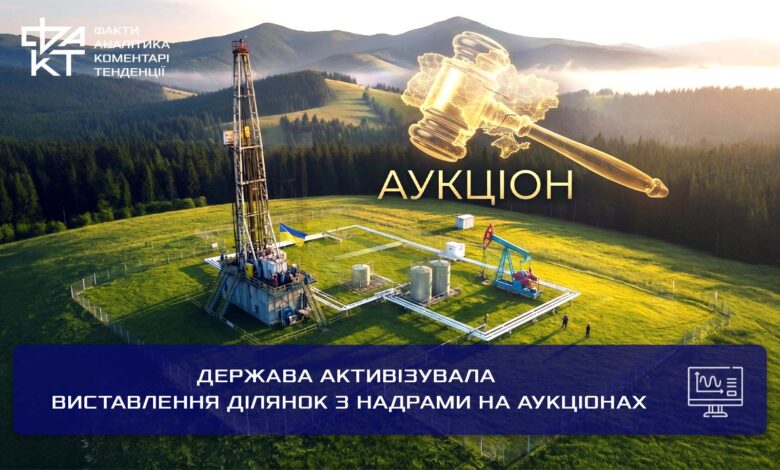
The State Geology and Subsoil Service of Ukraine in 2025–2026 has noticeably intensified the auctioning of subsoil plots. For world practice, this is a common practice when states allow private companies to explore and extract resources, and in return receive profits and taxes, without taking on the main costs and risks. However, in Ukraine there is its own specificity of this process, which carries significant risks. Behind open auctions are hidden not only the chance for investment, but also the question of who will receive long-term access to the resource that belongs to the people, how the state will control this process and what will remain for the country after the auction is over.
Ukrainian subsoil at auction: sale of special permits and privatization of enterprises
In recent years, the State Geology and Subsoil Service of Ukraine has noticeably intensified the sale of special permits for the use of subsoil, and this process has long been no longer limited to individual small areas of sand, clay or amber. Oil and gas fields with billion-dollar starting prices, strategic raw material deposits, areas with graphite, titanium, brown coal, groundwater and non-metallic minerals that may be of strategic importance for industrial chains are being put up for auction.
The Lysovytska hydrocarbon field in Lviv and Ivano-Frankivsk regions has become the most high-profile example of this wave, as the starting price of a special permit exceeds UAH 1.1 billion excluding VAT. According to the order of the State Geological Survey of Ukraine, the auction is scheduled for July 29, 2026. At the same time, the permit is offered for 20 years in an end-to-end format: geological study, experimental and industrial development and further extraction.
The area of the site is 80.11 sq. km, and the minerals listed include natural gas, oil, gas dissolved in oil, and condensate. The territory covers the Kalus district of Ivano-Frankivsk region and the Stryi district of Lviv region, that is, a region where interest in hydrocarbons immediately goes beyond the auction accounting and moves into the plane of environmental restrictions, local communities, and the real impact of industrial operations on the environment.
It should be noted that within the contour of the Lysovytska area there are hydrological natural monuments of local importance, the Morshynske Uzlisya forest reserve, the Morshynskyi landscape reserve, the Viazyna Bolekhivska reserve, and other nature conservation objects. Because of this, the lot cannot be evaluated only by the starting price or potential production, because along with the financial stake, there is the question of whether the state is able to combine investments in energy with strict control over work in territories with natural value.
The initiator of the bidding for the Lysovytska area was Flexor Invest LLC from Kyiv, established in February 2025. The sole owner and manager of the company is Bohdan Kravchenko from the Kremenchuk district of the Poltava region, and this detail is important not as a reason for assumptions, but as part of a transparent picture: a large billion-dollar lot appeared at the auction after a business initiative, and not as an isolated decision of the state without a specific applicant.
In this issue, it is necessary to separate the sale of special permits and the privatization of enterprises, because mixing these processes creates a false impression that the state is selling the deposits forever. In the case of the Lysovytska Square and most similar auctions, the State Geological Survey of Ukraine sells the right to use the subsoil for a certain period, while the subsoil itself, according to the Constitution, remains the property of the Ukrainian people.
A company that purchases a special permit does not receive an enterprise or a deposit into private ownership, but the right to carry out work on a specific site within the established conditions. It must invest money in geological study, drilling, equipment, experimental and industrial development and extraction, and after the start of work, pay the state a rent from the extracted resources. Such a model is closer to long-term use of the resource with financial and regulatory obligations than to the classic sale of property.
Privatization of state-owned enterprises has a different logic, because there the buyer receives a business with assets, infrastructure, equipment, personnel, contracts and often already existing licenses. The United Mining and Chemical Company, associated with the extraction of titanium raw materials, belongs to this type of asset, but its sale did not take place in 2025–2026: the auction was held on October 9, 2024, its buyer was “Tsemin Ukraine”, and the amount was UAH 3.94 billion.
The Bilhorod-Dniester Commercial Sea Port is also an example of privatization of an enterprise, and not the sale of a deposit or a special permit. Its auction was held in November 2024, the main contract was concluded in February 2025, and the completion of the transfer of ownership fell on August 27, 2025. This case is relevant to mention only for the purpose of comparing various state sales, and not as part of subsoil auctions.
The oil and gas segment remains the most visible in license auctions, because here the rates are measured in hundreds of millions and billions of hryvnias. At the end of 2025, the Novodykanska area in Poltava region was sold for over UAH 738 million, the Ostrivska area in Lviv region for UAH 555 million, special permits for the Dnistrovska, Solovyina and Zaozerna areas were also sold at auctions in 2025. The funds from these auctions go to the state budget, and licenses for the use of subsoil are granted for a period of 20 years.
At the same time, the Mezhyhirska and Svichanska areas in Lviv and Ivano-Frankivsk regions are moving through a different mechanism: in April 2025, the Cabinet of Ministers approved holding competitions for the conclusion of production sharing agreements. This format differs from the usual sale of a special permit, but the general direction is the same: the state is looking for private capital, technologies and management capacity to develop resources that require significant investments.
In February 2026, a special permit for the extraction of graphite ore at the Maidan section of the Burtyn deposit in Khmelnytskyi region was drawn, the winner was “Solartec Esko”, associated with the Czech holding Solartec, and the price reached UAH 31.7 million. Separately, there is the Balakhiv graphite project BGV in Kirovohrad region, for which the company reported plans to start construction work in the first quarter of 2026.
Titanium mining in Ukraine has its own weight, because it is associated with critical raw materials, as well as with the redistribution of assets that were previously under the influence of oligarch Dmitry Firtash. The state is preparing to put up for open auctions special permits for three large titanium deposits: Malyshevske in Dnipropetrovsk region, Valky-Hatskivske and Mezhyrichne in Zhytomyr region.
Brown coal also remains on the auction list, although it looks less promising in terms of technological modernization compared to graphite, lithium, or titanium. In early 2026, the northern part of the Banduriv deposit in the Kirovohrad region with reserves of over 400 thousand tons was put up for auction. This resource belongs to the older energy logic, but still figures in the state policy of subsoil use.
Lithium and aluminum are present on the lists of future auctions through the Kruta Balka site and the Vysokopil deposit. Their appearance shows that the state is trying to form a portfolio not only for the already familiar gas, oil, or construction raw materials markets, but also for the demand of the coming years, where battery technologies, light metals, and raw materials for industrial re-equipment will be important.
In addition, amber auctions in 2026 continue the line of legalization of the resource, which for years has been associated with shadow mining under the protection of top officials and destroyed forest areas. Small plots are put up for sale through Prozorro.Sales, in particular, “Olevska-1” and other objects.
At the same time, non-metallic minerals form a less noisy, but stable layer of auctions. In April-May 2026, the Bilhorod-Dnistrovsky sand deposit, the Torchyn loam deposit, the Andriyivskyi labradorite deposit, as well as plots of sand, clay, kaolin and other construction materials were put up for auction. Such lots rarely become major political topics, but they are directly related to construction, local budgets and the work of small and medium-sized businesses.
Groundwater also remains part of licensing policy. Mineral and drinking water plots in Zakarpattia, Vinnytsia, Kyiv, Mykolaiv and other regions are offered for auction, among the mentioned objects are Borzhava, Vinakva, Perlyna and Reliktova. The commercial scale of such permits may be smaller than in gas or titanium stories, but control over water quality, operation mode and impact on local aquifers is no less important here.
As of spring 2026, among the nearest auctions was the auction on May 5, where nine plots with sand, loam, clay, amber and groundwater were presented. The auction on July 29, 2026 regarding the Lysovytska oil and gas area remains the largest in terms of financial weight and public resonance, because it concentrates almost all the contradictions of this policy: the need for investment, production expectations, environmental restrictions, the role of new companies and the quality of state supervision.
Most of these sites are initiated by businesses and put up for auction through Prozorro.Sales, which creates an open procedure for Ukrainian and foreign companies. However, a transparent platform does not replace the state’s ability to monitor compliance with the conditions, because the auction is only an entrance to the project, and not a guarantee of responsible mining, payment of rent, land reclamation, or respect for environmental restrictions.
The Government of Ukraine, in accordance with Resolution No. 845, approved a list of 86 sites, including sites with titanium, lithium, nickel, cobalt, graphite, and other minerals, some of which are being prepared for auctions, some for production sharing agreements.
It should be noted that strategic and critical minerals are gradually coming to the center of global mineral policy, as global demand for raw materials for batteries, metallurgy, the chemical industry and defense production makes Ukrainian deposits a subject of much wider interest. Currently, world oil reserves are rapidly decreasing against the backdrop of war in the Middle East, which increases the risk of a new sharp increase in prices before the summer travel season. As reports the Financial Times, according to estimates by S&P Global Energy, the volume of crude oil in the world has decreased by almost 200 million barrels, which corresponds to approximately 6.6 million barrels per day.
This is happening even though the rise in the price of the resource has caused a drop in demand by about 5 million barrels per day – the most noticeable reduction in consumption outside the COVID-19 pandemic. In general, the market has already lost about 1 billion barrels of oil due to the war with Iran, and the decline in demand does not cover the loss of supply.
How countries control the subsoil and why the Ukrainian auction model has dangerous risks
The world has long stopped treating the subsoil as a chest that can be opened and the keys given to whoever pays the most. Every country that has oil, gas, titanium, graphite or lithium is actually bargaining not only with investors, but also with its own future. Governments calculate how much to take in money now, how much to leave under state control, who to allow to drill, who to entrust with geology, and who to not let into the resource even with a suitcase of money.
The American, Canadian and British models rely on licenses and leases, where the state puts up plots for auction, and the winning company pays for the right to work, takes on the costs of drilling, equipment, geology, service and the risk of failure. Such a system looks pragmatic, because the budget does not finance each well, the official does not decide manually who to give access to the resource, and business enters the game with its own money and the understanding that an empty well will become its problem, not a bill for taxpayers.
In the US, federal lands are regularly leased to oil and gas companies through auctions, and the logic there is quite rigid: if you want the resource, pay for access, invest, drill, extract, pay rent and taxes. This model works well where there are strong regulators, independent courts, a developed service market and companies that are afraid of losing their reputation no less than their money. Without these safeguards, a license can easily turn from a development tool into a piece of paper that is traded, blocked by competitors, or used to cover someone else’s political interest.
Production sharing agreements appear where the state does not want to just take a fee for a permit and wait for taxes, but seeks to receive a share of the extracted resource. This mechanism is often used in Africa, Southeast Asia, and in complex large projects that require expensive technologies, a long horizon, and patience for geological risk. The investor invests in exploration and production, then takes part of the production to cover costs and profits, and the rest goes to the state — not as an abstract payment to the budget, but as gas, oil, or other raw materials.
For Ukraine, this mechanism is indicative, because a regular auction can be too crude an instrument. On large or technically complex areas, the state must bargain not only for the starting price, but also for the future share, the pace of work, environmental conditions, local processing, access to data and the investor’s responsibility for the result. The sale of a special permit gives a quick cash effect, and a production sharing agreement allows the state to remain deeper inside the project, although it requires much higher management quality from it.
Norway shows a different level of conversation about resources, because there oil has become the basis of a long financial architecture. Equinor operates as a powerful company with state participation, foreign partners are allowed, but the rules are written by the state, which knows the price of every cent in future income. At the same time, excess profits are not dissolved in current expenses, but go to the State Pension Fund. It has become a true symbol of how raw materials can work for generations that have not even been born yet.
At the same time, Saudi Arabia holds the resource primarily as a lever of power, not a source of income and taxes. Saudi Aramco is an instrument of budget, foreign policy, influence on markets and internal stability for this country. Such a model is based on huge proven reserves, centralized power and the state’s ability to treat oil as a geopolitical currency, not just an industrial raw material.
However, Ukraine cannot mechanically copy the experience of Norway and Saudi Arabia, because copying a form without an institutional basis means getting a decoration instead of a system. The Norwegian model grew out of trust in the state, professional management, low levels of corruption and a political culture where resource revenues were not consumed immediately after receipt. The Saudi model grew out of a different political structure and a different scale of reserves. Ukraine, on the other hand, makes decisions in conditions of war, budget deficit, dilapidated infrastructure, lack of capital and long-standing distrust of state monopolies.
Therefore, auctions for Ukraine have become not an ideal model, but a forced compromise. The state receives money for a special permit, transfers the risk of an empty well to a private investor, launches competition for plots and tries to pull technologies from the market that it often does not have. One deep well can cost tens of millions of dollars, and in case of failure, the private company writes off its own risk. At the same time, the government in such a situation will not be able to explain to society why the funds that are not enough for the army, roads or hospitals went to a geological error.
However, the technological reason is no less important than the financial one. Western Ukrainian oil and gas fields do not always look like a simple well, where it is enough to drill and wait for a fountain. Complex layers, old geological data, the need for modern seismic, service solutions and precision drilling make such projects extremely costly. Moreover, private companies are able to finance equipment, staff salaries, software modeling, cost discipline and the ability to quickly change technical solutions.
However, the Ukrainian choice in favor of private capital has a dark side, and it begins where the auction is mistakenly perceived as the end of the story. In fact, winning the auction only opens the door to the resource, and then the much more dangerous part begins. Questions arise: will the company really drill, will it fulfill the work program, will it not hide the real volumes of production, will it not extract profits through contractors, will it not leave the community with broken roads, noise, dust and cracks in trust.
The risk of selling “cheap today” is especially painful for a country living under the pressure of war and budget deficit. The starting price may seem high, as in the case of billion-dollar oil and gas lots, but the long-term value of the resource is measured not only by the amount of the first payment. If the deposit confirms significant reserves, prices for energy carriers or critical raw materials increase, and processing, jobs, and an industrial cluster could be created around the resource, a quick victory in the budget line could turn into a strategic loss for the state.
In addition, there is a great environmental risk from mineral extraction by private companies. For example, the Lysovytska Square, which is surrounded by nature conservation objects, shows how thin the line between industrial logic and living territory can be. Extraction near reserves, hydrological monuments, or resort areas affects water, soil, forests, tourist reputation, people’s health, and the future price of land. The resource can be pumped out, but the damaged aquifer or the destroyed trust of the community cannot be quickly restored. This is not something that business structures that need to earn more here and now think about.
A separate risk is hidden in “dormant licenses”, when a company buys a permit not for extraction, but for waiting, reselling or blocking competitors. Officially, the state already has a user of the area, presentations can show “investments attracted”, but in reality, wells are not drilled, rent is not received, jobs are not created, and the resource lies in a legal drawer. Such behavior is especially dangerous for strategic raw materials, where time can be more expensive than the starting price.
No less serious is the problem of investor quality, because a high bid at the auction does not prove that the company has experience, equipment, an engineering team, transparent financing and the intention to work for decades. Newly created companies, complex chains of ownership, borrowed money, political connections or the participation of nominal owners should be checked not after the scandal, but before the company gains access to the resource. Subsoil is too expensive for a country to behave like a cashier who only sees the amount on the bill.
Strategic minerals create another level of danger, because gas, oil, graphite, titanium, lithium, nickel or cobalt cannot be evaluated according to the logic of “who gave more at the auction”. These resources affect energy security, the battery industry, defense production, metallurgy and Ukraine’s place in European supply chains. If a country limits itself to the role of a seller of raw material access, it risks repeating the old colonial scheme in modern packaging: the mineral goes abroad, the added value is created abroad, and quarries, conflicts and small budget revenues remain at home.
In this system, local communities often find themselves between beautiful words about investments and very concrete consequences near their own homes. Heavy machinery is on their roads, wells are appearing near their forests, water risks are affecting their wells, and major decisions are made far from village councils and local hearings. If the community does not see a fair share of the rent, constant monitoring, compensation, and the right to influence the conditions of work, any auction will be perceived not as development, but as an agreement behind people’s backs.
In recent years, the Ukrainian government has been conducting high-profile auctions, showing starting prices and winners, but it has been much worse at conducting long and invisible control work. A year after the auction, the work program must be checked, three years later — real investments, five years later — production, environmental impacts, rent payments, land condition, and compliance with the actual. It is there, in the long administrative routine, that it is decided whether the auction was a reform or a beautiful sign over old schemes.
The main issue surrounding auctions in Ukraine should not be reduced to a primitive choice between “sell” and “not sell”. This process should take into account: to whom to sell the right of use, for what period, with what conditions, under what control, with what share for communities, with what environmental barriers, with what sanctions for inaction and with what industrial purpose for the country. Resource policy becomes reasonable only when the state sees in the depths not a one-time lot, but a long-term agreement between generations. The real price of auctions should be determined not by the amounts of starting bids, but by whether Ukraine will be able to maintain a balance between economic benefit, environmental safety and public control over the resources that belong to its citizens. Unfortunately, this is not the case now.
The bid for auctions can be justified, because the country needs investments, gas, jobs, technologies and budget revenues. However, this model is dangerous if the state behaves like a seller who turns off the lights in the hall after the auction and forgets about the buyer. Subsoil does not forgive short memory, it either becomes the basis of economic stability, or turns into another story about how the country quickly received money, but slowly lost much more.