“We are not at home, but we are together”: over 2,000 Ukrainians took part in the pilgrimage in Madrid

The full-scale war forced millions of Ukrainians to seek refuge in various European countries. Spain became one of the destinations where a large community of people who left after shelling, occupation, loss of housing, or the inability to live safely at home formed. For many Ukrainian families, emigration turned out to be not a temporary trip, but a long and difficult period of adaptation to a foreign country, a new language, a different education system, and permanent life between two realities — Spain, where they had to build their lives anew, and Ukraine, where they remained with their relatives, friends, memories, and a sense of home. Against this background, large gatherings of Ukrainians abroad have long since transformed from religious or social events into a way to maintain contact between people who found themselves scattered across different cities and regions. The All-Spanish Pilgrimage of Ukrainians in Madrid was just such an event, bringing together over 2,000 people from different parts of the country.
Pilgrimage in the center of Madrid
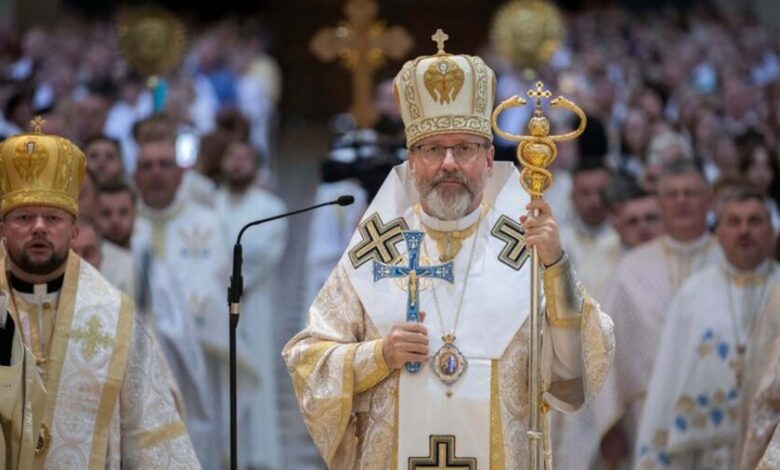
According to the Department of Information of the UGCC, together with the Head of the Church, the divine service on May 23 was attended by Bishop Josaphat Moshchych, Bishop Stepan Sus, Bishop Andriy Khim’yak, priests of the Ukrainian Greek Catholic Church in Spain, and Archbishop of Madrid José Cobo Cano. More than 2,000 Ukrainians who came to Madrid from different regions of Spain joined the joint prayer.
The main event of the pilgrimage was the Bishops’ Liturgy in the Cathedral of Saint Mary Real de la Almudena — one of the main churches of Madrid. The service was led by the Head of the Ukrainian Greek Catholic Church, His Beatitude Sviatoslav. Bishops, priests of the UGCC in Spain, and Archbishop of Madrid José Cobo Cano served with him.
For the Ukrainian community, this event had a special significance because of the location. Ukrainians have lived in Spain for over eight decades, but the large-scale joint procession in one of the country’s central Catholic cathedrals became a symbol of how noticeable the Ukrainian presence has become after the start of the Great War.
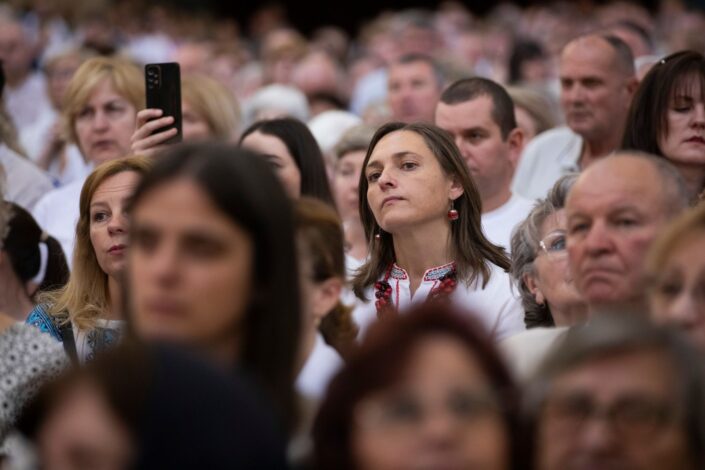
During the service, many people came with children, in embroidered shirts, with blue-and-yellow flags and photographs of relatives who remain in Ukraine or serve in the army. For some of those present, this meeting became emotional because of the opportunity to see acquaintances who were scattered by the war in different regions of Europe.
Ukrainians living in Madrid, Barcelona, Valencia, Malaga, Alicante, Murcia and other cities came to the capital of Spain. For some participants, this trip meant several hours of travel across the country, but many families consciously decided to join the meeting, as such events became a rare opportunity to feel part of a large Ukrainian community.
After 2022, the life of Ukrainians abroad has changed significantly. If previously a significant part of the community in Spain was made up of labor migrants who had worked in the country for years and gradually integrated into the local environment, now they have been joined by tens of thousands of people who left in a hurry due to hostilities. Many ended up in Spain without knowledge of the language, without stable work, without a clear understanding of how long their forced stay abroad would last.
In such conditions, Ukrainian churches, public organizations, and local associations have effectively become support centers for newly arrived families. Through them, people look for housing, receive humanitarian aid, process documents, meet other Ukrainians, and find an environment in which they can speak their native language without feeling alienated.
For children of Ukrainian refugees, the issue of preserving their own identity has become especially noticeable. A significant part of schoolchildren has been studying in Spanish schools for several years, communicating in Spanish or Catalan, and gradually growing into the new environment. Because of this, parents try to maintain their children’s connection with Ukrainian culture through communities, Sunday schools, church meetings, and joint events.
What was said about Ukrainians in Spain
In his speech, His Beatitude Sviatoslav thanked Ukrainians for maintaining their connection with their homeland, supporting Ukraine, and not losing their own identity even after several years of living abroad. He separately addressed families with children, emphasizing the importance of preserving the Ukrainian language, culture, and faith.
Also during the pilgrimage, they spoke about the role of Ukrainian priests, volunteers, and communities who help new refugees adapt to life in Spain. In many cities, Ukrainian communities were the first places people turned to after arriving from Ukraine.
Archbishop of Madrid José Cobo Cano noted that Ukrainians have long been a part of Spanish society. After the outbreak of full-scale war, this presence became much more noticeable, as Ukrainian families began to more actively integrate into local communities, schools, universities, and the labor market.
How the Ukrainian community in Spain has changed
In recent years, the Ukrainian community in Spain has become one of the largest in Western Europe. Along with people who came to work long before the war, families from Kharkiv, Mariupol, Kherson, Zaporizhzhia, Bakhmut and other cities that survived the occupation or constant shelling now live there.
Some of the refugees have already returned to Ukraine, but many families remain in Spain due to the security situation, children’s education or lack of housing at home. Because of this, Ukrainian communities are gradually changing: they are becoming more numerous, younger and much more actively involved in issues of education, psychological support and adaptation of children.
The All-Spanish pilgrimage in Madrid has become one of the largest gatherings of Ukrainians in the country since the start of the full-scale war. For people who have been living between the two countries for several years, such events remain a way to maintain a sense of community and not lose touch with Ukraine.