The issue of the security of the civilian population in the front-line areas has repeatedly become the subject of public discussions, expert discussions and direct appeals of the authorities to the residents. Despite the officially declared mandatory evacuation, tens of thousands of people remain in the areas of daily shelling. Among them is the most vulnerable category, which does not have any opportunity to independently decide its own fate: children. In 2025, after two years of full-scale war, this topic does not lose its relevance. On the contrary, it worsens every time statistics catch up with reality.
As of May 2025, 179 children remain in the zone of active hostilities in Donetsk region. Such a number voiced Dmytro Petlin, Head of the Department of Operational Duty, Communications, Alerting and Informing the Population of the Donetsk Regional Military Administration. According to him, these children continue to live in communities where danger is systemic and constant — in cities and villages that are under the threat of artillery strikes, airstrikes, and drone attacks from morning to night.
These children live in three communities officially recognized as frontline communities. There are 173 children left in the Lymansk urban territorial community. There are five children in the Toretsk city community. Another child is in the territory of the Komar village community. This means that minors still live in critically dangerous points on the map of Donetsk region, often without full access to school education, medical care, and psychological support. In most cases, it is under the responsibility of parents who refuse to evacuate.
Petlin clarifies that a total of approximately 277,000 people live in the Ukrainian-controlled part of the Donetsk region, of which 21,046 are children. These are the areas that are not classified as a zone of active hostilities, but are in the range of enemy fire. Some communities periodically come under mass attacks, in particular Kostyantynivska, Pokrovska, Myrnogradska.
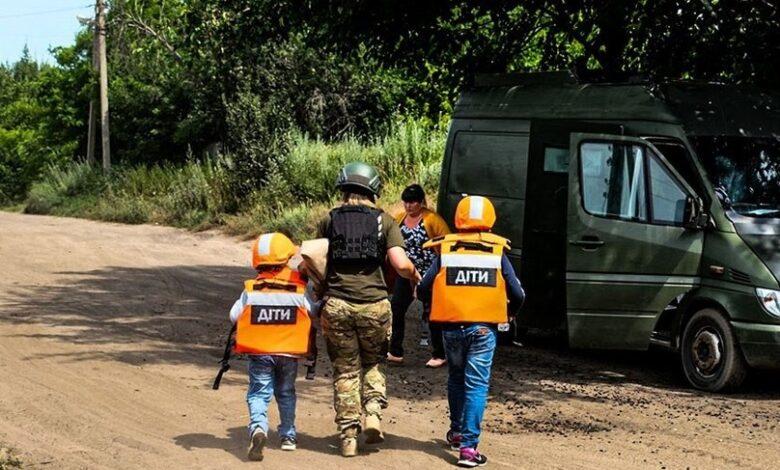
Officially, evacuation from the region continues. According to the representative of the OVA, the total number of evacuated civilians during the two years of the war exceeded 1 million 223 thousand people. Of them, more than 191,000 are children, and more than 46,000 are persons with disabilities. Evacuation crews operating in the region regularly transport people to safe areas, but some residents — both rescuers and the military admit — deliberately refuse to leave. The reasons are different: fear of the unknown, mistrust of the state, reluctance to leave property or deceased relatives who cannot be transported.
More than 1,130 people were evacuated from the region in the last week. But, as Petlin emphasizes, this is only a part of the total number of those who remain. In conditions where most of the settlements east of Kostyantynivka actually do not have stable energy supply, access to schools and hospitals, and only mobile groups of volunteers and military medics work on the streets, the presence of children is not just a security problem. This is a moral crisis that the whole country is facing.
Mandatory evacuation of children from front-line communities is in effect on the territory of the region. It provides not only removal, but also further resettlement, social support, adaptation in a new place. However, in each case, it can be implemented only with the consent of the parents or a court decision to remove the child. As practice shows, most families do not agree to this voluntarily.
The issue of the presence of children in the combat zone goes beyond informing, it has been repeatedly discussed at the level of the Ministry of Internal Affairs, the Ministry of Social Policy, and the Ministry of Social Affairs. But for now, the answer remains the same: Mandatory evacuation is yes, coercion is no, and the line between respecting private choice and saving lives is blurred.