A Taboo That Leads to Silence: Oksana Romaniuk’s Position on the Publication of War Crimes

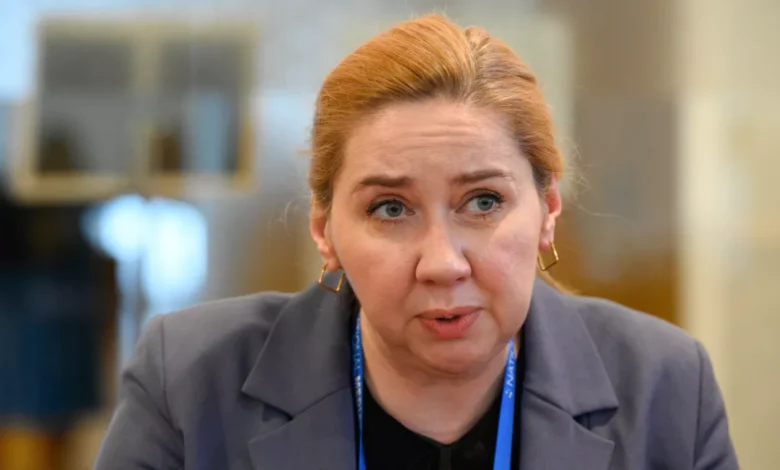
The issue of war visualization is one of the most acute for the Ukrainian media field. Especially when it comes to publishing images of the dead, bodies on the streets, wounded, broken houses, all that remains after Russian shelling. The discussions that flare up every time such footage is published testify to public sensitivity and the fact that there is still no stable agreement in Ukraine: what can be shown and what cannot. The boundaries between recording a war crime and violating the victim’s dignity, between public interest and the right to privacy remain fluid. In this difficult situation, there are increasingly calls for a complete ban on the publication of photos and videos of the consequences of shelling. But doesn’t such a ban turn into a mechanism for displacing reality? Doesn’t it bring us closer to ceasing to see war itself? These are the questions responds media expert, director of the Institute of Mass Information, Oksana Romaniuk.
Oksana Romaniuk immediately outlines the obvious: journalists should not exploit suffering. There is a clear summary of ethical norms that prohibits the display of images of naked dead bodies, bodies of children mutilated in bloody circumstances. However, even these rules, according to her, cannot be considered inviolable truths, everything depends on the specific context. Ethics is not a rigid matrix, but a field of choice in each situation.
The media expert draws attention to a dangerous trend in social networks, where a call for a complete ban on images of dead bodies is spreading. She calls it a simplification of a painful, complex problem. After all, it is not only about individual grief, but about war crimes that must be recorded, understood, and reported to society. According to her, the truth about atrocities should not only be described, but also shown. Otherwise, it is a denial of reality, the displacement of the crime from the collective memory. She clarifies what she says only within the current ethical standards of military reporting.
Romaniuk emphasizes: visual censorship of death is often a form of short-term psychological protection. But in the long term, such “sterility” of the information space contributes to the tabooing of the very topic of war, the depersonalization of victims, and the suppression of collective experience. And this, she believes, poses a threat to national security. Refusing to see is the first step to forgetting. And forgetting leads to impunity.
She pays special attention to the role of reposts. She considers reposting photos from the sites of shelling, footage of crimes — such as the shooting of Oleksandr Matsievskyi — to be important. Because it is through social networks that most citizens learn the truth. These images are one of the channels that record the crimes of the Russians and at the same time unite people in empathy and resistance. In her opinion, this is a form of experiencing trauma: people who repost, cry, sympathize, and not exploit. And it is through such living that collective healing begins, not re-traumatization.
Speaking about documentation, she reminds that not only official structures, but also journalists are engaged in recording crimes. Their materials have great probative value. She appeals to the experience of countries that have gone through genocide — Rwanda, Germany — where visual archives have become an important part of the process of social reinterpretation of tragedies.
Regarding legal boundaries, Oksana Romaniuk warns against trying to pretend that everything is clear in the legislation. There are no easy solutions. The right to privacy is important, but in a war it cannot be used to silence the destruction of civilians, bodies on the streets, destruction of homes. Therefore, in her opinion, it is necessary to find a reasonable balance between the right to privacy and the public interest – a balance that is already partially formulated in ethical norms, but cannot be definitively fixed, because each situation is unique.
Ethical publication, she says, is not just a photo, but a photo with context, with a meaningful warning in the title, with a blur or no recognizable features if necessary, and respect for human dignity. This is the line that journalism should maintain.
Romanyuk is also categorically opposed to the demonization of the entire profession due to some glaring mistakes. She mentions two examples from recent days when the publication of a photo (of a naked dead man and an injured woman in an ambulance) really violated the boundaries of dignity. But he emphasizes: the presence of violations does not mean that the entire profession should be crossed out. Such generalizations are dangerous and incorrect.
In the end, she clearly formulates the main thesis: tabooing images of war crimes is a direct road to silencing, and therefore to historical amnesia, impunity and repetition of crimes. War is not only pain, but also a duty to remember. And the media should be the ones to show something that cannot be forgotten.
“The taboo on the publication of images of the consequences of war crimes is a direct road to silence. And therefore, to Russian impunity.” – summarizes Romanyuk.