
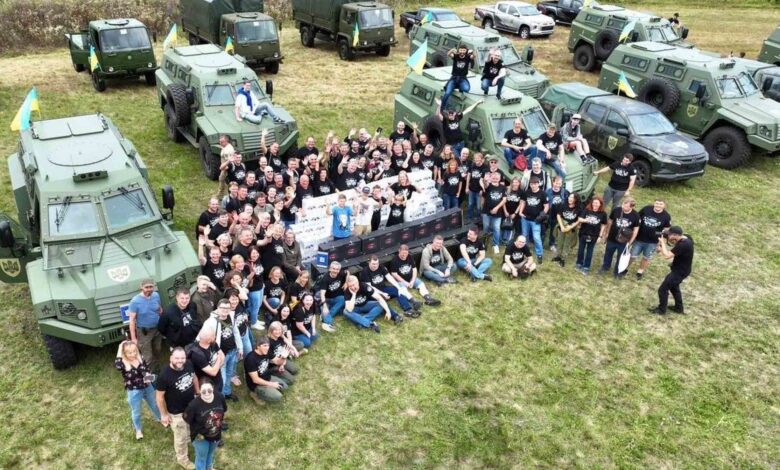
April 20 is Volunteer Appreciation Day and International Cli-Fi Day. This day has brought together political decisions, scientific breakthroughs, military events, and tragedies that have had a significant impact on world history in different years.
Volunteer Appreciation Day
This day is dedicated to people who help others in difficult circumstances without pay, participate in humanitarian initiatives, support social projects, and respond to emergencies. The volunteer movement covers various areas: medicine, education, disaster relief, and support for the military and civilians during crises. In many countries, volunteers have become an important part of the response system, where speed and flexibility are crucial.
In Ukraine, volunteering has gained particular importance after 2014 and has become even stronger with the start of a full-scale war in 2022. It was the volunteers who provided the army with essential supplies in the first months of the invasion, organized the evacuation of civilians, and delivered humanitarian aid to frontline areas. Their activities are often coordinated informally, through personal connections and initiative, which allows for a quick response to needs. Volunteer Appreciation Day is an opportunity to remember the contribution of these people and draw attention to the scale of their work.
Interesting facts
The first mass volunteer initiatives in Ukraine during a full-scale war arose literally in the first days after February 24, 2022, when thousands of people independently organized humanitarian aid warehouses in schools, gyms, and even underground parking lots.
In 2022, Ukrainian volunteers created large-scale networks for supplying drones to the front, often purchasing them abroad and modernizing them in Ukraine for combat needs.
During active fighting in Kharkiv, volunteers delivered food and medicine to areas under fire, using private cars without any protection, sometimes several times a day.
Volunteer initiatives have emerged in Ukraine to evacuate animals from the war zone, and some have taken thousands of domestic and wild animals to safe regions and abroad.
In 2023, Ukrainian volunteers began mass-producing trench candles from recycled materials, which are used by the military for heating and cooking in the field.
Some volunteers specialize in restoring damaged cars for the military, collecting cars from several non-working ones and returning them to the front in working condition.
In many front-line cities, volunteers have organized mobile aid stations that change their location depending on the security situation.
Ukrainian IT volunteers created digital services to coordinate aid, search for missing persons, and raise funds, which significantly accelerated the interaction between people and organizations.
During the war, some volunteers worked as informal psychologists, supporting people after shelling and losses, without having special education, but undergoing short trainings directly during their activities.
International Cli-Fi Day
This day is dedicated to fiction about climate change. This is a separate direction in modern culture that focuses on the consequences of global warming, environmental disasters, and the transformation of society under the influence of climate change. Texts of this genre can be both realistic and with elements of fiction, but their main feature is attention to real environmental threats and their impact on people’s lives.
Cli-Fi was formed as a response to the growing interest in climate issues in the world and the need to understand these processes through art. The authors describe future scenarios, model the behavior of societies in crisis conditions and show how everyday life is changing due to environmental challenges. This trend is gradually going beyond literature, influencing cinema, art and public discussions, where artistic images help to better understand the scale of the problem.
Interesting facts
The term “Cli-Fi” began to be actively used only in the 2010s, although works with similar themes appeared much earlier and did not have a separate definition.
One of the early examples of literature on climate change is considered to be a novel that describes global warming even before this topic became part of a wide scientific and political discussion.
After 2022, Ukrainian writers began to address the topic of the environmental consequences of war more often, combining it with Cli-Fi elements in their texts.
As a result of hostilities in Ukraine, significant areas have been contaminated with soil and water, and these real events are already becoming the basis for artistic plots about future environmental crises.
Some modern Cli-Fi works describe scenarios where cities adapt to life in conditions of constant water shortages, and these ideas partially coincide with real forecasts of climatologists.
After the explosion of the Kakhovka hydroelectric power station in 2023, the topic of man-made environmental disasters in Ukraine received a new reflection in literature and journalism.
In the Cli-Fi genre, there is often no clear division into “good” and “bad”, as the authors show complex systemic problems where responsibility is distributed among many participants.
Some writers collaborate with scientists to make their works as close as possible to real climate forecasts.
Cli-Fi is increasingly used in education as a way to explain complex environmental processes through stories that are easier for readers to understand.
Historical events on this day
1653 – Oliver Cromwell forcibly dispersed opposition members of the English Parliament, demonstrating that the political struggle in England at that time was increasingly moving into a phase of fierce confrontation. This step became one of the most striking manifestations of the crisis of the old system of power and testified to how deep the contradictions were after the Civil War.
1770 – James Cook reached the east coast of Australia and opened up the territory that was later called New South Wales to Europeans. His voyage was a milestone in British maritime exploration and laid the foundation for the subsequent colonial development of the region.
1841 — Edgar Allan Poe’s story “The Murders in the Rue Morgue” was published, which is considered the first full-fledged detective story in world literature. It was in it that the features of the genre appeared, which later became classics: a mysterious crime, a careful analyst, and solving the case through logic, not chance.
1865 — The appearance of safety matches was first announced, which became much less dangerous in everyday use than their predecessors. This innovation had not only household, but also social significance, as it reduced the risks of fires and injuries when using fire in homes and at work.
1902 — Pierre and Marie Curie were the first to obtain pure radium, confirming the exceptional importance of their research in the field of radioactivity. This achievement became one of the key moments in the development of physics and chemistry at the beginning of the 20th century and opened up new opportunities for science and medicine.
1918 — The Slavic group of the Separate Zaporozhian Division of the UNR Army liberated Sloviansk in the Donetsk region from the Bolsheviks. This operation became part of the struggle of the Ukrainian People’s Republic for control over the eastern territories and for the right to independently determine its own political future.
1938 — The Ukrainian SSR adopted a resolution on the mandatory study of the Russian language in all schools. Formally, this was presented as an educational decision, but in practice it became another step towards increasing Russification and narrowing the space for the full development of the Ukrainian language in the education system.
1940 — The first electron microscope was demonstrated in the United States, which made it possible to study structures inaccessible to conventional optics. This event was a real breakthrough in science, as it significantly expanded the capabilities of researchers in biology, medicine, and materials science.
1949 — The First World Congress of Peace Supporters began its work, uniting representatives of different countries around the idea of preventing new major wars. Against the backdrop of post-war tension and the beginning of the Cold War, such initiatives had not only symbolic, but also a clear political meaning.
1959 — The USSR began operating a new passenger aircraft, the Il-18, which became one of the most famous Soviet airliners of its time. Its appearance meant a significant step forward for civil aviation, as the aircraft was used on domestic and international routes for many years.
1989 — Chinese authorities ordered students to leave Tiananmen Square in Beijing, where large-scale protests were taking place. This decision was one of the stages of the escalation of the crisis, which soon developed into a harsh military crackdown on the protest movement and had a major international resonance.
1999 — One of the most famous mass school shootings in modern US history occurred at Columbine High School in Colorado. The tragedy shocked American society and sparked a large-scale discussion about school safety, the impact of violence in the media, and access to weapons.
2000 — A tactical missile hit a residential building in Brovary, killing three people and injuring five more. This tragedy was a painful reminder of the dangers of military exercises if mistakes are made and caused a serious public outcry in Ukraine.
Oliver Cromwell Dissolved Parliament and Established Sole Rule
On April 20, 1653, Oliver Cromwell harshly dissolved the English Parliament. He entered the meeting hall, sharply accused the deputies of inaction, and effectively ordered them to disperse. There was no vote, no formal agenda. According to legend, he told the parliamentarians the phrase: “You have been sitting here too long. For God’s sake, go!”
The army did not oppose and obeyed Cromwell, and for many contemporaries what happened was a shock. The Speaker was taken out of the hall, and his chair was carried out to prevent even a symbolic continuation of the meeting. Thus ended the history of the Long Parliament, which lasted 13 years and during this time became a center of political struggle, intrigue, and constant delay in decisions.
A few years before these events, largely with the participation of Cromwell himself, King Charles I was declared a tyrant and a criminal. In 1649, he was executed by beheading, and this step was an unprecedented blow to the very idea of the inviolability of the monarch. The overthrow of the king opened the way for a radical reorganization of power in England.
After the dissolution of parliament, a period began that was officially called the Protectorate. Formally, Cromwell was not king, but as Lord Protector he concentrated almost monarchical powers in his hands. The difference was only in the title and external attributes, because the Puritan environment to which he belonged rejected the magnificent symbolism of power.
His reign was distinguished by strict moral discipline. Under Cromwell, theaters were closed, entertainment was limited, drunkenness, gambling and festivities as such were condemned. Instead, a model of behavior based on work, prayer, and strict order was imposed on society.
The Irish campaign stands out in the history of his reign, which left a particularly difficult memory. The actions of Cromwell’s troops in Ireland were extremely brutal: thousands of people were killed during the assaults, in particular in Drogheda and Wexford. This became one of the bloodiest episodes of his career and seriously undermined the resistance of the Irish rebels, after which Kilkenny capitulated. He also subjugated Scotland by military force, and in foreign policy he first began a trade confrontation with Holland, which later escalated into war.
After Cromwell’s death, his political legacy did not save him even symbolically. After the restoration of the monarchy in 1661, his body was exhumed, executed posthumously, and his head was displayed on a peak. This gesture became a demonstrative act of revenge by the restored royal power and at the same time showed how unstable political greatness can be if it is based only on force and fear.
The “killer rabbit” attack on Jimmy Carter
On April 20, 1979, while fishing with US President Jimmy Carter, an unusual episode occurred, which the press later dubbed the “killer rabbit attack.” At first glance, this story could have remained just a funny presidential fable, but it quickly gained wide publicity and even made the pages of The Washington Post under the headlines that the president was attacked by a rabbit.
According to Carter, it all started with the rabbit running away from the hounds along the shore, then jumping into the water and swimming towards the boat. The president recalled that the animal behaved quite aggressively: it hissed, gnashed its teeth and tried to get to the side. When the rabbit swam almost to the side, Carter pushed it away with an oar, after which it changed direction, swam to the side and got out of the reservoir.
This scene gained particular publicity because the moment of the rabbit’s retreat was recorded by a White House photographer. It was thanks to this that the incident ceased to be just an oral story and turned into a media story that journalists eagerly picked up. The combination of an absurd plot, the participation of a sitting president and photographic evidence made this episode one of the most famous curiosities in American political history.
The story of Jimmy Carter and the rabbit later became an example of how even a small and random incident involving a president can instantly turn into a news sensation. In the political memory of the United States, this case remained a vivid symbol of how unpredictable the news events surrounding presidents can be.


