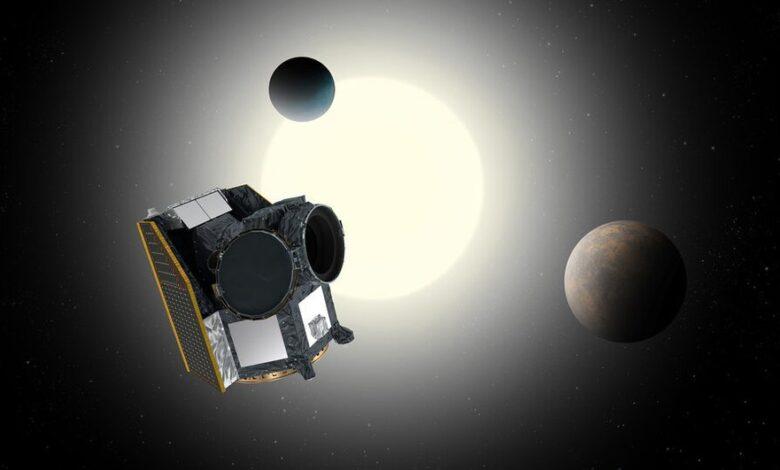
With the help of the Swiss space telescope CHEOPS, astronomers for the first time recorded the so-called “suicide planet” – the exoplanet HIP 67522 b. About this informs Swissinfo.
This planet provokes super-powerful flares that gradually destroy its atmosphere, forcing it to contract. According to the European Space Agency (ESA), over the next 100 million years, HIP 67522 b may shrink from the size of Jupiter to the size of Neptune. This is the first documented case of such a phenomenon.
Experts explained that similar flares also occur on the Sun, when its magnetic field undergoes deformations, throwing streams of radiation and charged particles into space. When these particles reach the Earth, they can cause the auroras by interacting with the magnetic field and atmosphere.
The peculiarity of this situation is that scientists proved for the first time: the planet itself is capable of causing flares on its star. The theory that some planets, rotating at a very small distance from the star, can affect its magnetic field and provoke flares, existed since the 1990s. HIP 67522 b is a prime example of such an interaction—it is so close to its star that it completes its rotation in just 7 days.
The star itself, around which the planet revolves, is young — its age is only 17 million years. For comparison: our Sun is already 4.5 billion years old, that is, it is 265 times older. The younger the star, the more energy and magnetic activity it exhibits. According to ESA observations, the recorded flares turned out to be 100 times more powerful than scientists predicted.