
Bail, fines and no imprisonment: corruption cases of top officials as a crisis of the Ukrainian legal system

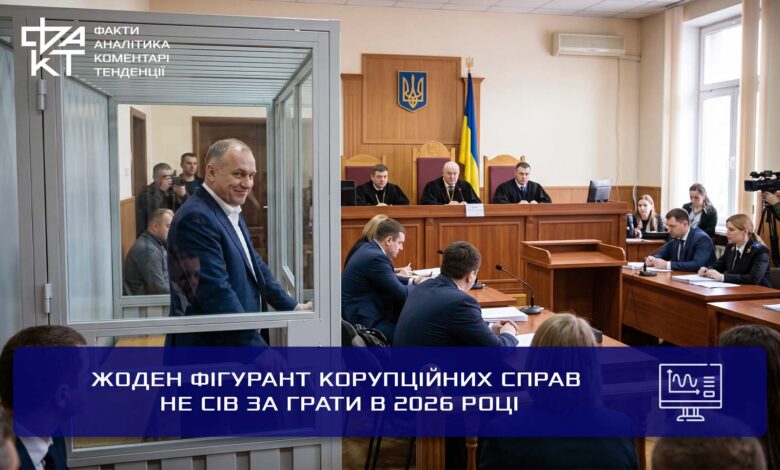
In Ukraine, a dangerous gap has long emerged between what people hear in courtrooms and what they feel when watching high-profile cases. Formally, the system operates in the language of law, procedures, and procedural guarantees. However, every time a case involving a top corrupt official ends with a fine, bail, or years of delay without a final outcome, society sees the devaluation of the idea of responsibility and loses trust in laws and courts. At the same time, the authorities continue to assure society of their active fight against corruption, official and other crimes.
Corruption cases without imprisonment: why 814 court decisions ended only with fines
Since the beginning of 2026, Ukrainian courts have issued 814 decisions in cases of corruption offenses, but not a single person involved in such proceedings has received a prison sentence. According to the data of the Unified State Register of Persons Committing Corruption Offenses, all recorded punishments were limited to fines.
Such statistics look especially sharp against the backdrop of public outrage over the actions of corrupt officials, because the figure of 814 court decisions creates the impression of noticeable activity of the system, but the final result turns out to be much more restrained. In no case did the court issue a decision on imprisonment, while the amount of fines ranged from 850 to 34 thousand hryvnias. For some offenses, this is a sanction provided for by law, but the overall picture shows that most cases that fall into the register do not belong to the category of serious criminal corruption crimes.
From January to April 2026, the number of court decisions in cases of corruption offenses decreased by 27% compared to the same period in 2025. This decrease is important not only as a statistical indicator, but also as a sign of a change in the pace of such cases through the judicial system. At the same time, a smaller number of decisions may indicate various processes – from longer consideration of individual proceedings to a change in the structure of detected violations.
It should be noted that the majority of cases were violations related to financial control. They accounted for 91% of all decisions, i.e. 742 proceedings. This category includes errors in declarations, untimely submission of documents or failure to comply with reporting requirements. By their nature, such cases often resemble not high-profile corruption stories with suitcases of money, but bureaucratic violations, where deadlines, forms, completeness of data and correctness of the submitted information become key.
At the same time, bribery accounted for 6% of court decisions, and conflict of interest – 3%. Such a distribution significantly changes the perception of the total figure, because 814 decisions do not mean 814 convictions for large-scale corruption schemes. The main mass was formed by administrative violations in the field of declaration and reporting, while the criminal component turned out to be much smaller.
It is noteworthy that 93% of cases were administrative offenses, and only 52 proceedings were criminal. It is this imbalance that explains why, in the end, the courts mainly imposed fines, rather than more severe punishments. An administrative case, according to the logic of the legal mechanism, has a different weight, a different procedure, and a different set of sanctions than criminal proceedings, where proving guilt is usually more difficult, and the consequences for the accused are much more serious.
It is quite clear that criminal corruption cases occur less frequently, and their investigation and subsequent trial require more time. This means that statistics for the first months of the year do not show the full trajectory of criminal proceedings. Some of them may be at the investigation stage, some may be moving through the courts much more slowly than administrative materials, but a similar situation has been observed in previous years.
Data for 2026 show a rather contrasting picture: there are court decisions in corruption cases, the register is being updated, fines are being imposed, but not a single case of imprisonment has been recorded during this period.
Bail, which is increasingly irritating to society
When Ukrainians are once again explained that bail is not a purchase of freedom, does not replace punishment and does not cancel a future sentence, it sounds legally correct, but it is increasingly less convincing for society, which sees a completely different picture. According to current legislation, a person is not considered guilty until a court decision, and a pre-trial detention center cannot be an automatic response to every suspicion, even if it is loud and outrageous. But in a country where cases of top corruption, treason or crimes involving human victims often drag on for years, procedural logic comes up against a very vivid sense of injustice.
In a criminal trial, bail should not release a person “just like that,” but tie them to the investigation and the court with a financial obligation. In this case, the funds are deposited into a special account, but the suspect receives not complete freedom, but the right to wait for the court decision outside the cell under a number of prohibitions and obligations. He must come to the summons, not contact witnesses, not influence other participants in the case, not destroy evidence, surrender his passport, wear an electronic bracelet if necessary, and fulfill additional court requirements. In case of violation of these rules, the deposited money may go to the state, and the preventive measure may become stricter.
This construction in the code looks almost flawless: the state does not keep a person in a pre-trial detention center without a sentence, but does not release him without control. However, in real life, the effect is often the opposite. The defendant is released after depositing a large sum, which relatives, friends, business partners or legal entities helped to collect, and the public is again told that everything happened within the framework of the procedure. For a lawyer or judge, this may be a correct formulation, but for the family of a person who died at the hands of a criminal or citizens who have been observing the selective severity of the state for years, such a formulation sounds like a screen behind which influential people get more room to maneuver.
If you look at this model without emotions, its humane meaning is obvious. The state should not throw a person behind bars just because the investigation has raised suspicion, because guilt has not been proven to be a verdict. Pre-trial detention is expensive for the budget, but it costs the person himself even more: lost health, work, reputation, connection with his family and the opportunity to defend himself normally. When the suspect is not a dangerous criminal, terrorist or a person who cannot be controlled by other means, the law allows him to be left outside the cell, putting him on a financial and legal chain.
The whole weakness of this idea is revealed at the moment when the same amount has completely different weight for different people. For an ordinary family, a million hryvnias can mean selling a home, debts, and years of financial exhaustion. However, for an official, businessman, or person with access to shadowy resources, such an amount seems like an acceptable fee for waiting for a court hearing at home. Where bail should be a painful safeguard, it begins to resemble a paid passage from a pre-trial detention center to a more comfortable life under procedural conditions.
It should be noted that Ukrainian legislation still recognizes that there are categories of cases where money cannot replace a real restriction of freedom. The court may choose detention without bail if the crime involves violence or the threat of violence, if it resulted in the death of a person, if the person has already violated the conditions of a previous bail, if the case involves criminal organizations under Articles 255–255³ of the Criminal Code, or especially serious crimes in the field of drug trafficking. Bail is also not set for people who are internationally wanted, as well as for those who are in occupied territory or in Russia.
During martial law, the list of such exceptions is expanded to include crimes against the foundations of national security, terrorism, high treason, and war crimes, in particular under Articles 109–114, 258–261, 402–408, 429, 437–442 of the Criminal Code of Ukraine. When the issue of detention is considered at the request of the International Criminal Court, bail is also not set. These norms show that in certain situations the risks are so serious that financial leverage cannot be a sufficient guarantee.
As is known, since bail is not a punishment, it is returned to the person who deposited the money if the person is acquitted. Even after a guilty verdict, the funds can be returned, because they are not a fine and are not part of the court’s sanction. Bail is forfeited when a suspect or accused violates the rules: does not show up for court, runs away, ignores his or her duties. For lawyers, this difference is fundamental, but for society it is often erased, because people do not see the intricacies of the process, but a simple scene: a defendant in a high-profile case leaves the pretrial detention center after paying a large sum.
Without bail, a democratic legal system risks another danger — the pretrial detention center as an instrument of pressure, revenge, or quick pacification of an outraged public. But where citizens do not see the same rules for everyone, the legal mechanism begins to work against its own purpose. When some cases move quickly, while others languish in a procedural quagmire for years, when for some the amount of bail means the ruin of life, and for others it is just the price of comfort, society ceases to perceive this procedure as a balance between human rights and the interests of justice.
In a country where trust in the court is already fragile, bail has become not only a legal instrument, but also a painful test of equality before the law. It was supposed to protect a person from the arbitrariness of the state, but in high-profile cases it increasingly looks like a privilege for those with money, connections, and strong defense. Until the state learns to explain its decisions convincingly, strictly control the fulfillment of duties, and apply the rules equally, each new large bail will sound to society not as a guarantee of justice, but as yet another proof that we have one law, but people perceive it differently.
Bail for the powerful of this world: how high-profile detentions drown in judicial routine
Ukrainians have long known this plot from the first frames: security forces come in with searches, an official or an influential business figure is declared suspicious, huge sums flash in the reports, and the authorities speak the language of a resolute fight against corruption. The first hours look like a blow to the untouchables, but then the case often turns into a completely different genre – a slow judicial dissolution, where the loud formulations fade, and the main event becomes not the verdict, but another reduction in bail.
Bail in a normal legal system should work as a safety net, not a privileged way out of an unpleasant situation. It reduces the load on the pre-trial detention center, saves state costs for keeping people in custody and does not contradict the presumption of innocence, because suspicion is not yet a proven crime. A large sum can keep a person in court more firmly than any solemn promises, but only on one condition: its loss must be truly painful.
However, Ukrainian practice breaks down precisely on this condition. For an ordinary person, bail can mean a sold apartment, family debts and years of financial survival, while for a defendant in a case worth hundreds of millions, even tens of millions, sometimes look like a payment for the opportunity not to wait for trial in a detention center. At this point, property inequality ceases to be a sociological term and becomes a very concrete boundary: some remain behind bars, others buy themselves room to maneuver within the law.
The worst begins when a person returns not just home after bail, but to an environment of connections, influence, and resources. A ban on contact with witnesses, a surrendered passport, an electronic bracelet, and procedural obligations look good in a ruling, but they are worth little without daily monitoring and a quick response to violations. An influential defendant at large has much more chances to negotiate, coordinate positions, pressure, delay, and prepare alternative routes than a person who is actually isolated from the process.
However, the reduction of bail in high-profile cases looks especially toxic when society does not hear a convincing explanation for why it suddenly became smaller. At the start of the case, the state talks about huge losses, the danger of influencing witnesses, and the seriousness of the suspicions, and then those same risks seem to evaporate in appeals and new rulings. The numbers fall, the responsibilities weaken, court hearings are postponed, and society sees not legal flexibility, but a gradual loosening of the screws for those with money and good lawyers.
After bail is posted, many high-profile proceedings lose their main energy. Searches, press releases, and statements about “exposing the scheme” remain in the news archives, and the case moves into a long corridor of motions, recusals, appeals, illnesses, replacements of defense attorneys, and hearings that never took place. In this judicial drag, the sense of inevitability of responsibility disappears, because the system seems to move, but so slowly that time itself begins to work for the accused.
The most convenient ending for the defendants is not acquittal after a fair trial, but the expiration of the statute of limitations. In such a scenario, innocence is not necessarily proven on the merits; it is enough to drag out the process so much that the court can no longer put an end to it with a verdict. Years go by in procedural circles, the case ages, public attention fades, the bail is returned to the bailiff, and the high-profile proceedings, which began as a demonstration of the state’s power, end almost without a sound.
This weakness is even more starkly demonstrated by escapes abroad after the easing of preventive measures. Formally, a person may have a travel ban, documents handed in, a bracelet and a list of responsibilities, but in practice, influential defendants sometimes find medical, official, permit or frankly illegal routes. When such a person disappears, collecting the bail to the state budget looks like weak compensation, because money will not put him in the dock and will not provide answers to the victims.
The war added another very sensitive issue to this scheme – the possibility of changing a preventive measure through conscription for military service. In a country at war, service cannot automatically be perceived as a cunning legal maneuver, and it is important not to distort this. But when defendants in high-profile cases with large sums of money, strong legal teams, and an obvious interest in postponing the verdict are seeking such a path, the verification must be as strict as possible. Otherwise, respect for the army risks becoming a screen for a procedural pause.
The problem with bail in Ukraine is not the very existence of this tool, but that it operates in an environment of slow courts, unequal resources, and weak control. Where proceedings last for years, lawyer tactics easily turn the procedure into a marathon of exhaustion, and the state does not explain its decisions in understandable language, any bail begins to be perceived as the price of escaping real pressure.
High-profile detentions are no substitute for sentences, just as a bright trailer cannot replace a full-fledged film. If after the first spectacular shot, a long-term procedural delay begins, society sees not a real fight against corruption, but a well-known mechanism of delaying cases and the absence of punishment. As long as the legislation and judicial practice leave the defendants so much room for action, each new detention of officials turns into just another spectacle, the finale of which is impunity and the flourishing of crime.


