Ban on mobile phones in schools: a corresponding bill has been registered in the Verkhovna Rada

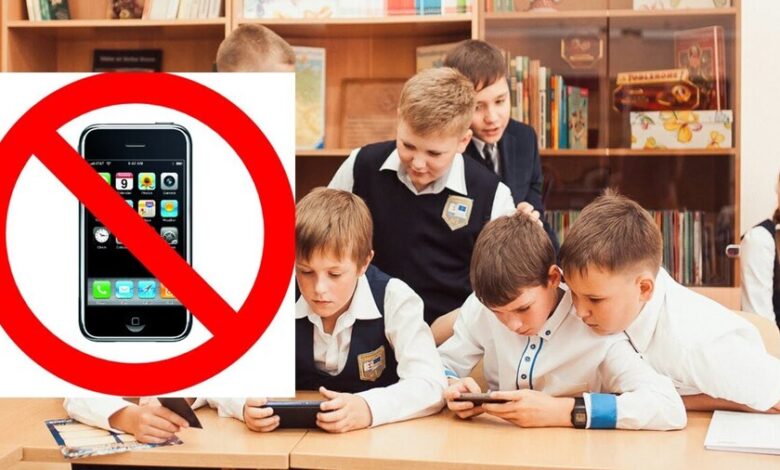
The debate about children using phones at school in Ukraine arose due to the contradiction between two real needs that children and adults face every day. The educational process requires concentration, silence and attention to the teacher, while life during the war taught children and parents to keep communication at hand, because in conditions of air raids, sudden changes of route or urgent messages from home, gadgets have long become part of everyday safety for many schoolchildren. However, a draft law has been registered that requires not using phones, tablets and smart watches during lessons.
What the draft law proposes
On March 27, the Verkhovna Rada registered a draft law that requires not using phones, tablets and smart watches during lessons. Its author, People’s Deputy Heorhiy Mazurashu, proposes to consolidate such a norm through amendments to Article 53 of the Law of Ukraine “On Education”, which defines the rights and obligations of education seekers. Exceptions are provided only for educational and medical needs, and the main stated goal of the document is called reducing distraction from the educational process and eliminating related problems.
The initiative is built on the following logic: during the lesson, a student should not use gadgets, unless there is an educational or medical reason for this. The author’s argument is based on the experience of other countries, in particular the Netherlands, Denmark and a number of other states, where similar restrictions are already applied in the school environment. According to Mazurashu, such a requirement should strengthen discipline in the lesson, reduce student absent-mindedness and increase the level of respect for teachers, for whom competition with the phone screen has long become a daily problem.
Why this initiative is supported
In this part, the logic of the bill is clear, because the problem of distraction really exists and has a completely practical form for the teacher. A phone lying on the desk quickly turns into a source of messages, videos, correspondence and short attention spans, after which the class loses the pace of the lesson, and the teacher is forced to spend time not on explaining the material, but on returning children to the topic of the lesson. For supporters of restrictions, this is enough to consider legislative intervention justified.
Support for such ideas by a part of society is explained by the fact that the phone is the cause of a student’s weaker concentration in lessons. Therefore, the argument about distraction from the educational process sounds convincing both for teachers and for some parents who are tired of seeing a child constantly living in a fragmented attention mode, where the teacher’s explanation, notifications from a messenger and a social media feed exist simultaneously.
An additional argument concerns the atmosphere at school. Supporters of the ban have reason to believe that restricting the use of phones during classes can reduce the number of situations where students film each other without consent, correspond in the middle of a lesson, provoke conflicts in chats, or transfer digital tension directly into the classroom. In this logic, a gadget in a lesson does not look like a neutral object, but a constant irritant that distracts attention and changes the very nature of school attendance.
What do opponents of this initiative think?
Opponents of this initiative proceed from the fact that Ukrainian schools operate in wartime, so the mechanical transfer of restrictions that apply in peaceful countries does not take into account the real experience of children. For a child studying during a war, a phone often performs a much broader function than a device for entertainment or communication with classmates. It receives messages from parents after an air raid, clarifications about the route home, news about changes in plans, requests to urgently get in touch, or just a short signal that everything is okay at home.
Critics of the ban also believe that the problem is not limited to the fact of having a phone in the classroom, since the decisive factor is not the gadget as an object, but how the school builds the rules for using it. From this point of view, a strict legislative norm may turn out to be too harsh a tool, because it puts a child who aimlessly scrolls through social networks during class on the same level as a child who keeps a phone with him due to anxiety related to war or family circumstances.
Another argument is that such an initiative can create the appearance of solving the problem without affecting its deeper causes. Opponents point out that distractions in class, decreased concentration, digital addiction, and poor discipline are not caused by phones alone, so a simple ban without a well-thought-out school policy, without parental involvement, and without clear rules is unlikely to change the situation dramatically. In this sense, they believe that a total restriction is more effective than a clearly defined order in which the phone does not dominate the lesson, but does not disappear as a means of communication.
Separately, opponents of the initiative draw attention to the risk of conflicts between the school, parents, and children. When the norm is written too rigidly, it easily turns into a source of new tension, where the teacher is forced to control more than teach, parents perceive the rule as a threat to communication with the child, and students begin to look for ways to circumvent the ban. Because of this, critics say, the restrictions could backfire if the school receives yet another formal requirement but lacks an effective and reasonable mechanism for enforcing it.
Where is the line between discipline and safety?
The most difficult thing about this debate is that both sides have compelling arguments, and neither of them boils down to a petty domestic conflict. The teacher seeks to restore meaning, rhythm, and attention to the lesson, without which learning falls apart into separate fragments. Parents want to know that their child is connected, especially in a country where an alarm, the threat of shelling, or a sudden change in the situation have long ceased to be an exception. The students themselves also perceive the gadget differently: for some, it is a habit of endless scrolling, for others, it is a nervous support, without which the school day seems even less predictable.
Because of this, the key question is not so much whether it is possible to restrict phones during the lesson, but how to do it. If the rule is constructed as a rigid demonstration of control, it will arouse distrust and be perceived as another attempt to ignore the reality in which Ukrainian children live. If the restrictions are formulated precisely, with clear exceptions, a clear procedure and taking into account safety needs, then it will have a better chance of working not as a ban for the sake of a ban, but as a school rule that truly protects the educational process.
The discussion of this bill shows that a Ukrainian school cannot live by templates developed for quiet time, even if they work successfully in other countries. A lesson requires concentration, but a child of war also needs a sense of connection with those on whom his daily safety depends. Because of this, the answer to the problem of phones in the classroom should be born not from a desire to demonstrate severity, but from an understanding of how childhood itself has changed in Ukraine and why for this generation, gadgets have long become a part of life under the pressure of circumstances that schools cannot simply take out of the classroom.