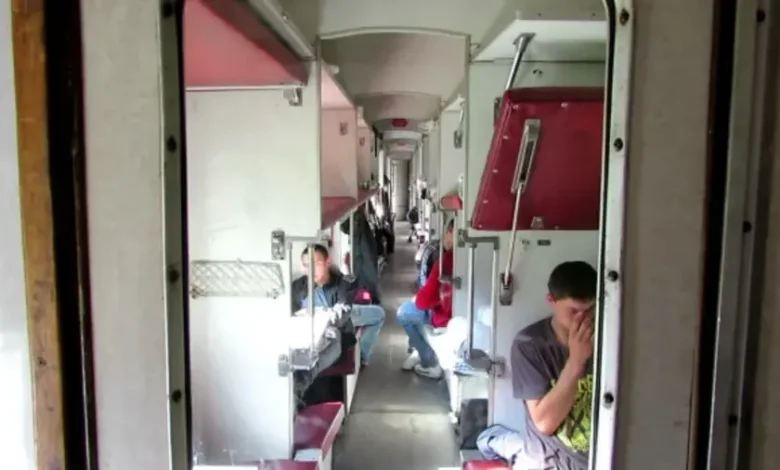
Complaints about insects in passenger cars have once again drawn attention to the sanitary condition of Ukrzaliznytsia trains, as some passengers report bites after trips and demand prompt inspection of the cars. One such case concerns the Odesa-Dnipro flight, after which the passenger reported a severe allergic reaction and contacted the carrier. This case caused a stir on social networks, as the situation concerns not only comfort on the road, but also the sanitary condition of the cars, in which people spend many hours.
Complaint of a passenger during a trip on the Odesa-Dnipro flight
A passenger reported in Threads that on April 25 she was traveling on train No. 054 Odessa-Dnipro. According to her, the problem arose in carriage No. 12, where after the trip she found traces of numerous bites on her body, which she attributed to bedbugs.
The woman wrote that the consequences of the trip were serious: the treatment has been going on for the tenth day, and the allergic reaction is accompanied by swelling and vesicles. She separately emphasized that she works as a doctor, so she perceives the situation as a sign of unsanitary conditions and a potential threat to passengers who may encounter the same problem.
According to the author of the post, she contacted Ukrzaliznytsia almost immediately after the trip — approximately on the second or third day. She sent a message via email and the application, but she claims that she did not receive a response.
In her appeal, the woman asked the carrier to remove the carriage from flights, conduct a full disinfection, and provide confirmation of the treatment. Her demand concerned a specific carriage in which, according to her, she could have been bitten.
The passenger drew special attention to the fact that such cases require a quick response, because after one trip the car can continue to run with other passengers. Because of this, she insisted that the inspection should be prompt, and not postponed until several subsequent trips.
After the publication, comments from other users began to appear under the post, describing similar situations during trips. Some passengers wrote that they had also encountered bites in the cars, so they began to ask how often Ukrzaliznytsia processes sleeping equipment.
Ukrzaliznytsia’s reaction
Ukrzaliznytsia responded to the complaint and apologized to the passenger for the situation. At the same time, the company noted that ten days had passed since the trip, and during this time the car had managed to make several trips, undergo scheduled cleaning and sanitation.
The carrier asked the woman to provide a photo of the ticket so that employees could accurately determine the flight, place and car she reported. The company explained that after checking the data, the car could be sent for additional sanitation, if such a need is confirmed.
This response means that UZ did not deny the possibility of checking, but for the company’s official response, specific data about the trip is needed. First of all, this is the train number, car number, flight date and confirmation by ticket.
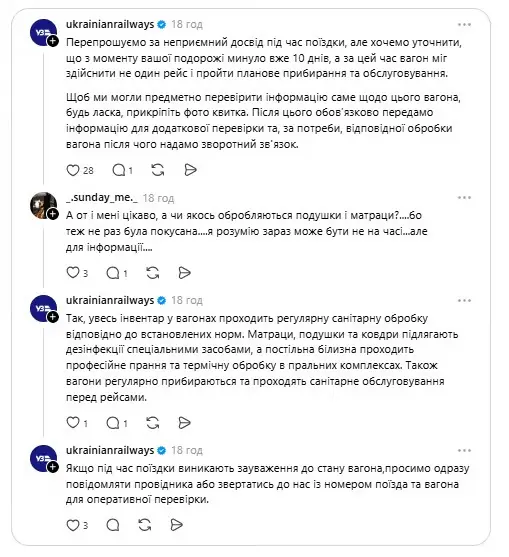
Ukrzaliznytsia responded that the inventory in the cars regularly undergoes sanitation in accordance with established standards. According to the company’s explanation, mattresses, pillows and blankets are disinfected with special means.
Separately, the carrier reported that bed linen is washed in laundry complexes, where it undergoes heat treatment. UZ also noted that such procedures should reduce the risks of spreading insects or other sanitary problems in the carriages.
What passengers should do during the trip
Ukrzaliznytsia urged passengers to report such cases immediately during the trip by contacting the conductor. This method, according to the carrier, allows for a faster detection of the problem and transmission of information to the responsible services.
Passengers are also advised to contact the company through official channels, indicating the train number, flight date, carriage number and location. Without this data, the inspection may be delayed, since the carriage is returned to circulation after the trip and undergoes several stages of maintenance.