Certification of the time of presentation of a document: a little-known way to protect your rights through a notary

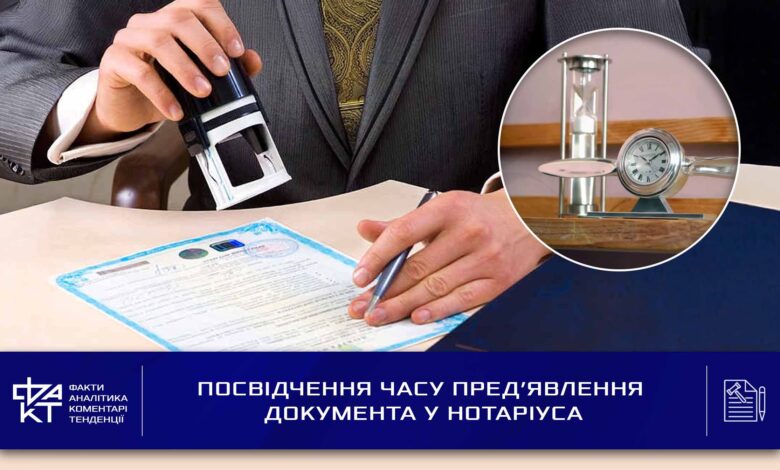
A notary may be needed not only when it is necessary to draw up an inheritance, power of attorney or contract. His powers include a lesser-known action – certification of the time of presentation of a document. It helps to record that a certain document, manuscript or application already existed at a specific moment. For a person, this can become important evidence if a dispute later arises about authorship, the date of creation of a document or priority in the preparation of certain materials.
Lawyers of the law association “Repeshko and Partners” commented on how certification of the time of presentation of a document works, when such a notarial action can be useful, what requirements apply to documents and why it is worth preparing materials in advance before contacting a notary.
Usually, when people contact a notary, they are most often talking about familiar life situations: certification of a contract, registration of a power of attorney, drawing up a will or opening an inheritance case. Because of this, it may seem that the work of a notary is limited only to such actions. In fact, the Law of Ukraine “On Notaries” provides for a much broader range of powers.
According to Article 34 of this Law, notaries not only certify transactions, including contracts, wills, powers of attorney and requirements for notarization of a transaction. They also take measures to protect inherited property, issue certificates of the right to inheritance, certificates of ownership of a share in the joint property of spouses or former spouses on the basis of a joint application or in the event of the death of one of the spouses, as well as certificates of acquisition of property from public auctions or auctions, including when such auctions or auctions did not take place.
A separate block of powers concerns property and its legal regime. Notaries take measures to establish guardianship over the property of an individual who is recognized as missing or a person who has disappeared under special circumstances; issue duplicates of notarial documents stored in the notary’s files; impose and lift a ban on the alienation of real estate, property rights to real estate, objects of unfinished construction, future real estate, rights to which are subject to state registration, shares in the ownership of such property, and in cases established by law, movable property.
Notaries also impose a ban on the alienation of sums of money that will be credited by the claimant, determined in accordance with part four of Article 65-2 of the Law of Ukraine “On Joint-Stock Companies”, to a conditional storage account opened in accordance with the specified law.
No less important are the actions that citizens and businesses may encounter in daily practice. Notaries certify the accuracy of copies, photocopies of documents and extracts from them, the authenticity of the signature on documents, the accuracy of the translation of documents from one language to another. They certify the fact that an individual or legal entity is the executor of a will, the fact that the individual is alive, the fact that the individual is in a certain place, as well as the time of presentation of documents.
In addition, the powers of notaries include the transfer of applications from individuals and legal entities to other individuals and legal entities, acceptance of monetary sums and securities for deposit, execution of executive inscriptions, protests of bills of exchange and maritime protests, as well as acceptance of documents for storage.
The law also provides that notaries may be entrusted with the performance of other notarial acts. For most citizens, not all of the listed possibilities are obvious or necessary in everyday life. At the same time, among them there is one notarial act that is worth paying special attention to.
It should be noted that not all of the listed possibilities may be of interest to ordinary citizens, however, there is one point that is worth paying attention to. Article 83 of the said law is devoted to one of the actions – certification of the time of presentation of a document. It states that the notary certifies the time of presentation of the document to him. In confirmation of this circumstance, the notary makes a certification inscription on the document indicating the person who presented it. That’s all. The law does not specify anything else about this type of notarial service, but why is it an interesting legal instrument that almost no one uses?
Not every one of the listed notarial actions is one that the average person encounters in everyday life. However, among them there is one possibility that deserves special attention, although in practice few people know about it. Article 83 of the Law of Ukraine “On Notaries” is devoted to certification of the time of presentation of a document. Its content is quite concise: the notary certifies the time of presentation of the document to him, and in confirmation of this circumstance makes a certification inscription on the document indicating the person who presented it. This is where the legislative regulation of this notarial act actually ends. At the same time, it is this simplicity that makes such a tool interesting, because it can be useful in situations where it is necessary to confirm not the content of the document, but the very fact of its existence at a certain point in time.
The need for such confirmation can arise in various circumstances. If it is a document issued by an institution, organization or enterprise, which is dated and stamped, special questions usually do not arise. Another thing is documents created by the person himself: manuscripts, texts, drawings, formulas, descriptions of ideas, technical materials or other results of intellectual work.
About a quarter of a century ago, when the legislative framework was different, young lawyers were explained one of the practical ways to protect an intellectual property object at advanced training courses. If a person independently wrote a book or created an invention consisting of formulas, drawings or other materials, they were advised to seal these documents in a postal envelope and send it to themselves. After receiving such a shipment, the envelope could not be opened.
The essence of this method was that on the date of mailing the corresponding document or work already existed. The date of its existence was confirmed by postmarks: the date of acceptance of the postal item and the date of its issuance by the post office directly to the author. In this sealed form, the envelope was to be stored as a kind of insurance in case a dispute over authorship arose in the future.
Such a method is not excluded today. However, the development of legislation and notarial practice makes it possible to resolve such issues faster and more clearly – by contacting a notary to certify the time of presentation of the document. However, contacting a notary with such an issue has certain requirements and restrictions that must be observed.
First of all, the notary must establish the person presenting the document. Identification of a person is carried out using a passport of a citizen of Ukraine or another document that certifies the person and is provided for by the Law of Ukraine “On the Unified State Demographic Register and Documents Confirming Citizenship of Ukraine, Certifying a Person or Their Special Status”. A national passport of a foreigner or a document that replaces it, an identity card of a person with a disability or a participant in World War II, as well as a certificate issued at the place of work of an individual may also be used for this purpose.
At the same time, a driver’s license, a seaman’s identity card, a crew member’s identity card, an identity card of a person with a disability or a participant in World War II, as well as a certificate issued at the place of work of an individual cannot be used to identify a person.
When performing a notarial act, the notary also checks the validity of documents according to the Unified State Demographic Register, if such documents were issued using the means of this register.
The second requirement concerns the documents themselves. Notaries do not accept for notarial acts documents that:
- do not meet the requirements of the law,
- contain information that degrades the honor, dignity and business reputation of an individual or the business reputation of a legal entity,
- have erasures or additions, crossed out words or other unwarranted corrections,
- the texts of which are impossible to read due to damage,
- documents written in pencil;
- torn documents,
- documents laid out on two or more separate sheets, unless the sheets are connected in a way that makes it impossible to separate them without violating their integrity.
Before certification, the notary personally familiarizes himself with the content of the presented document.
So, if in your case the only documents that identify you are a driver’s license, and the document is written in pencil, then you can only use the old proven method – to send the document to yourself by mail.
The notary, certifying the time of presentation of the document, makes a certification inscription on the corresponding presented document. In order for the notary to perform the specified action, the person only needs to contact the notary orally – no special or special statements in writing with a description of what is being certified and why it is needed. Certification is carried out by a notary regardless of the location, as well as the place of residence of the person who applied for the performance of such a notarial action. So, being in any part of the country, regardless of the place of residence or registration, any notary can be useful to you.
However, in order for the notary to certify the time of presentation of the document, he must be provided with the document in two copies. In this case, if the documents being certified, issued or certified are laid out on two or more separate sheets, they must be connected in a way that makes it impossible to separate them without violating their integrity, indicating the number of stitched (stitched), numbered and stapled sheets, with the notary’s signature and seal. Therefore, it is necessary to prepare the document itself in advance to perform the necessary action.
In this procedure, one copy is issued to the applicant, and the second remains in the notary’s files. In the case of submitting one copy, the notary can make a copy of it, which will then remain with the notary, but when it comes to a couple of sheets, this is quite possible, but the notary does not have the physical ability to copy the same large drawings or three hundred pages of formulas.
If several documents are submitted, the certification inscription is made on each document separately and each of them is recorded in the register for registration of notarial acts under its registration number.
The notary affixes the certification inscription directly on the document, indicating the person who submitted the document. The use of special forms of notarial documents for performing this notarial act is not provided for by the legislation of Ukraine. You can contact both a public and a private notary for the performance of this notarial act.
We would like to separately draw attention to the fact that this type of notarial service is not very common, and notaries are quite formalized people and do not like to work with something that they are not familiar with or that may raise many questions. That is why it may be difficult to find a notary who will volunteer to perform this action. Therefore, we recommend that in case of refusal of one notary, to address with a similar question to several more, because practice knows cases when four notaries can refuse to perform some action, and the fifth will perform it without any problems. This is a purely human factor.
We also advise not to ignore the possibility of notarizing the time of presentation of the document, if the date of its existence may be important in the future. Before applying, it is worth checking the document, preparing it in a readable form, making two copies and having an appropriate document for identification.