Child safety decoration in reports: only one in four school shelters is suitable for learning

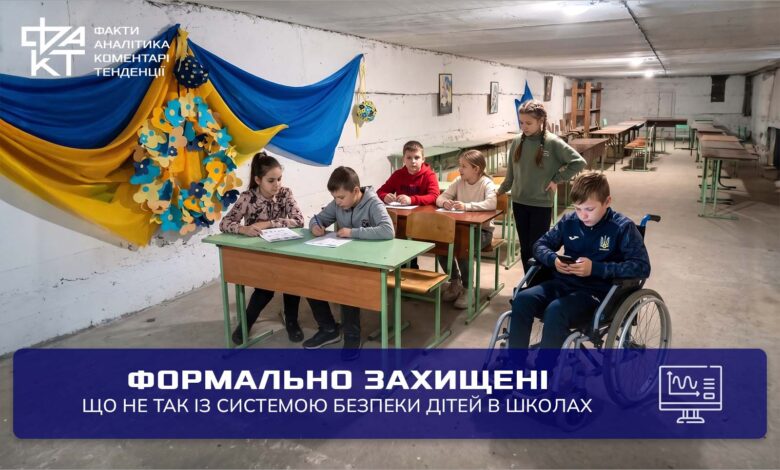
A school shelter should be a place where a child can continue to study safely during an emergency without fear, cold, or darkness. Instead, in the fifth year of a full-scale war, Ukraine is increasingly seeing a different reality: reports show shelters, estimates say millions, and presentations show beautiful underground schools, but in practice, children are sitting in damp shelters that do not meet current standards, and only a quarter of them are currently suitable for learning. The most acute problem is that the state has not yet created an effective control system where someone should actually be held accountable for each unfinished, unsuitable, or dangerous facility.
The degree of readiness of shelters in educational institutions of Ukraine to ensure the continuous educational process
According to official data of the Chairman of the Verkhovna Rada Committee on Education Serhiy Babak, 83% of Ukrainian schools are provided with shelters. However, this optimistic indicator hides a different reality, where 16% of institutions still have an urgent need for the arrangement of shelters, and in 7% of schools they are physically unable to accommodate all students and teachers.
The real state of affairs in Ukrainian education in the conditions of a prolonged security crisis indicates that the nominal availability of protective structures in educational institutions significantly diverges from their actual functional suitability. Analytical data published by the State Service for the Quality of Education shows that only a quarter, i.e. 25% of domestic schools, have managed to transform their basements into full-fledged spaces that are adapted for continuous classes during air raids. However, government officials forget that the mere existence of a basement absolutely does not guarantee the presence of an appropriate microclimate, lighting, ventilation and furniture there, necessary for the full implementation of learning conditions.
A serious challenge is still ensuring unhindered access to protective structures for low-mobility groups and children with disabilities. Despite the recorded positive dynamics compared to the previous reporting period, architectural and infrastructural inclusiveness remains at an unsatisfactory level, since only 26% of school storage rooms are technically adapted for unhindered access and stay of children with disabilities and other low-mobility groups. Even more critical is the state of information notification within these civil defense facilities, as only 7% of notification systems have integrated engineering solutions that take into account the special physical needs of students with profound visual and hearing impairments.
The State Financial Strategy for 2026 is attempting to systematically respond to these challenges through large-scale cash injections, allocating 5 billion hryvnias for the modernization of school shelters and additionally allocating 1 billion hryvnias for the needs of preschool education. Within the framework of strict budget management, the Government has applied a selective approach, fixing priority funding for military lyceums and lyceums with enhanced military-physical training, as well as for transitional facilities for the period 2023–2025. The main criterion for obtaining these resources is a high degree of construction readiness of the facility, which must be at least 60%, subject to a categorical veto on any increase in the estimated cost of works covered directly from the state budget.
Along with long-term planning, the executive branch is using rapid response tools, redistributing 231 million hryvnias of targeted subvention for the immediate completion of work on the finish line in 11 regions of Ukraine. The specified financial tranche is aimed at finalizing 22 specific infrastructure projects that are already at least 60% ready and are geographically concentrated in Dnipropetrovsk, Zaporizhia, Kirovohrad, Lviv, Mykolaiv, Odessa, Poltava, Rivne, Sumy, Kherson and Khmelnytskyi regions. According to the calculations of the Cabinet of Ministers, such a point-by-point distribution of capital investments will allow this year to completely close construction issues and open a safe offline or blended learning format for 10 thousand Ukrainian students and cadets of specialized military and naval lyceums.
The procedure for distributing basic allocations is based on clear mathematical filters and security zoning, which cuts off unprofitable or unpromising projects. Only special educational institutions, as well as general education schools with a contingent of at least 200 students or those unique institutions that are the only ones in their community and actually operate in a full-time or hybrid mode, are able to receive funding on a general basis. During the selection process, a specialized commission will first of all assess the degree of territorial military threats, establishing a proportion at which at least 40% of the total budget will go to schools with a very high level of security risk, while institutions with moderate and satisfactory risks will receive a total of 25% of the funds. Similar pragmatic coefficients will be applied during the evaluation and selection of projects in the kindergarten sector.
The described approach to the distribution of basic allocations, despite its mathematical clarity and pragmatism, poses a serious threat to the educational network in peripheral regions, effectively condemning remote rural schools to extinction. A strict filter with a minimum contingent of 200 students automatically discriminates against understaffed institutions in de-occupied or frontline villages, where due to migration processes and the demographic crisis it is physically impossible to gather such a number of children. Even the status of the “only institution in the community” does not save the situation if the school is forced to work exclusively in remote mode due to security restrictions, which automatically deprives it of funding on a general basis.
In addition, the fixation of strict budget proportions leaves in a financial vacuum those remote communities that, while formally in relative safety, do not have the resources to arrange alternative shelters or maintain kindergartens. Relying solely on financial and security factors, the state neglects the constitutional right of children to education at their place of residence. This not only hinders the restoration of territories, but also provokes the opposite effect, which will certainly manifest itself in the complete extinction of Ukrainian villages, which lose any prospects for the return of families in the event of school closures.
Shelter according to the standard and contrary to the basements: when the norm does not fit into reality
The problem of adapting the educational space to the realities of wartime has received a new vector of discussion due to increased requirements for security facilities. As reported the Educational Ombudsman Nadiya Leszczyk on her Facebook page, the Office of the Commissioner regularly records complaints from citizens about inadequate conditions in school shelters, where children are forced to wait out air alarms. Parents and teachers point to dampness, piercing cold, the appearance of mold and general discomfort, which negatively affects the health of schoolchildren. Responding to these challenges, state institutions have introduced radically updated sanitary standards for absolutely all protective structures in educational institutions since 2026, however, their practical implementation instantly provoked heated debate in expert and pedagogical circles.
In an effort to create the safest possible environment for the younger generation, the developers of the regulatory framework have prescribed in detail the physical and chemical parameters of the air space and lighting in shelters. The thermometer column in the premises should not fall below 17 °C and rise above 21 °C, and the relative humidity of the air must be maintained within clear limits from 40% to 60%. The level of carbon dioxide is limited to a limit of 0.07%, while the concentration of lethal carbon monoxide cannot exceed 5.0 mg/m³. To minimize the strain on children’s vision, shelters must be equipped with lamps of the white, warm white or natural white spectrum, ensuring a level of artificial lighting at workplaces of at least 400 lux.
The installation of autonomous generators is now clearly regulated by safety rules that completely eliminate the risk of toxic combustion products and other pollutants entering the protective structure. It is mandatory to provide students with drinking water and arrange areas for eating. Particular attention is paid to bathrooms, where reserve water containers must appear, the volume of which is calculated mathematically – at least 5 liters for each person who is simultaneously in the shelter during the educational process.
A critical analysis of these innovations has at the same time revealed a huge gap between ideal office calculations and the harsh realities of Ukrainian school basements. If we take into account an average school for 200 pupils, then in order to fulfill the norm, it is necessary to integrate a tank with a capacity of 1000 liters into the shelter. The administration faces purely technical tasks regarding the transportation of such large-sized and heavy structures through narrow basement stairs, as well as ensuring the correct conditions for its storage so that the water does not become a source of infection.
This requirement has an even more utopian appearance in large urban educational institutions, designed, for example, for 1000 students. In this case, the storage must be filled with 5 huge tanks weighing one ton each. So, again, we only have well-written regulations on paper, which are absolutely unrealistic to fulfill under existing conditions. However, the most painful aspect of this legal novel is that the inability to provide this volume of water automatically becomes the basis for drawing up an administrative protocol, and the financial burden in the form of fines falls directly on the shoulders of the director of the institution.
The comments and responses of the educational community under the publication of the Educational Ombudsman demonstrate solidarity with its critical position and convey deep concern. Educators are convinced that the new strict criteria cannot be blindly applied to those basements and the simplest shelters that have already been adapted and put into operation according to previous standards at the beginning of the crisis period. The updated standards should become a roadmap exclusively for those protective structures, the design and construction of which is only beginning now.
As a separate point, the professional community highlights the issue of fairness in determining responsible persons. The school principal is the manager of the educational process, not a civil engineer or a specialist in ventilation and water supply systems. Educators emphasize that compliance with all engineering parameters should be the responsibility of the contracting organizations that directly carried out the reconstruction or construction of the facility, as well as the education management bodies, whose direct responsibility is the financing, procurement and logistical support of protective structures. Until this balance of responsibility is achieved, the new sanitary standards risk turning from a tool for protecting children into an instrument of systemic pressure on school leaders.
Shelters that are not put into service: between construction, reporting and lack of responsibility
Society is also deprived of access to reliable state statistics on the exact number of anti-radiation shelters that have not just been completed, but have been officially put into operation and transferred to the balance of relevant institutions or communities. As practice shows, underground educational spaces are often transformed into platforms for creating a positive image in front of top officials or foreign delegations, while the actual completion of the construction cycle is relegated to the background.
Public presentations of incomplete facilities for the sake of formal reporting create serious safety and legal precedents. Legal commissioning is a guarantee that authorized specialists have taken personal responsibility for the compliance of the structure with all construction and safety standards. When education starts in premises without proper acts of readiness, legal responsibility for the life and health of students is actually blurred, which makes it impossible to find the culprits in the event of an emergency.
A striking example was the case when the head of the Zaporizhzhia OVA Ivan Fedorov announced in his Telegram channel about the start of blended learning in an underground school based on the Bilenkivsky Lyceum “Leader”, as well as the opening of the fifth such facility in the region on the territory of the Petropil Lyceum. According to him, the blended format covers more than 60 thousand students in Zaporizhzhia, including 5.5 thousand first-graders. However, the experience of last winter showed the technological inability of many such facilities to function in conditions of a prolonged absence of centralized power supply. Due to the lack of high-power generators, the ventilation, drainage and water supply systems completely stopped working underground during prolonged blackouts.
In Zaporizhia Gymnasium No. 46, a case was recorded when students found themselves in absolute darkness for several hours in a row during classes due to the coincidence of the educational process with the schedules of stabilization outages. Teachers did not have the right to let children out into the street before the end of lessons, and parents, being at their workplaces, could not promptly pick them up. Only now has the process of emergency retrofitting these facilities with autonomous power sources begun, because without them, the forcedly erected underground concrete boxes become unsuitable for people. Moreover, haste during design and construction sometimes leads to gross engineering errors, the consequence of which is subsidence of loose soils or critical flooding of premises with groundwater.
An additional factor of social tension is the closed nature of the decision-making process itself, since local governments often find themselves on the periphery of planning. Strategic decisions on the location of future storage facilities are made solely by specialized agencies, while resolving conflicts with the community caused by the closure or reorganization of educational institutions for these large-scale projects is transferred to the shoulders of local administrators. The tool of public hearings remains the only communication channel for reaching a compromise, although logic suggests that the construction of defense facilities should directly resonate with the real demographic indicators of specific neighborhoods, which local specialists are not allowed to analyze.
While in some regions the operation of unfinished premises continues, in the capital the construction of similar facilities has not left the stage of paper approvals or initial excavation for a long time. Such example is the situation around the Kyiv specialized school No. 130 named after Dante Alighieri, where, according to the parents’ association, the process of creating an anti-radiation storage facility has been going on for 3 years, but the actual excavation has not yet taken place. During periods of air raids, students are forced to walk through several city blocks to the nearest metro station, and outraged parents are trying to find out the fate of the allocated funding and the effectiveness of control over the contractor.
Official registers of the Kyiv City State Administration confirm that in July 2024 the working design of this dual-purpose building was approved. The contract was awarded to an LLC that offered to perform work for 197.95 million hryvnias with an obligation to complete the facility by November 1, 2025. However, the disruption of schedules was an expected consequence, given the involvement of the winning company in previous tender scandals. Similar precedents of ineffective management and delaying work are inherent not only in the capital region, but are a systemic disease of many Ukrainian cities.
Thus, at the beginning of 2026, the Poltava leadership officially admitted the inability to complete the construction of 3 school shelters on time, the financing of which for the current year has been fulfilled by only a few percent. In particular, the construction of a protective facility for Poltava Secondary School No. 19 and the adjacent primary school No. 45 has currently been financed by only 2.4% of the total estimate of 87 million hryvnias, while the allocation of only 2.1 million hryvnias from the local budget has been confirmed. The DREAM electronic system contains information on the development of a working project, conducting geological surveys and making adjustments, which have already cost the community significant financial losses.
Due to a chaotic change in the concept of the storage facility for Secondary School No. 19, the city authorities overpaid almost 900 thousand hryvnias. The Department of Capital Construction declared this as a regular adjustment, although in reality the facility was completely redesigned with a change in its location and an increase in capacity. Officials began to consider the need to include the neighboring primary school No. 45 in the project only after an official appeal from its administration, which was received after the payment of the first version of the design documentation worth 985 thousand hryvnias. Due to the lack of basic communication between educators and builders, a million hryvnias was spent on unnecessary papers, while the city council did not initiate official investigations and not a single official was disciplined.
Similar crisis trends were recorded in Kremenchuk, Poltava region, where at the end of 2025 the city administration openly included a number of school facilities in the category of those requiring “enhanced control” due to systematic violation of obligations by contracting organizations. This algorithm is universal for most Ukrainian communities, when financial resources are allocated in full, construction equipment appears on the sites, but the actual commissioning of finished structures is postponed indefinitely.
The situation is also complicated by internal organizational barriers, which are regularly reported by users on various social networks. Parents describe frequent cases when the administrations of existing preschools and schools refused to let children and their companions into existing shelters during air raids, forcing people to remain behind locked gates. The heads of institutions interpret the current instructions and safety rules at their own discretion, turning protective structures into closed departmental facilities, which completely destroys the very idea of civil protection of the population under martial law.
As we can see, the analysis of the current situation indicates a deep systemic crisis, where the safety of children has become hostage to bureaucratic formalism and inflexible management. The state’s attempt to solve infrastructure problems exclusively in the language of strict regulations and mathematical financing filters has exposed the disconnection of government decisions from the real capabilities of communities. Further ignoring these disparities and pursuing indicative reporting instead of real control over construction threatens not only the disruption of safe learning, but also the degradation of the entire education network in the context of a protracted war.