Children taken by war: in Kyiv, people bring flowers to the site of the death of three schoolgirls

The death of children in war always exposes the most terrible meaning of Russian strikes on Ukrainian cities, because behind the dry numbers of losses are schoolchildren, whose satchels, notebooks, correspondence with friends, family photos and vacation plans remain after them as painful evidence of a life cut short.
In cities that live under the threat of missiles and drones, children grow up next to worries, shelters, broken windows and news of the dead, but even this danger familiar to war does not make the death of children understandable or acceptable. Each such death returns society to a simple and unbearable fact: war takes away those who have not yet had time to live their own history, choose a path, experience the first important victories, mistakes, love, disappointment and joys of growing up.
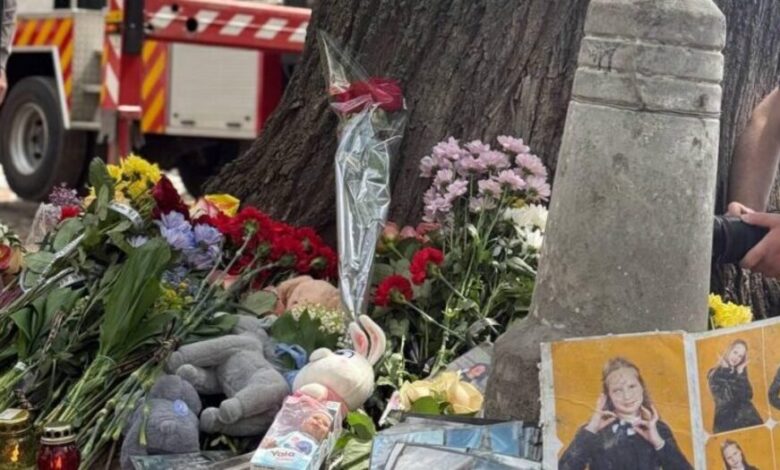
In the Darnytskyi district of Kyiv, after the Russian missile strike, people began to bring flowers to the place where civilians died, among them three children. A spontaneous memorial has appeared near the destroyed house, to which Kyiv residents come without speeches or unnecessary words, leaving bouquets, lamps and children’s toys. In such places, silence often speaks more accurately than official statements, because it is based on a shared sense of loss, which cannot be reduced to a report of the consequences of another attack.
As a result of the massive Russian strike on Kyiv, 24 people died, among them three girls aged 12, 15 and 17. For the capital, this tragedy became another painful reminder that missiles hit not only houses, entrances and apartments, but also families, school classes, children’s friendships, plans for the summer, graduation albums and a future that was supposed to continue without fear of nightly shelling.
One of the dead was 12-year-old Lyubava Yakovleva, a sixth-grade student at Lyceum No. 323. Her life had already been marked by the war due to the loss of her father: Ukrainian defender Yevhen Yakovlev, known by his call sign Ryzhy, died while performing a combat mission. After the missile strike on Kyiv, this family experienced another irreparable loss. The lyceum reported that Lyubava’s older sister was also under the rubble, and this makes the tragedy even more difficult, because in one blow the loss of her father at the front, the death of her child, and the pain of those who were waiting for rescue among the ruins came together.
Lyubava was a schoolgirl who had to return to lessons, talk to her classmates about ordinary childhood things, grow, change, quarrel and reconcile with loved ones, dream of a profession, travel, friends, and adult life. After her death, the lyceum where she studied became a place of shared grief for children and adults, because at such moments the school loses not just a student from the class list, but the living presence of a person who was known by his voice, smile, character, habits and everyday trifles.
Among the deceased was also 15-year-old Maria, a ninth-grade graduate. At this age, childhood is already approaching an important boundary, when the choice of further education, a new environment, other acquaintances, the first adult decisions and the feeling that life is gradually opening up wider. Maria should have thought about summer, school, friends, future plans, conversations with relatives and that period when a teenager is just beginning to see himself in the adult world. Instead, flowers, photos and words of farewell appeared near her memory.
In Lyceum No. 237, Maria was remembered as a gentle and bright girl who had recently gone to school, talked with friends and dreamed of the future. Such words hurt especially acutely, because they bring the deceased child back from the plane of statistics to real life, where there were lessons, morning assemblies, laughter in the corridors, conversations after classes and anticipation of vacations. The memory of her will now be kept by her family, friends, teachers and all who saw in this tragedy not just another number of losses, but the death of a child who was supposed to live.
The third child among the deceased was a 17-year-old girl. Her age is almost the threshold of adulthood, when a person is faced with choosing their own future, but still remains a child for parents, loved ones and those who remember her from childhood. At 17, there were supposed to be studies ahead, the first serious decisions, finding oneself, the road to independent life, but the Russian strike cut short this path before it had time to unfold.
Ukrainian President Volodymyr Zelenskyy arrived at the scene of the tragedy, where he paid tribute to the victims near a house destroyed by a Russian missile and expressed his condolences to the families who lost their loved ones. His presence near the destroyed house was part of the general commemoration, but the main meaning of this place is concentrated in the flowers carried by Kyiv residents and the children’s names left after the strike.
The spontaneous memorial in Darnytsia district has become a space of memory for children torn from their families and school classes by the war. The flowers near the ruins remind us that behind each dead child there is a whole world, consisting of a home, school, friends, dreams, fears, favorite things and conversations that will never be repeated.