The international community has been shaken by news that China may be conducting secret nuclear weapons tests in an attempt to evade international monitoring. American officials and intelligence agencies have expressed serious concerns that Beijing is building a nuclear arsenal not just to deter potential threats but also for a possible nuclear war. China is rapidly building intercontinental ballistic missile silos and deploying strategic naval forces capable of hitting targets thousands of kilometers away. This creates serious uncertainty for countries around the world: traditional mechanisms for control and deterrence no longer reflect the true scale of the arsenal. So the question arises: will the rapid buildup of China’s nuclear arsenal become a new threat to global stability?
Secret Nuclear Tests: What China Is Hiding
New data shows that from 2020 to 2026, China conducted a series of secret low-power nuclear tests, many of which went unnoticed by international monitoring systems. A resonant article on this topic was published in The Washington Post, where Robert Peters, a senior fellow for strategic deterrence, describes in detail the data obtained by American agencies. In particular, he notes that China has been conducting nuclear weapons tests, including supercritical ones, for several years, while actively denying any such activity. According to Peters, these tests are of low power, but their secrecy and the manner in which they were conducted indicate that China is trying to hide the real capabilities of its arsenal from international observers.
The article also mentions that on June 22, 2020, a suspected explosion occurred near the Lop Nur nuclear test site. According to US officials, the test was supercritical, and seismic graphs indicate the release of significant energy. At the same time, the CTBTO International Monitoring System recorded two small seismic events with an interval of twelve seconds, which did not exceed the threshold for official classification, but coincided with US assessments of secret tests.
The Washington Post also notes that China has not invited international observers to the Lop Nur test site and continues to refuse to participate in discussions on strategic stability and arms control. The rapid growth of China’s nuclear arsenal, the construction of silos for intercontinental ballistic missiles, and the development of forces capable of hitting targets from Japan to Australia and Guam create the potential for waging nuclear war, not just deterrence.
The article also notes that Donald Trump last year instructed the government to consider resuming nuclear testing “on equal terms” with China and Russia. This decision was a signal that the United States takes Beijing’s possible covert actions seriously, especially after the statements of the CIA and the Senate Intelligence Committee about supercritical nuclear weapons tests in China and Russia.
In addition, the chairman of the US Senate Intelligence Committee, Tom Cotton, noted that according to CIA estimates, China and Russia could conduct supercritical nuclear weapons tests. This actually confirms Washington’s concerns about Beijing’s real ability to increase the capacity of its arsenal and bypass international control. According to the US State Department, China carried out a series of low-power explosions equivalent to hundreds of tons of TNT. Of particular interest is the incident that occurred on June 22, 2020, when seismic stations recorded tremors of magnitude 2.75, which corresponded to the characteristics of a nuclear explosion.
At the same time, Deputy Secretary of State Thomas DiNanno emphasized that Beijing uses the “decoupling” method — carrying out explosions in underground chambers, which significantly reduces the seismic effect and allows you to bypass the monitoring system of the Comprehensive Nuclear-Test-Ban Treaty Organization. Technically, the CTBTO is not able to identify explosions with a capacity of less than 500 tons, which makes such tests almost invisible to international monitoring structures.
Therefore, this situation creates a picture that China is probably conducting a covert program to develop low-yield nuclear weapons, actively denies their existence and does not demonstrate any willingness to be transparent to the international community. This increases the concerns of the United States and other countries about Beijing’s strategic intentions and indicates the need to review defense and deterrence mechanisms.
The history of the development of China’s nuclear potential and the prospects for its modernization
Until the mid-2000s, China, among the five permanent members of the UN Security Council, possessed the smallest number of nuclear warheads, which became the subject of constant analysis by both Western and domestic strategists. It is difficult to say unequivocally whether this was the result of a conscious policy of “minimum deterrence” or whether it reflected the country’s technical and economic weakness during the early development of its nuclear potential. In the 1960s and 1980s, Beijing demonstrated ambitions to develop strategic weapons, including several types of intercontinental ballistic missiles and the Project 640 missile defense project.
It should be noted that most of these initiatives failed due to limited resources and technology, rather than a lack of political will. Project 640 continued to develop for almost two decades until it was shut down in 1982 by Deng Xiaoping. Similarly, the development of China’s neutron bomb was curtailed in the late 1980s, when the end of the Cold War and new economic priorities forced the country’s leadership to abandon a large-scale arms race.
The turning point in the development of nuclear potential came in the late 2000s due to the sharp growth of China’s scientific, industrial and financial potential. By 2007, the first modern mobile solid-fuel intercontinental ballistic missile DF-31A was created, capable of reaching the territory of the United States, which marked the PRC’s entry into a new level of strategic capabilities. The testing and serial production of the JL-2 submarine-launched intercontinental ballistic missile in 2012–2013, together with the construction of serial Type 094 nuclear submarines, allowed China to create for the first time a comprehensive naval component of strategic forces capable of withstanding intensive combat duty.
By 2015, China had mastered the production and deployment of heavy liquid-fueled ICBMs DF-5B with ampoule tanks that do not require refueling before launch, and separate warheads with individual guidance, 5–6 units per missile. The series also includes solid-fuel DF-41s that can carry 3–4 ICBMs, and the latest data from American sources indicate preparations for the deployment of the DF-5C with ten warheads, which reflects China’s plans to significantly increase the arsenal. As of the end of 2024, the number of land-based intercontinental missiles in China, according to experts, reached about 400, equaling the number of similar systems in the United States.
It is noteworthy that China is not limited to land-based complexes: strategic aviation receives H-6N bombers with the ability to refuel in the air and carry air-launched missiles, work is underway on the low-visibility H-20. At the same time, missile defense systems and early warning systems are being developed, including ground and space components, which creates multi-level protection and increases the stability of the arsenal. The DF-26 medium-range missiles, capable of being used in both nuclear and conventional versions at a distance of up to 4,000 km, had about 250 launchers in 2024, and satellite images confirmed the active deployment of new installations ready for commissioning.
China’s nuclear weapons policy has traditionally been based on the principles of “no first use of nuclear weapons” and the rejection of an arms race, but modern practice demonstrates a significant expansion and modernization of the arsenal, an increase in the frequency of exercises and launches of ICBMs outside the national territory, which allows it to practice a global deterrence strategy while maintaining the formal principles of no first strikes.
In 2024, China proposed a treaty on the non-first use of nuclear weapons to other nuclear powers, which, according to Beijing, is designed to transfer commitment to deterrence to the West and leave the PRC flexibility in using nuclear potential for escalating dominance.
Historically, China’s nuclear forces have developed under the strict control of the CPC Central Military Council. As noted in American intelligence, warheads are stored separately from carriers, and their issuance to missiles occurs only by order of the leadership. At the same time, the 67th base of the PLA Rocket Forces includes a central underground storage facility in Baoji (Shaanxi Province) and dispersed arsenals next to the missile bases. At the same time, the special forces regiment “Lizhen” (“Sharp Blade”) is responsible for the security of the strategic arsenal.
Such an organization guarantees maximum security and control, but limits the possibility of an instant counterattack. Chinese strategy has always been focused on survival during a potential first strike and consistent response training, rather than strategic enemy defeat in an instant response mode. This has determined the nature of the large-scale construction of underground complexes, mine launchers and protected command posts. Interestingly, the depth of underground facilities can reach hundreds of meters, the command post for senior management, built in the 2010s–2020s in the Xishan Mountains, is located at a depth of about 2 km. Up to 40% of the personnel of the Missile Forces are engineering and construction units, which creates the world’s largest underground infrastructure of strategic forces.
Thanks to the large-scale construction of underground complexes, numerous mine launchers, protected command posts and tunnels hundreds of meters deep, China has formed the world’s most powerful underground infrastructure for storing and deploying nuclear forces. Given the pace of development of science, industry and financial resources, by 2027 the PRC plans to form a “high-level strategic deterrence system” that combines nuclear and non-nuclear components and guarantees escalating dominance in any military-political crisis scenario in Asia. All these data are not recorded in official documents in China, but are based on indirect data or expert interpretations of satellite images.
Therefore, the history of the development of Chinese nuclear forces demonstrates a gradual transition from a limited arsenal with the principle of minimum deterrence to a complex system of strategic potential with multi-level infrastructure, mobile and stationary components and a high level of centralized control. At the same time, the prospects for modernization provide not only for the increase in quantitative potential, but also for increasing technological and operational efficiency, which creates the basis for China’s escalating influence on the global strategic balance.
Currently, the PRC aims to create a “high-level strategic deterrence system” by 2027, combining nuclear and non-nuclear components and ensuring escalating dominance in crisis scenarios in Asia. Previously, the role of the nuclear arsenal was limited to preventing nuclear strikes and blackmail, but today China combines the principles of minimum deterrence with active modernization of the arsenal, demonstrating readiness for global strategic competition and preparation for any crisis scenarios.
The current scale and pace of development of China’s nuclear infrastructure are impressive: more than 100 new intercontinental ballistic missiles have already been deployed in mines in the north of the country, and secret nuclear facilities are being built in the mountainous regions of Sichuan province. The current Pentagon assessment indicates that China’s arsenal as of early 2026 has approximately 600-700 deployed warheads, and this number is projected to increase to 1,000 by 2030. At the same time, China is not limited to land platforms: sea-based missiles complement strategic flexibility and provide the ability to strike targets at long distances, including Hawaii, Alaska, and the continental United States.
It is extremely important that by 2030 China may become the world’s third nuclear power, and its strategic nuclear forces will be on par with those of Russia and the United States. At the same time, the total number of nuclear warheads of the PRC is likely to remain smaller than that of Russia or the United States, since China has not yet paid much attention to non-strategic nuclear weapons. This will not affect the balance of power between China and the United States.
Having created a powerful strategic arsenal, China becomes practically invincible, because any nuclear attack on it will threaten the aggressor with unpredictable losses. This makes any potential conflict with the PRC much more expensive and dangerous. In the event of local clashes near China’s borders, external players, including the United States, will be forced to carefully assess the risks of intervention.
China’s global military presence, covered by nuclear capabilities, allows Beijing to act more actively and even offensively. Even with the US superiority in the fleet and the network of bases, direct attacks on Chinese forces in other regions become risky. This changes the approach to deterring China. Just as during the Cold War in Europe, effective deterrence will require the presence of large contingents of American troops directly on the territory of allies. This fact will require the concentration of significant US resources in East Asia and limiting their presence in other regions. At the same time, in South Korea and Japan, the growth of Chinese capabilities, together with the threat from North Korea, stimulates discussions of their own strategic deterrence. Doubts about the reliability of American security guarantees may push these countries to develop their own nuclear arsenal.
The deployment of such a powerful arsenal while maintaining strict secrecy and refusing international control demonstrates Beijing’s desire to create a strategic reserve that provides it with significant autonomy in decision-making and increases its geopolitical influence.
The global arms race: the nuclear budget in numbers
Today, China is considered the third nuclear power, although its arsenal is significantly smaller than that of Russia and the United States. In such a situation, China’s logic is to build up its capabilities to a level that allows it to negotiate arms control on more equal terms and demonstrate its ability to influence the international balance of power.
As of 2026, global spending on nuclear weapons continues to grow and has exceeded $100 billion per year. All nine nuclear powers — the United States, China, Russia, the United Kingdom, France, India, Pakistan, Israel, and North Korea — are in a phase of active modernization and expansion of their arsenals, reflecting the general trend of the global arms race.
According to estimates by think tanks, the United States bears the largest expenses — about $57–60 billion, which is more than half of the entire global budget for nuclear weapons. However, this amount covers only current maintenance programs, modernization of warheads, and delivery vehicles. In fact, if we take into account all long-term plans for a ten-year period, US spending on nuclear weapons will amount to about $95 billion annually, or almost $1 trillion by 2034, making the maintenance and development of nuclear potential one of the largest items in the country’s federal budget.
China allocates $12.5–14 billion, demonstrating the fastest pace of funding against the background of the construction of new missile silos and the expansion of strategic potential. The exact amount of Russia’s spending on nuclear weapons is not officially disclosed, since this data is classified. However, according to the Pentagon, Russia spends $8.5–10 billion.
The United Kingdom (10.4 billion) and France (6.9–7.5 billion) direct funds to modernize submarines and ballistic missiles. India and Pakistan spend $2.6–3 billion and $1.1–1.3 billion, respectively, on developing the maritime component and maintaining regional parity, while Israel and North Korea spend approximately $1.1 billion and $0.6–0.9 billion, with Pyongyang spending up to a third of its national income on nuclear and missile programs.
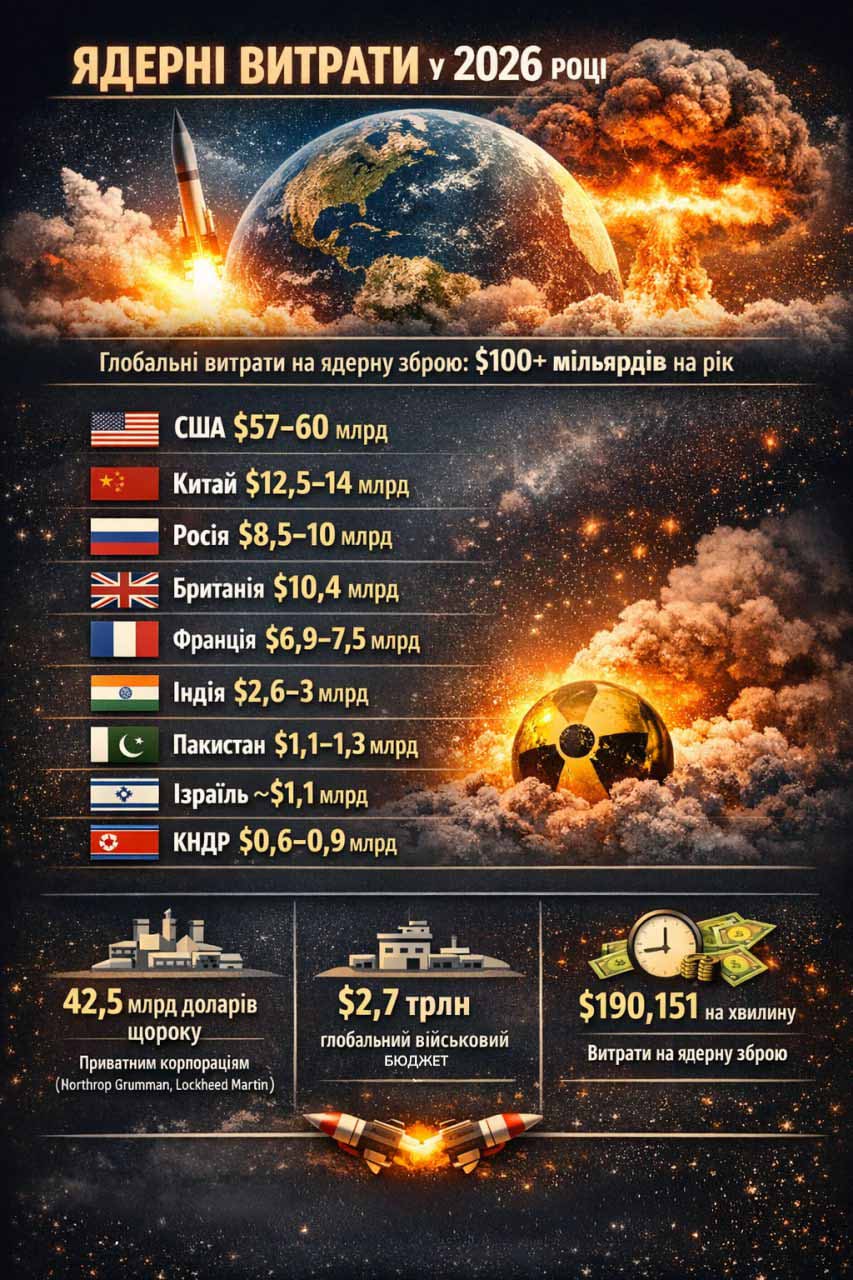
In general, in 2024–2026, military spending in the world increased to unprecedented levels: according to SIPRI, global defense spending exceeded $2.7 trillion, which was the sharpest increase at least since the end of the Cold War and reflects a 10-year trend of increasing budgets in most countries. Such funding means that every hour the world spends the equivalent of hundreds of millions of dollars on weapons, equipment and personnel, including expensive deterrence programs.
Some estimates suggest that nuclear spending will exceed $100 billion in 2024, or about $190,151 per minute for all nine nuclear-armed states, with some of that money going to long-term contracts and maintenance of high-tech systems. This distribution of resources is putting pressure on national budgets and significantly exceeding spending on social needs in many countries. At the same time, the rapid buildup of China’s nuclear arsenal is putting global stability at risk, as China’s arsenal is already capable of reaching key strategic locations in the United States, Japan, Australia, and other allies.
This reduces response time and makes any military conflict highly risky for the entire world. Traditional control mechanisms and international agreements no longer guarantee predictability — now even regional confrontations can quickly escalate into global escalation. If the pace of modernization and arsenal expansion continues, the world could be on the verge of a new phase of nuclear instability.