Cash, cryptocurrency, luxury cars and real estate: declared assets of CCC employees and shadow market schemes

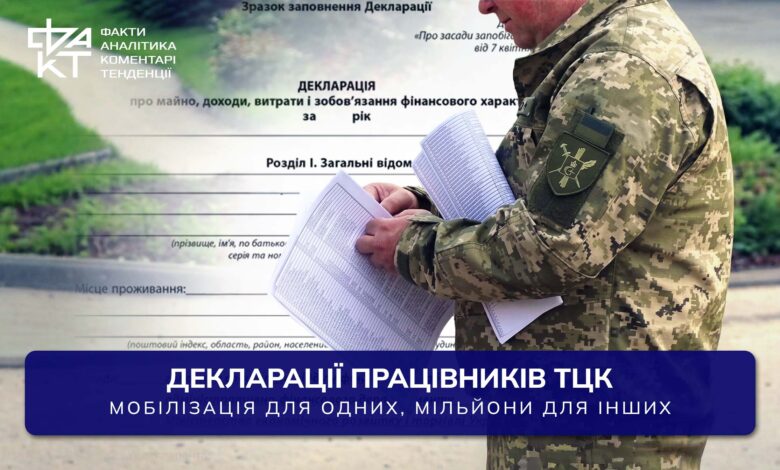
Against the backdrop of a protracted war, public irritation over unfair mobilization is increasingly merging with another painful issue – the origin of the wealth of officials working in the system of territorial recruitment centers. This topic is especially acute at a time when the state requires service, endurance and sacrifice from some citizens, and from others – minimal financial transparency.
Millions during the war: what the declarations of TCC employees show
The 2025 declaration campaign, which lasted from January 1 to March 31, 2026, once again brought this contradiction back into the spotlight. The next stage of inspections began on April 1, and the NACP, like last year, selects declarations on a risk-based principle, identifying significant violations, assets that are not commensurate with official income, as well as savings that are atypical for military personnel.
The most high-profile stories of recent times show that the set of tools for accumulating and storing wealth is changing, but the essence remains the same. On April 1, it became known that an employee of the Svyatoshyn CCC in Kyiv, Roman Danylyshyn, declared 4,716 Ethereum for 2025 — that is about $10.14 million, or approximately 450 million hryvnias. Against the background of this amount, another number that he indicated in the declaration looks especially striking: the value of crypto coins is slightly more than 195 thousand hryvnias. Such a gap between the real market value of the asset and the declared figure looks extremely disproportionate.
Another illustrative example is related to Volodymyr Hak, an officer of the administrative offenses support group of the Kyiv Regional CCC, whose declaration for 2025, in addition to real estate and a 2024 Hyundai Tucson, also contains other assets. His property includes gold bars worth 124 thousand hryvnias, precious coins worth 130 thousand hryvnias, 27 thousand US dollars in cash, and over 4 thousand pounds sterling. In wartime, such a combination of a new car, cash currency, and bank metals looks like a demonstration of a level of accumulation that is difficult to consider normal for a civil or military service.
At the same time, an employee of Department 1 of the Buchansky RTCC and SP Oleg Kolomiyets indicated in his declaration for 2025 gold and silver jewelry worth UAH 442 thousand. At the same time, he declared UAH 3 thousand in social payments. In his declaration for 2026, he already indicated assets in precious banking metals — gold in bars (plates) — worth UAH 7 million 700 thousand 300. He also declared UAH 25,291 in social benefits during this period.
The contours of the problem are even more severe in the criminal history of Denis Galushko, former deputy head of the Odessa Regional CCC and SP and former deputy ex-head of the Odessa Regional CCC and SP Yevgeny Borisov, who is a defendant in several criminal proceedings. Borisov is accused of illegal enrichment of over UAH 188 million, organizing a “white ticket” scheme for tax evaders, unauthorized leaving of service and legalization of illegal income, in particular, the purchase of a villa in Spain during a full-scale war. At the same time, Borisov was repeatedly detained, but was released on bail, the last of which amounted to over UAH 44 million.
Law enforcement officers in absentia reported Galushko on suspicion of illegal enrichment and legalization of property. According to the investigation, during 2020–2022, the official acquired assets worth more than 37.7 million hryvnias, which exceeds his official income by more than 6,500 tax-free minimum incomes. The investigation established the acquisition of five premium cars — Mercedes-Benz GLE 43 AMG, Mercedes-Benz GLS 350d, Mercedes-Benz V-Klasse, BMW X7 XDrive 30D, Toyota RAV4 Hybrid, and Mazda CX-5 — with a total value of over 12 million hryvnias, three residential buildings with land plots in the village of Tairove in the Odessa region with a total market value of over 23 million hryvnias, as well as the deposit of over 1.58 million hryvnias in cash through self-service terminals into his own bank account.
Separately, there is a deliberate entry of false information into the declaration for 2023. The former official was reported on suspicion under Article 368-5 of the Criminal Code of Ukraine — illicit enrichment, under Part Three of Article 27 and Part Three of Article 209 — organizing the legalization of property obtained by crime, as well as under Part One of Article 366-2 — declaring false information. The mother of the defendant’s wife was also reported on suspicion under Part Five of Article 27 and Part Two of Article 209 — aiding and abetting the legalization of property obtained by crime, and under Part Four of Article 358 — using a knowingly forged document. Both suspects are outside Ukraine, their whereabouts are being established.
No less characteristic of the war period is the declaration of the Dnipropetrovsk Regional CCC and JV employee Oleksandr Lyalko, which lists digital assets purchased after the start of the full-scale invasion. According to the document, at the end of 2024 he purchased Bitcoin for 411,869 hryvnias, and on the same day he bought Tether (USDT). He also has Binance Coin, purchased back in 2022. The sequence of dates here is of particular importance, because it shows not a long-standing investment history, but the accumulation of assets during the great war, when the financial behavior of officials in the CCC system is perceived through a completely different lens than before 2022.
Along with cryptocurrencies, this declaration contains other details that increase interest in Lyalko’s sources of income. In 2025, his father, a pensioner who received 198,737 hryvnias in pension for the year, purchased two land plots in the village of Mykolaivka, Dnipropetrovsk region, with a total area of 5,543 square meters, but did not report the value of this asset. That year, Oleksandr Lyalko purchased a MINI COOPER car, the value of which, according to the declaration, was 236,000 hryvnias. At the same time, he indicated that in 2025 he earned 1,702,701 hryvnias as an entrepreneur.
At the same time, according to the Unified State Register of Legal Entities and Individual Entrepreneurs, Lyalko, who works at the CCC, has the following KVED: 58.29 “Publishing other software”, 62.01 “Computer programming”, 62.02 “Consulting on informatization issues”, 63.11 “Data processing, posting information on websites and related activities”. The individual entrepreneur is registered in the same village of Mykolaivka, where his father lives.
If Lyalko’s story shows how cryptocurrencies and entrepreneurial income appear in the CCC declarations, then the case of Serhiy Ivanin focuses attention on the classic set of assets — real estate, cash and property, traditionally registered for the family. The former head of the second department of the Mukachevo RTCC and the joint venture in Transcarpathia filed a declaration upon dismissal, which is extremely indicative due to the volume and nature of the declared assets.
In the declaration filed in 2025, Serhiy Ivanina indicated a significant amount of real estate in Transcarpathia. Among the main objects are a residential building with an area of 201.45 square meters in the town of Mizhhirya, acquired in 2008, two apartments in Uzhhorod with an area of 36.6 and 36.9 square meters, acquired in 2016, four land plots in Mizhhirya with a total area of 432 square meters, acquired between 1977 and 2014, as well as a non-residential premises with an area of 59.8 square meters there. The list itself already looks impressive, but the geographical context makes it even more telling: Transcarpathia has long become a region where real estate in attractive locations retains a high market value, so even without an official assessment, it is clear that the total price of such a property set is measured in millions.
The financial part of Ivanina’s declaration looks even more telling than the property part. He keeps 120 thousand US dollars and 115 thousand euros in cash, which at the current exchange rate is over 10 million hryvnias. No significant amounts are indicated in bank accounts. His official income for 2024 amounted to about 671 thousand 883 hryvnias, of which 445 thousand 422 hryvnias are cash benefits from the Transcarpathian OTCC, 214 thousand 280 hryvnias are pensions, and a small part is cashback payments from PrivatBank. Already at the level of a simple comparison, doubts arise: with such declared annual income, it is extremely difficult to explain the accumulation of almost a quarter of a million in foreign currency in cash.
A separate line in this story runs through the official’s wife, Oksana Ivanina, since a significant part of the property is registered in her name. She owns a house with an area of 245.7 square meters in Uzhgorod, two apartments – 66.2 square meters and a land plot with an area of 450 square meters, as well as two non-residential premises with an area of 9.3 and 22.3 square meters, acquired in 2022. In the transport block, a 2022 Toyota Land Cruiser 150, a 2019 Hyundai Tucson and a 1995 Ponticelli ER-120U bus are registered in her name.
It is worth noting that among the most notable wartime acquisitions are non-residential premises from 2022 and a Toyota Land Cruiser 150 from 2022, an expensive car that in this context looks not just property, but a signal of the family’s level of well-being at a time when the majority of the country lived in a mode of losses, evacuations, and reduced consumption.
During 2024–2025, the National Agency for the Prevention of Corruption (NAPC) conducted checks of 23 declarations of officials of the Territorial Centers for Recruitment and Social Support. As a result of this work, signs of entering unreliable data in the amount of more than 28.5 million UAH, signs of illegal enrichment in the amount of more than 5.6 million UAH, as well as unfounded assets in the amount of more than 2.6 million UAH were found.
In particular, signs of illegal enrichment were found in the declaration of the head of the Dnipropetrovsk Regional Territorial Center for Recruitment and Social Support for 2022. It was established that in the period from August 26, 2021 to July 18, 2023, close persons of this official acquired assets in the amount of more than 8.8 million UAH, while the legality of the origin of the funds was not confirmed. Among such property are two apartments in Dnipro, two Volkswagen Passat and Ford Ranger cars, as well as 65 thousand US dollars, which the wife received as a gift from her father, although his income did not allow for such a gift.
In addition, the official did not indicate in the declaration six real estate objects that belong to him by right of ownership, as well as two more objects that he used together with his family members. He also did not indicate information about the two cars that he used, and about the income received by him and his wife.
In the declaration of the officer of the recruiting and staffing department of the Odessa OTCC and SP for 2022, the NACP recorded signs of unreliable information in the amount of more than 3.8 million UAH. The official did not include in the declaration a land plot that belongs to him, an apartment that he used in the reporting period, as well as two apartments owned by his daughter. At the same time, based on the materials of the NACP, the State Bureau of Investigation opened an investigation under Article 366-2 of the Criminal Code of Ukraine and in relation to the head of the military registration department of sergeants and reserve soldiers of the Dubno RTCC and SP of the Rivne region. His 2023 declaration contained signs of inaccurate information amounting to over UAH 1.6 million. The official did not declare a residential building and a land plot that he used with his family.
In addition, the National Agency for the Prevention of Corruption (NACP), based on data from criminal proceedings received from the investigative department of the Main Police Department in Mykolaiv region, as well as the results of lifestyle monitoring, discovered signs of a corruption criminal offense that may indicate the illegal enrichment of the head of the Malinovsky District Territorial Center for Recruitment and Social Support of Odessa, Vyacheslav Kushnerov, by almost 47 million UAH.
In May 2022, the military commissar’s spouse acquired an apartment in Odessa with an area of 111.1 sq m. m, the cost of which was 600 thousand UAH. A year later, this housing was sold for 7.56 million UAH. Later, his wife purchased a Toyota Highlander for almost 1.9 million UAH, which she later sold for 2 million UAH. In the same year, the military commissar’s mother gave him a residential building with outbuildings with a total area of 259.2 sq. m in the Ovidiopol district of the Odessa region. The cost of this property was estimated at 1 million UAH. The NACP established that her income over the past 22 years was significantly less than the cost of such a gift.
Over the past few years, the military commissar’s mother-in-law has become the owner of an apartment in the Lyman district of the Odessa region worth over 300 thousand UAH, as well as a Mercedes-Benz GLS 400 for 420 thousand UAH. At the same time, the average market value of such a car exceeds 5 million UAH, which may indicate that the real purchase price is being hidden. It was also found out that the mother-in-law had previously bought a Mercedes-Benz GLC 220D car worth 1.4 million UAH, which she later resold to her daughter for 1.5 million UAH. During August 2022, members of the military commissar’s family issued a gift of funds to each other for a total amount of 30 million UAH, which is confirmed by data from the register of notarial acts, although they did not have official income sufficient for this. At the same time, the military commissar’s son became the owner of an apartment in Odessa with an area of 55.8 sq. m. worth almost 500 thousand UAH, as well as a Mercedes-Benz Sprinter 511 car for almost half a million UAH. At the same time, he also did not have sufficient monetary assets obtained from legal sources for such a purchase.
All these examples boil down to one harsh and unpleasant truth for the system: every time an official’s official income does not explain tens of millions of assets, society sees a moral gap between the front and the rear authorities. In this situation, there is no convincing answer to the question: where did everything that does not fit into the official salary of CCC employees come from?
These examples can be continued endlessly, and in the declarations of CCC employees, luxury cars, land plots and real estate in Ukraine and abroad are listed in the names of their relatives. To hide the origin of the money, officials register real estate and luxury cars purchased in Ukraine and abroad in the names of their retired parents, unemployed wives or distant relatives. In addition, they declare large sums as gifts or inheritances, because it is difficult to verify. At the same time, transferring illegally earned money into digital assets or precious metals is easier for them to transport, and harder for regulatory authorities to track.
What does the shadow market earn in the CCC
The biggest money in the CCC and SP system revolves not around official procedures, but around people’s fear of conscription and willingness to pay for any “exit”. Where the state has created strict accounting, registers, conclusions of military medical commissions and deferral rules, the corruption market has turned each such tool into a commodity with its own price tag. As a result, employees and intermediaries who have access to documents, databases and the necessary contacts earn money by updating military registration data, making changes to the “Oberig” register, fictitious unfitness for service, exclusion from the register, fake deferrals and reservations, illegal seizure of property under the guise of army needs, as well as schemes with payments that should go to those who are really fighting.
The scheme that in 2025 investigated by SBI employees regarding two officials of the command of one of the branches of the Armed Forces of Ukraine. The investigation established that they organized an illegal mechanism for updating military registration data through two CCCs and joint ventures – in Kyiv and Volyn. In January 2025, the lieutenant colonel told one of the men that he had acquaintances in the Kyiv CCC and the Joint Venture, and with their “assistance” it was possible to update the military registration data and enter the necessary information into the “Oberig” registry. The cost of such “services” was 4 thousand US dollars. After the entire update procedure was completed, the official received the agreed amount. So, this is not an episode of random domestic corruption, but a money-making scheme in which access to the state registry and official connections was sold as a separate privileged function.
After the first successful deal, the lieutenant colonel decided to expand this practice and suggested to his boss to establish a “business” on “evaders” not through the capital, but through the Volyn CCC, where the boss had connections. Then the scheme became even more expensive and cynical. Підполковник знайшов трьох клієнтів і запропонував їм оновити дані вже через волинський ТЦК, але цінник зріс до 9 тисяч доларів США. За ці гроші військовозобов’язаним навіть не потрібно було з’являтися до центру комплектування, оскільки всі документи підписували виконавці. В цій схемі особливо важливий не лише розмір хабаря, а те, як швидко вона почала масштабуватися: щойно з’явився попит, службовий контакт одразу перетворили на товар, а потім на маленький ринок із різними тарифами.
Ще небезпечніший рівень відкривається там, де мова йде про системне втручання в державні реєстри. В березні цього року працівники Державного бюро розслідувань викрили і припинили діяльність міжрегіональної групи, яка системно втручалася в державні реєстри та організовувала ухилення від призову військовозобов’язаним. За даними ДБР і спеціалізованої прокуратури у сфері оборони Центрального регіону, до складу групи входили військовослужбовці одного зі столичних та обласного ТЦК та СП, колишній правоохоронець і безробітний мешканець Києва.
Такий склад групи добре показує, як у подібних схемах поєднуються доступ до службових повноважень, досвід роботи в силовій структурі та звичайна кримінальна посередницька логіка. Вони налагодили кілька механізмів незаконного зняття чоловіків з військового обліку, уникнення мобілізації та виїзду за кордон. Вартість таких «послуг» становила 4 тисячі доларів США з особи.
Ключовим інструментом цієї схеми була електронна система «Оберіг», куди оператори ТЦК вносили неправдиві відомості й безпідставно виключали військовозобов’язаних з обліку за станом здоров’я, посилаючись на вигадані висновки військово-лікарської комісії. Фактично державний реєстр, який мав би бути запобіжником від хаосу й маніпуляцій, перетворювався на робочий інструмент для оформлення фіктивної законності. Зараз досліджуються понад 80 фактів безпідставного зняття військовозобов’язаних з обліку за станом здоров’я шляхом внесення до системи неіснуючих висновків ВЛК. З них 31 особа безповоротно перетнула державний кордон України.
Для маскування своєї діяльності учасники схеми регулярно змінювали транспортні засоби та канали зв’язку, а також діяли через посередників. Особливий цинізм ситуації полягав у тому, що вони залучили неповнолітню дитину як кур’єра. Через дівчинку поштою відправляли документи військовозобов’язаних і отримували гроші за «послуги». У такий спосіб дорослі намагалися знизити для себе ризик викриття. Тут корупція вже не обмежується одержанням хабаря за окрему дію, бо вона фактично підміняє собою державну функцію: хто платить, тому змінюють статус; хто має доступ до бази, той вирішує, кому залишатися в країні, а кому відкривати шлях на виїзд.
Ще одним прибутковим напрямком є фальшиві відстрочки. Оформлення липових документів про навчання, догляд за хворими родичами або інші підстави для відтермінування служби дає змогу не знімати людину з обліку остаточно, але надовго виводити її з-під мобілізаційного тиску. Для клієнта така схема виглядає безпечнішою, ніж грубе виключення з бази чи фіктивна непридатність, бо формально вона спирається на передбачені законом підстави. Для тих, хто цим торгує, це стабільний спосіб заробітку на документах, які мають створити правдоподібну оболонку навколо брехні. У таких випадках продається не просто довідка, а правдоподібність, і саме за неї платять великі гроші.
Інші корупційні схеми навколо бронювання в ТЦК найчастіше будуються на хабарях за оформлення фіктивного працевлаштування на підприємства, які мають статус критично важливих. За гроші посередники разом з посадовцями ТЦК обіцяють включити людину до списків на бронювання, хоча насправді законна процедура для таких підприємств є безкоштовною і проходить через портал «Дія». Сума таких «послуг» коливається від 6 до 50 тисяч доларів або євро з однієї особи.
Одна з найпоширеніших схем полягає в тому, що людину лише формально влаштовують на підприємство критичної інфраструктури без фактичного виконання роботи. Крім цього, учасники схеми підробляють накази Мінекономіки, документи про відстрочку або вносять неправдиві дані до реєстру «Оберіг». Окрему роль у таких оборудках відіграють посередники, через яких передають кошти керівникам ТЦК за «прискорення» процедури чи гарантування броні. Також трапляються випадки, коли законне підтвердження бронювання навмисно затягують, щоб підштовхнути людину заплатити за швидше вирішення питання.
Окремий пласт зловживань відкривається там, де працівники ТЦК використовують не облік людей, а майно бізнесу, яке потім збувається. Як повідомили в березні цього року в ДБР, працівники Бюро завершили досудове розслідування щодо колишнього начальника одного з районних територіальних центрів комплектування та соціальної підтримки Київської області, який незаконно вилучав транспорт у підприємців. Обвинувальний акт скеровано до суду. Слідчі встановили, що посадовець без законних підстав забрав 8 автомобілів у двох підприємств, які займаються вантажними перевезеннями. При цьому транспорт вилучали без належних документів під приводом потреб Збройних Сил України, причому через такі дії підприємства зазнали збитків на понад 4 млн грн. У воєнний час така схема особливо брудна, бо прикривається армією і суспільною готовністю терпіти обмеження заради фронту. Підприємець в такій ситуації опиняється в пастці: відмовляти небезпечно, а погоджуватися – означає втрачати майно.
Отже, якщо звести всі ці епізоди в загальну картину, то перед нами постає не набір розрізнених зловживань, а чітка економіка тіньового ринку при ТЦК. Для одних українців війна стала смертю, втратою рідних, пораненнями, важкою службою на передовій без ротацій, тоді як для інших вона відкрила «золоту жилу» з можливістю накопичувати космічні статки. Причому це відбувається серед тих, хто має боронити нашу країну, а не лише посилати цивільних на фронт, застосовуючи силу та часто порушуючи закони.
Суспільство гостро реагує на несправедливість, коли одні проходять через мобілізацію без вибору, а інші, користуючись посадою і зв’язками, опиняються по інший бік правил, заробляючи при цьому великі гроші. Поки в державі допускається така ситуація, кожна нова подібна історія все більше буде посилювати невдоволення в суспільстві та недовіру до влади, що може призвести до вкрай негативних для країни наслідків.